I’d never really thought to count the years before, but since I first started on the North America server, it’s been 18 years now—by the calendar, anyway. Eighteen. Saying it out loud as a number makes it feel strangely… long. And yet, when I look back across all those years, I honestly can’t remember the last time I was so purely entertained by the game that I was basically spam-clicking the “Find Match” button. It just doesn’t come to mind.
Is that because my memories are too old to rely on? Or is it because, as I’m playing Malphite, “ultimate upheaval” hits me and floods my system with dopamine—getting me properly, pleasantly drunk on it? Either way, there I am: slamming into an enemy ADC who’s hesitating from afar, wondering whether to throw a single auto attack—and then slamming in again. And again.
Right. League of Legends’ ARAM: Mayhem delivers that particular brand of dopamine that only LoL can give—so cleanly it sticks in your head, even when it’s a mode you might otherwise forget. And the funny thing is: it’s not like it’s introducing something wholly, fundamentally new.
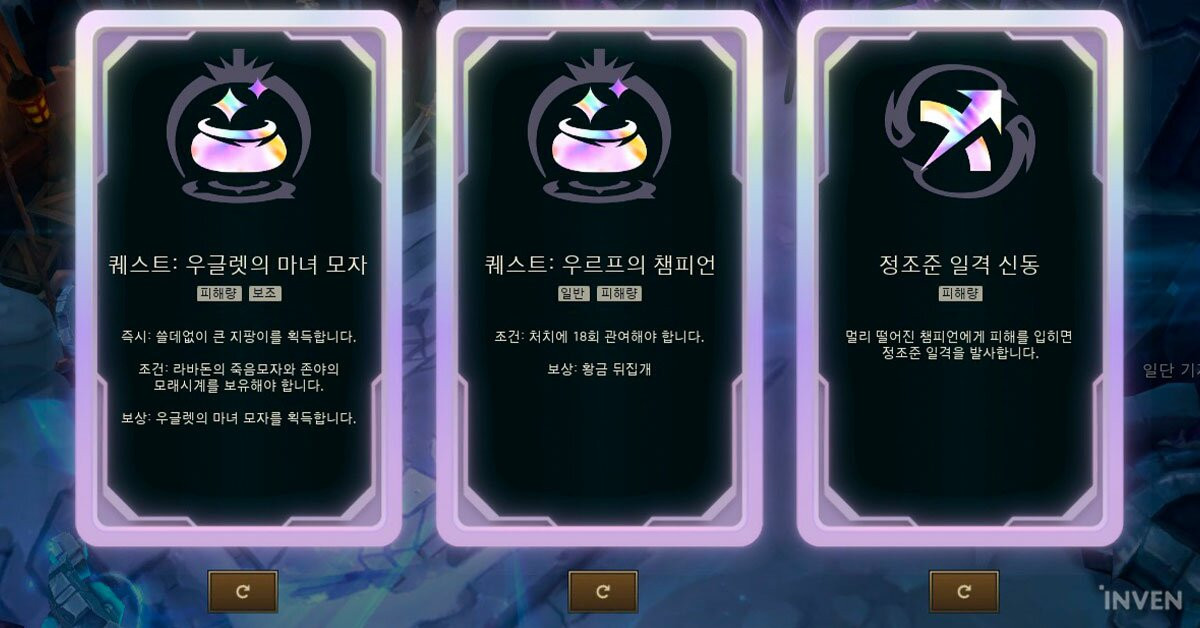
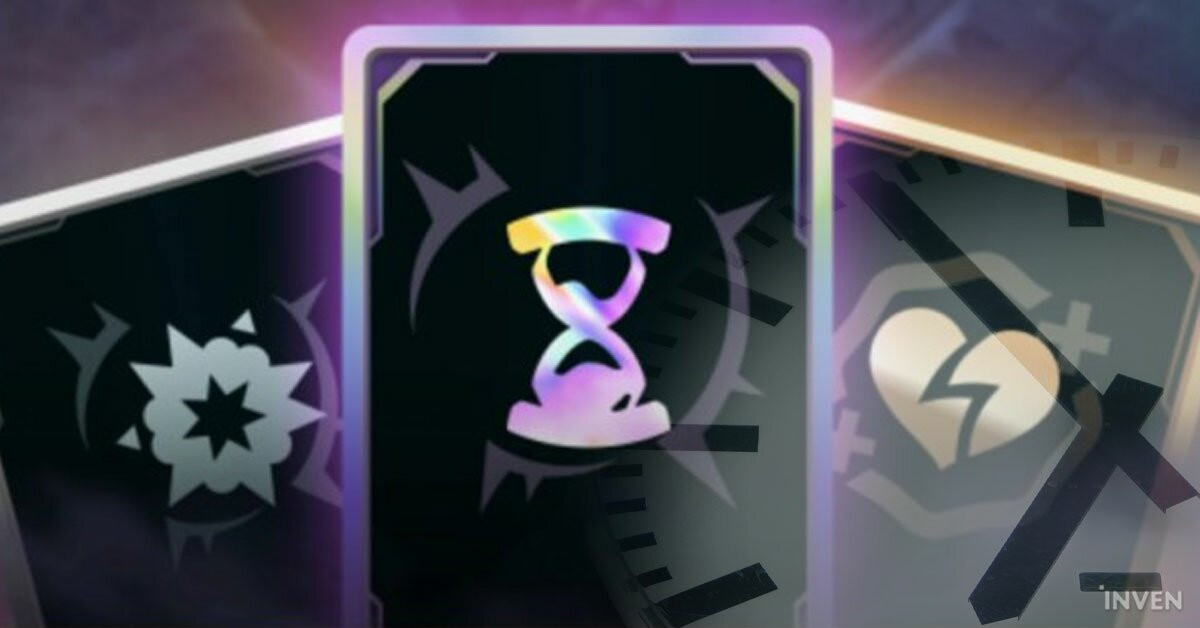
“Jeungbaram” (the community nickname basically meaning “Augment ARAM”) is exactly what it sounds like: a mode that takes Augments—already showcased through Arena and Teamfight Tactics—and applies them to ARAM on the Howling Abyss. Instead of picking runes before the game, you choose Augments at levels 1, 7, 11, and 15, then select effects that fit together, combine them, and steer the match around those choices.
But it’s those random Augment rolls—the ones that pop up and force you to choose—that really enhance you. Or rather, they drive you “jeung-mal” insane (yes, that pun is inevitable). You’ll get something that converts 30% of your Ability Power into Ability Haste, or something that grants invulnerability or crowd-control immunity when you cast your ultimate. You might even get an effect that polymorphs champions hit by your ultimate for two seconds so they can’t do anything at all. In practice, if you can assemble the right Augments for your champion, almost anyone can become overpowered. Veigar stacks Ability Power to infinity and machine-guns spells without breathing. Kassadin turns enemies into tiny animals every time he uses Riftwalk and Flash in sequence.
That full-body, shiver-inducing thrill you get once your build comes together is the result of Riot’s many “experiments.” That’s a nice way to put it—but what it really means is that they blended together ingredients that already existed. Augments (aside from a few Arena-exclusive ones) are something we’ve been seeing for a while. ARAM, too, is essentially the only mode—out of the many that have come and gone across LoL’s long history—that’s truly survived alongside Summoner’s Rift. And somehow, the combination of those two is unbelievably good.
URF is fun for a few rounds, sure—but the hyper-speed spell spam and solved-tier lists make it wear thin fast. Arena surged in popularity early on thanks to Augments, but its round-based structure and the barrier to entry for solo players became clear issues. One-champion modes, by their nature, couldn’t help but offer limited strategic variety. Every mode had its own ceiling.
Mayhem ARAM, on the other hand, is built on standard ARAM rules. It’s lighter than Summoner’s Rift, but it doesn’t chase the extreme pace of some other modes. Aside from removing runes and adding Augments, the underlying systems are the same as a normal match—it doesn’t fundamentally rewrite what the champions are. And that, in turn, strips away the resistance people often feel toward a “new mode.”
It even addresses ARAM’s most fundamental pain point: failure states created by random champion assignment. If your random comp is doomed, you suffer for the entire game. But in Mayhem ARAM, if your Augments roll well, it’s easy to watch a “doomed comp” flip into an “OP comp.” Random progression becomes a tool that can overcome the disadvantage baked into random champion selection.
For existing Summoner’s Rift and ARAM players, what you need to learn is surprisingly small: understand what Augments do, and understand how to fill out four to five strong Augment picks that fit your champion. There isn’t much to study—but once you start factoring in Augment combinations and champion synergies, you can test countless builds inside a match that lasts barely 10 to 20 minutes.

That loop—growth, strategy, and the payoff of victory—has always been the heart of a MOBA. Since the genre began as a branch of real-time strategy, MOBAs became massively popular by balancing strategy, RPG progression, and team-versus-team combat. But as I said earlier, it’s been nearly 20 years. To really feel that core fun, you often have to commit to matches that can run 40 to 50 minutes. Meanwhile, even if you look at shooters alone, we’ve watched wave after wave of subgenres and trends rise and fall: military shooters, tactical shooters, hero shooters, battle royales, extraction—endless variations.
Mayhem ARAM is probably just Riot taking its own existing work and tossing it into a self-made “everything stew.” But when you pair that with the smart use of randomness—and ARAM as the cooking method—it adds a savory depth that wasn’t there before.
And Riot has less to fear from this kind of mode, too. Even though Mayhem ARAM has been so well received that the number of “regular ARAM on the Howling Abyss” games has dropped sharply, the overall volume of normal Summoner’s Rift games has held steady. It’s popular enough to stand as a second pillar mode after Rift. And it’s trendy in the sense that it can deliver the excitement you’d forgotten—compressed into a tighter window of time. You can see that in the attention it’s drawing from LoL communities, streamers, and game creators everywhere.
The one real problem is that it’s still a limited-time mode. It’s scheduled to end on the 6th, lined up with the seasonal update. Sure, like many rotating modes before it, it could return at any time—especially given the level of interest right now. And yes, Riot can (and likely will) adjust balance around overtuned Augments and champion combinations. But on the other hand, even permanent modes like Summoner’s Rift and standard ARAM receive balance changes without the mode itself being shut down. And if Riot tries to “fix” things by restricting combinations, there’s also the risk that Mayhem ARAM’s exaggerated, over-the-top fun gets sanded down—exactly the way some past modes lost what made them special.
This piece was supposed to end with a simple complaint: “It’s this fun, it’s doing this well—and you’re shutting it down?” But Riot quietly announced an extension for Mayhem ARAM. Sure, it’s an extension that still schedules the end again in four days—but it also extended the lifespan of my dopamine generator by four days.
Extension or not, Riot: while I’m still asking nicely, read the room and announce that Mayhem ARAM is becoming a permanent mode. Announce it. Please. I’m begging you.
This article was translated from the original that appeared on INVEN.

Sort by:
Comments :0