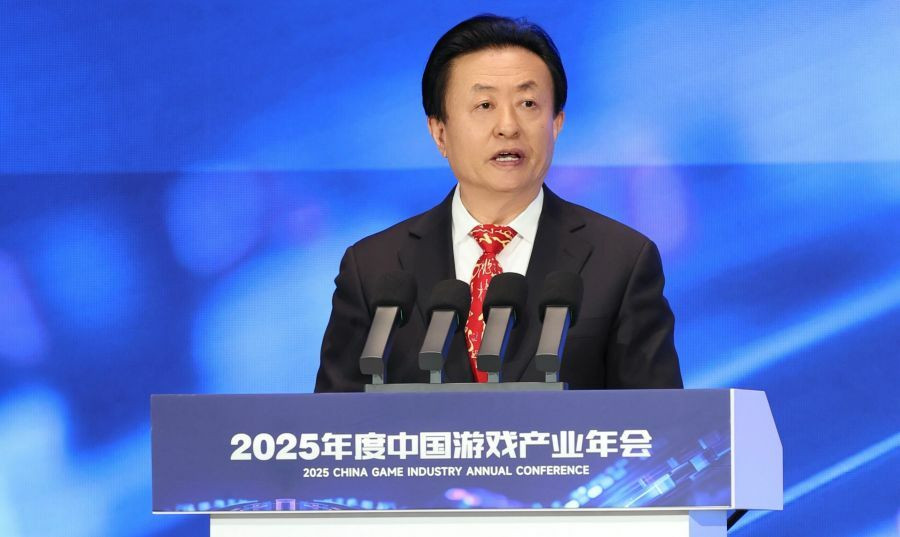
China’s game industry has been defined as a “cultural medium of the new era” that carries forward li-yue-shi-shu (禮樂詩書)—Confucian values traditionally associated with rites, music, poetry, and books—rather than remaining merely a form of entertainment.
At the 2025 China Game Industry Annual Conference held last month at the West Bund International Convention and Exhibition Center in Shanghai’s Xuhui District, Sun Shoushan, chairman of the China Audio-Video and Digital Publishing Association (CADPA), delivered a keynote speech in which he reframed games’ cultural value and social function along these lines.
This is understood as an attempt to elevate the game industry into a central pillar of the national cultural strategy ahead of the forthcoming 15th Five-Year Plan. That plan is expected to be announced during China’s “Two Sessions” period in March.
The China Audio-Video and Digital Publishing Association (CADPA) is the only nationwide industry organization in China and operates under the administration and supervision of the National Press and Publication Administration (NPPA). Within the Chinese industry, CADPA’s stance is widely regarded as a de facto “guideline” that reflects the authorities’ policy direction.
In his address, Chairman Sun emphasized: “Just as the classical li-yue-shi-shu nourished society through humanistic practice, games must become the new era’s li-yue-shi-shu, carrying civilization and empowering innovation.” Noting that the Chinese game market achieved quantitative growth in 2025—posting revenue of 350.789 billion yuan (approximately KRW 72.7 trillion, up 7.68% year-on-year)—he argued that the industry has now reached a moment when it must pursue qualitative advancement and deepen its cultural substance. He then presented four core directions.
First, Chairman Sun framed games as the new era’s li (禮, “rites”), calling on them to serve as a corrective force for the order and values of digital civilization. If traditional li established behavioral norms, then “rites” in games mean adherence to rules within virtual worlds and the internalization of social responsibility. Citing the JX Online (剑侠情缘) series for addressing a broader national cause and The Invisible Guardian for conveying ideals and convictions through revolutionary history, he explained that outstanding games should become spaces for digital etiquette education—places where users understand order and learn fairness.
Second, games, as the new era’s yue (樂, “music”), should function as a purifying agent that cultivates the public’s aesthetic sensibilities. Chairman Sun underscored that games are a comprehensive art form in which literature, music, and visual art converge, and said they should provide users with an aesthetic space through that synthesis. As specific examples, he pointed to Arknights’ Ambience Synesthesia concert series as expanding auditory experience, and to Genshin Impact’s reinterpretation of the Peking opera piece “The Divine Damsel of Devastation” as an achievement that spread Eastern aesthetics worldwide.
He went on to argue that games, as the new era’s shi (詩, “poetry”), inherit cultural roots and narrate the spirit of their time. Where classical poetry expressed aspiration and intent through language, he said, games build a distinctly Chinese “digital poetics” through interactive narrative. Referencing Ink · Mountains and Mystery—which adapts the famous painting A Thousand Li of Rivers and Mountains—and Black Myth: Wukong, which philosophically reinterprets Eastern mythology, Chairman Sun assessed that such works turn users from mere bystanders of their era into participants, forming a shared cultural resonance.
Finally, he defined games as the new era’s shu (書, “books/writings”), asserting that they should become living classrooms that disseminate knowledge and explore the future. This refers to transforming difficult knowledge into interactive forms through serious/educational games. He mentioned Tantan Island, a game about carbon neutrality concepts, and I Am an Astronaut, which provides a space science experience, explaining that through such examples games are evolving beyond “play” into tools for “learning.”
Chairman Sun also presented strategies the game industry should uphold during the upcoming 15th Five-Year Plan period based on this li-yue-shi-shu framework. He stressed: “Through a dual-track strategy in which culture becomes the soul and technology becomes the wings, we must raise quality internally while externally strengthening the communicative power of Chinese civilization.” He added that the industry should establish correct creative direction and ethical standards in operations so that games can provide “positive energy” that contributes to the flourishing of socialist culture.
Meanwhile, according to data released the same day, China’s game industry in 2025 is facing challenges including rising development costs and homogenized competition within the market. The association indicated that the redefinition of games’ value as li-yue-shi-shu is not mere rhetoric, but a necessary survival strategy aimed at enabling high-quality development and securing global competitiveness.
This article was translated from the original that appeared on INVEN.

Sort by:
Comments :0