On the 15th, the Democratic Party of Korea's Special Committee on Games (chaired by Kim Sung-hwan) and the IT Committee of the Korean Chemical, Textile & Food Workers' Union (chaired by Oh Se-yoon) held a policy roundtable at the National Assembly titled 'K-Games in the AI Era: Asking the Workers for the Way Forward.' The event was organized to verify the impact of key policies within the proposed full amendment to the Game Industry Promotion Act through the voices of 1,078 industry professionals, and to propose the establishment of a labor-management-government cooperation system to respond to the AI-driven transformation.
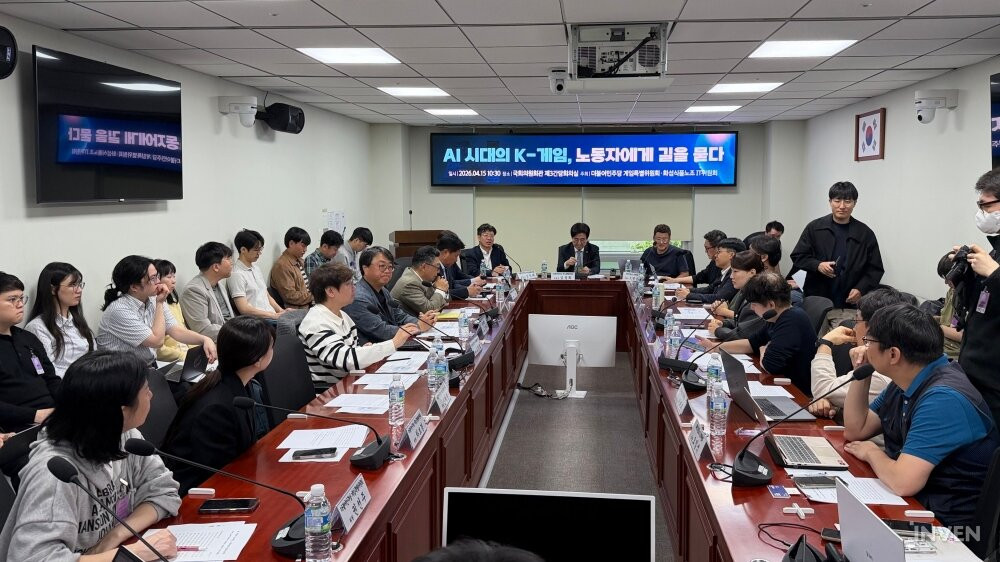
Kim Sang-ho, head of the Nexon union branch, presented the results of a survey conducted among 1,078 members from eight game companies under the Chemical and Textile IT Committee. Development staff accounted for 65.9% of respondents, and those in their 30s and 40s made up 88.7% of the total, providing a concentrated reflection of the views from the field.
The survey results showed overwhelming support for the main policy directions of the Game Industry Promotion Act amendment. Approval rates by item were: ▲Tax credits for game production costs (94.5%), ▲Enactment of AI-related laws (93.1%), and ▲Establishment of a Game Promotion Agency (91.3%).
However, awareness of the specific details of these policies remained low, at 12–16%, highlighting limitations in information dissemination. In particular, only 37.3% expected that tax credit benefits would lead to actual improvements in working conditions or job retention, reflecting widespread concern over the imbalance in policy benefits. Kim emphasized, "Institutional feedback mechanisms are needed to ensure that tax support does not stop at improving corporate finances but leads to actual wage increases and job stability."
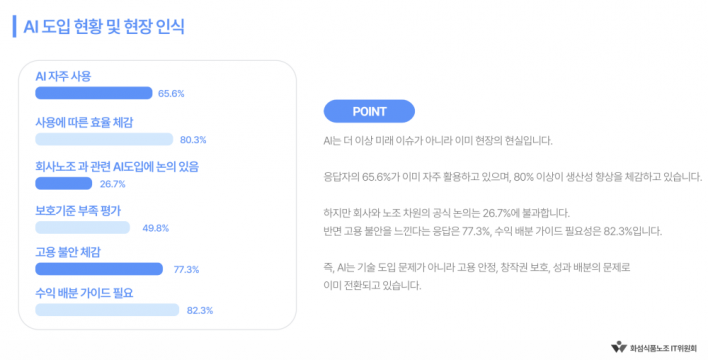
The sense of crisis in the field due to AI adoption was also reflected in specific figures. While 65.6% of respondents said they already use AI frequently in their work and 80.3% felt an improvement in efficiency, 77.3% expressed job insecurity, and 82.3% called for guidelines on profit distribution. With only 26.7% of workplaces currently engaged in formal discussions between management and unions, the need for urgent countermeasures was confirmed.
Noh Young-ho, a member of the Special Committee's Industry Promotion Subcommittee (and head of the Webzen branch), proposed the formation of a 'labor-management-government consultative body involving actual industry workers' to address the uncertainties facing the game industry during this era of AI transformation.
Noh cited three reasons for the need for such a body. First is establishing a foundation for field-oriented legal reform; he argued that worker participation is essential to accurately convey the intent of the legislation and increase its acceptance. Second is building a future-oriented model where AI technological innovation and job stability coexist. Noh suggested, "We must create a 'labor-management-government standard guideline' that allows AI technology to be used as a creative assistant tool." Third is preventing industrial conflict through a regular cooperation system.
Specific agenda items proposed included: ▲Building a human-centric AI environment for game development (establishing job transition training and performance-based distribution standards), ▲Designing a field-oriented promotion system for the Game Promotion Agency (guaranteeing labor union participation in decision-making bodies), and ▲Tax support policies to enhance human capital competitiveness (monitoring the expansion of job retention and inducing reinvestment). Noh stressed, "This is the golden time for K-Games, and we must create a structure where government policy will, corporate investment, and worker creativity align."
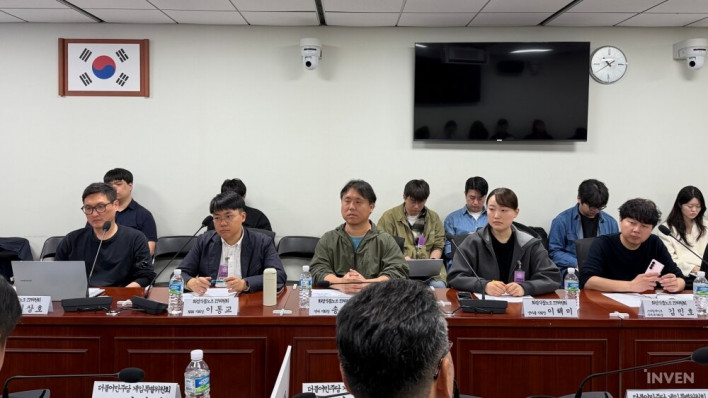
Lee Dong-gyo, head of the NHN union branch, noted, "While we have been trying various things like in-house AI hackathons, there is a significant gap between the AI utilization plans envisioned by the company and the direction workers actually think is necessary," pointing out that this perception gap must be bridged through the consultative body.
Song Ga-ram, head of the NCSoft union branch, emphasized, "The unique aspect of the game industry is that the producers are also the most passionate customers, which gives field employees much deeper insights." He pointed out, "Management tends to be conservative and risk-averse, often accepting field feedback too late. To keep up in the rapidly changing AI era, the insights of field employees must be quickly reflected in policy and strategy."
Lee Hae-mi, head of the Netmarble union branch, lamented, "Most employees want to use AI to make more fun games, but due to a lack of systematic training or support from the company, we are relying on individual sacrifice and effort." She conveyed the difficulties in the field, adding, "Because of this, AI is not seen as a convenient and fun tool, but rather as homework that increases working hours."
Kim Min-ho, senior vice-head of the Smilegate union branch, shared the atmosphere in the field: "An employee who joined the union just before today's forum wrote that their reason for joining was 'curiosity about the union's stance on AI adoption,' showing that AI issues themselves are now becoming a direct motivation for joining." He urged, "Given the high level of anxiety in the field, it is more important than ever for labor, management, and the government to proactively prepare countermeasures."
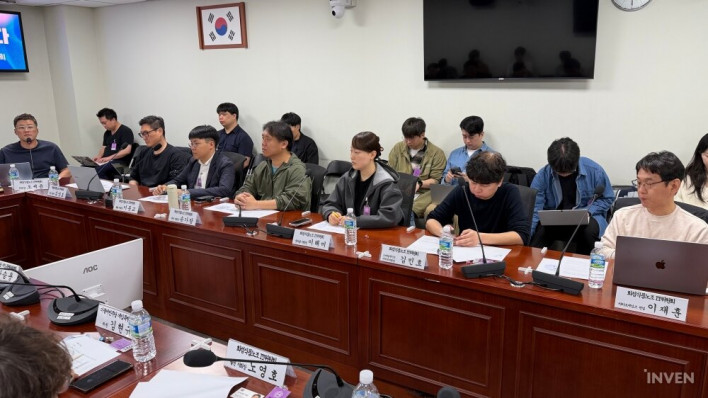
Lee Jae-hoon, a representative from Kakao Games, suggested, "Resources saved through AI adoption should be invested in resolving "crunch mode" rather than downsizing, creating a virtuous cycle." He added, "Policy support is also needed so that workers at small and medium-sized game companies, who have less support than large companies, can also utilize AI effectively."
Regarding job stability and the issues faced by small and medium-sized developers without unions, Oh Se-yoon, head of the Chemical and Textile IT Committee, emphasized, "We must create a foundation where workers can continue to take on challenges on a safety net even if a game fails. To change the ecosystem of the entire industry beyond individual companies, we need to introduce an 'industry-level bargaining' system to resolve job insecurity for workers in small and medium-sized game companies."
Chairman Oh assessed, "The game industry is one where only workers in democratic countries, who have plenty of imagination and can talk about anything, can create proper works and stories. Even if artificial intelligence writes the code, our competitiveness ultimately lies in showing exciting stories."
Regarding the proposal to form a labor-management-government consultative body, he added, "I generally agree with the direction of having labor and management gather opinions with the government to solve this problem. Having heard the workers' positions today, I will talk to the association to arrange time to hear from management as well, and I will strive to make this an industry that grows alongside its workers."

Sort by:
Comments :0