Even compared to other high-tech industries, changes in the gaming industry never lag behind. In fact, the winds of change blowing inside and out—from development to live operations and monetization—are all the more fierce and intense. In an era where global live service has become the norm, keeping pace with regulatory and policy shifts across different countries is more challenging than ever.
Xsolla, which opened the Xsolla Clubhouse at Grand Josun Busan during G-STAR, focused on the opportunities to capture amid those shifts. Under the banner of 'solutions to grow games together,' it provided a space for experts to share game growth strategies and for industry professionals to network comfortably. At the center of it all stood Xsolla as a partner.

The company also introduced its steadily expanding role, building on core game payments to offer web shops, commerce, monetization, publishing, and direct-to-consumer (D2C) solutions. This is why Xsolla highlights providing everything needed from launch to growth and success. In the sessions held in the meeting room at the same venue on November 20, discussions focused on shifting global regulations, new strategies, collaborations, and ways to reach more users through partnerships.
Taxes Are Fragmented, and App Market Doors Have Opened Yujin Jung of Xsolla Outlines This Year's Regulations and Four Responses
The first session was '2026 Gaming Industry Trends: Regulation and Opportunity' by Yujin Jung, APAC Regional Director of Customer Success at Xsolla. Having worked at Xsolla for nearly six years and provided country-by-country updates to partner companies via email, she noted that she had never sent as many tax-related communications as she did this year.

Taxes are far from simple, starting with indirect taxes like VAT. In the United States, tax rates vary by state and local jurisdiction, while Canada splits them into GST, HST, PST, and QST. Tax rates also differ depending on whether a product is classified as a digital service or a platform. On top of that come direct taxes levied on payments to foreign entities, as in Taiwan, and country-specific taxes such as Argentina's local gross receipts tax or Ecuador's foreign currency remittance tax.
In addition, the most critical keyword this year was age verification. Countries like Brazil, Indonesia, Australia, the United States, and India began legally regulating age verification, while the UK mandated age verification for platforms like Xbox and Steam. The core requirement is that self-reporting, such as entering a birth date, is no longer sufficient and must go through a state-certified system.
A prime example is Brazil's ECA Digital. Enacted in September 2025, it came into full force in March this year after the grace period ended, applying to foreign businesses if their services target Brazilian users. Developers must verify age using one of five state-approved systems and provide parental supervision features for minors. Non-compliance can lead to fines of up to 10% of revenue or even suspension and prohibition of operations via court order.
[001]
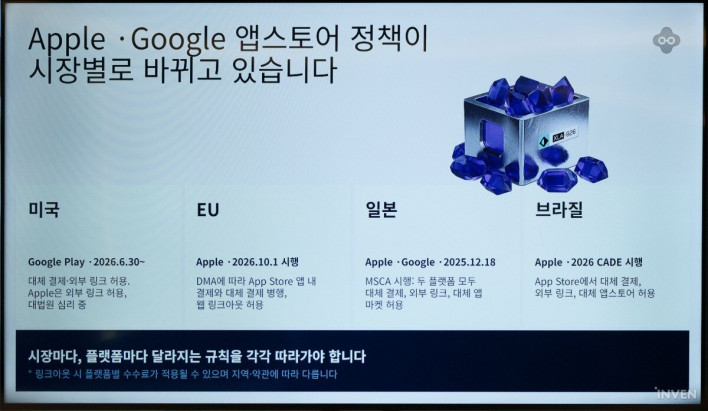
Conversely, app stores saw regulatory easing. In the United States, Google allowed alternative payments and external links starting June 30, while Apple's case remains under Supreme Court review. In Europe, Apple permits in-app purchases and link-outs, while Japan has allowed alternative payments, web links, and alternative app markets across both platforms. Of course, fees may still apply depending on the region and terms of service, so this does not mean fees disappear entirely.
So how does Xsolla respond? Taxes are managed as a Merchant of Record (MoR). Xsolla calculates, applies, and collects taxes from users, and handles filing, payment, and tax audit responses according to each country's reporting cycle and method. Global revenue and collected tax details can be checked directly in the Publisher Account. Jung emphasized that while many companies claim to be MoRs, Xsolla is the only one covering over 200 regions with more than 20 years of experience—meaning partners make the games, while Xsolla handles tax filings on their behalf.
Age verification is also addressed. Age-appropriate store controls and parental consent are key, delivered by integrating PRIVO's COPPA and GDPR-certified system. Adults can complete payment immediately after a quick identity verification. However, if a user is flagged as under 18, they are directed to a parental consent page and an email notification is sent to the parent, with payment enabled only after the parent completes consent. This effectively prevents situations where children make unauthorized purchases with their parents' cards.
The starting point for D2C is the Xsolla Web Shop. Developers can choose payment paths, directly collect user data from initial purchase to repeat visits, and build direct relationships with players through promotions, loyalty initiatives, and referral programs. It natively supports over 1,000 payment methods and local currency transactions, with more than 700 web shops added since the service launched in 2021. Director Jung noted that 60 of the top 100 grossing games have adopted web shops, stating that the days of treating web shops as merely 'worth a try' are over.
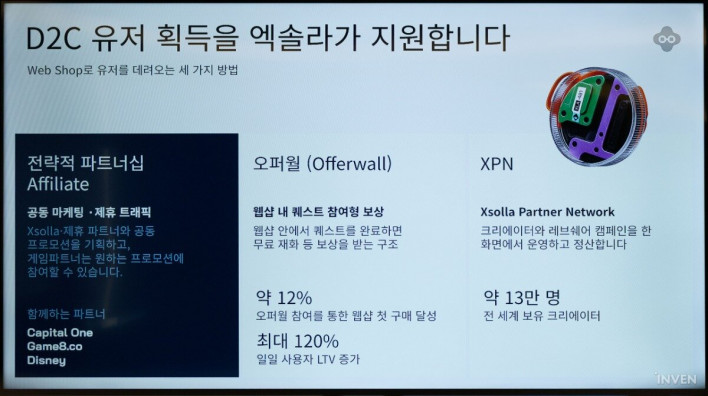
Of course, opening a store is useless if customers don't show up. That is why Xsolla presented three ways to drive users to web shops: strategic partnerships and affiliates where Xsolla and partners co-plan promotions; Offerwalls that grant rewards like free currency for completing quests inside the web shop; and the Xsolla Partner Network (XPN), which manages and settles revenue-sharing campaigns with creators on a single dashboard. Approximately 12% of Offerwall participants converted to first-time web shop purchasers, daily active user ATV (Average Transaction Value) grew by up to 120%, and Xsolla boasts around 130,000 creators worldwide. Current affiliated partners include Capital One, GameAid, and Disney.
The final piece is payment conversion rate. Most people have had the experience of typing in a credit card number, thinking 'I'll do this next time,' and closing the window. Local payment methods now command over 50% market share in many regions—such as Pix at 51% in Brazil and UPI at around 55% in India. In short, payment options equal conversion rates.
The same applies to currencies. Industry studies show that sellers adding local currencies typically see conversion rates rise by 5–20%, displaying prices in local currency boosts cross-border revenue by an average of 17.8%, and offering local payment methods on top drives increases of up to 30%. Both elements must be present to maximize results, and Xsolla added over 50 new local payment methods between 2025 and this year.
The results were proven in the numbers. Revenue in Japan grew 46% year-over-year, with expectations of reaching 63% growth by year-end, while Indonesia saw 147% followed by 33%, and the United States is eyeing growth from 7% up to 52%. Following the introduction of new payment methods, conversion rates rose by 0.83 percentage points in Japan, 4.61 percentage points in the US, and 8.62 percentage points in Indonesia.
Payment steps were also streamlined. Unlike traditional payments that require four steps—from selecting a payment method to entering card details and identity authentication—Instant Flow completes the transaction when the user taps the Pay button and authenticates via biometrics. Following its rollout, Google Pay conversion rates rose by 20%, Apple Pay grew by 5%, and combined revenue from both payment options surged by 58%.
Underpinning all of this is Pay Station, which supports over 1,000 payment methods, 200+ regions, 130+ currencies, and 25+ UI languages with a single integration. Yujin Jung summarized that Xsolla tackles taxes with MoR, age verification with parental controls, platform shifts with web shops and user acquisition, and payment conversion with local payment methods and Instant Flow. Xsolla has worked with over 2,000 game developers for over 20 years, employing more than 1,000 staff serving 200+ regions. She concluded her presentation by noting that while regulations will continue to change, having a partner to tackle them together remains constant, expressing her hope that Xsolla stays a partner that leads ahead of regulation rather than just keeping up.
Web Shops Are Retention Spaces, Not Mere Cash Registers Three Web Shop Revenue Growth Strategies: From Repeat Visits to External Traffic
The following session covered web shop operation strategies. Policy changes have transformed web shops from an option into an essential element of company growth, but partner reactions remain mixed. While some report strong results, many others say performance has fallen short of expectations.
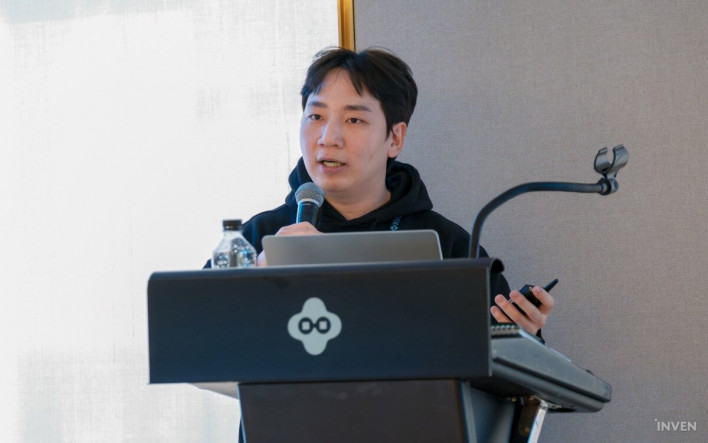
Their concerns generally fall into three areas: users visiting once and never returning, web shops being forgotten like empty roadside stands because they connect to nothing, or traffic coming in without generating proportional revenue. The speaker pointed out that the root cause lies in treating and structuring the web shop merely as a cash register that collects payments. Rather than acting as a checkout counter where the relationship ends once payment is made, a web shop must become a retention space that welcomes, engages, and brings users back.
The first strategy is creating a reason to return. Over 700 partner companies have launched web shops through Xsolla, and many top-grossing game companies have already adopted them. The speaker highlighted the figure 72%, signifying that the majority of web shop revenue comes from players making repeat purchases after their initial transaction.
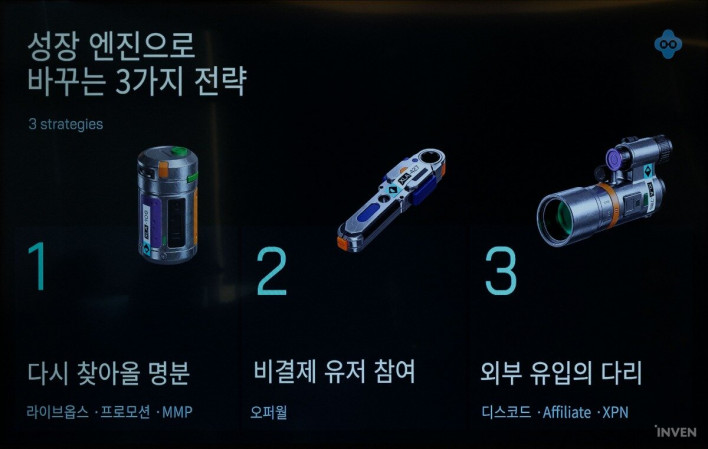
Therefore, driving repeat visits is the most urgent priority. This means enticing users to return regularly through perks like daily rewards, while lowering the psychological barrier of the first transaction via first-time buyer perks and offer chains to make purchasing familiar. In practice, Web Shop A achieved a first-purchase conversion rate over 30% higher when running promotions compared to when it simply listed virtual currency and items.
It doesn't stop there. By integrating MMPs (Mobile Measurement Partners), operators must track which acquisition channels users come through when visiting and purchasing at the web shop, as well as their behavioral and payment patterns, feeding those insights into subsequent operations and events. In short, web shops must understand and deliver what users truly want.
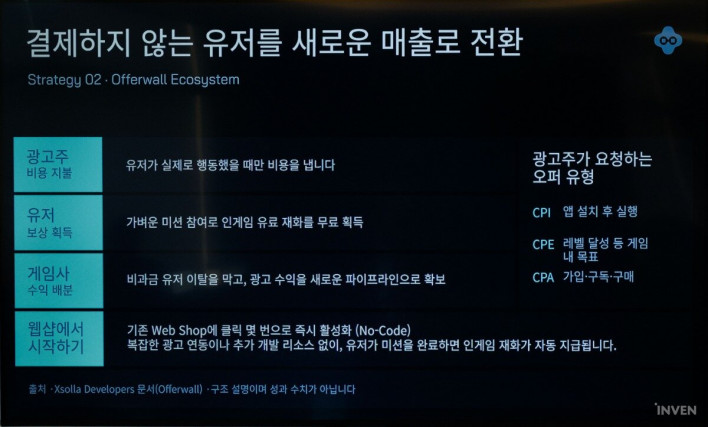
The second strategy is turning non-paying users into monetization opportunities. Most users who visit a web shop leave without spending money, and the speaker's answer to this is Offerwalls. When advertisers present missions, users voluntarily participate to earn rewards, creating positive touchpoints with the service that lead to repeat visits or future revenue.
Missions typically take the form of CPI, CPE, or CPA campaigns requiring app installs or engagement actions, generating revenue from advertisers while granting players corresponding rewards. Integration takes just a few clicks, and advertising, missions, and in-game currency distribution are processed automatically within the web shop, leaving little for developers or publishers to worry about. Looking at overseas developer cases, Company K saw Offerwall revenue account for about 5% of its total web shop revenue, while Company V experienced a 10%+ increase in web shop transaction count after implementing Offerwalls.
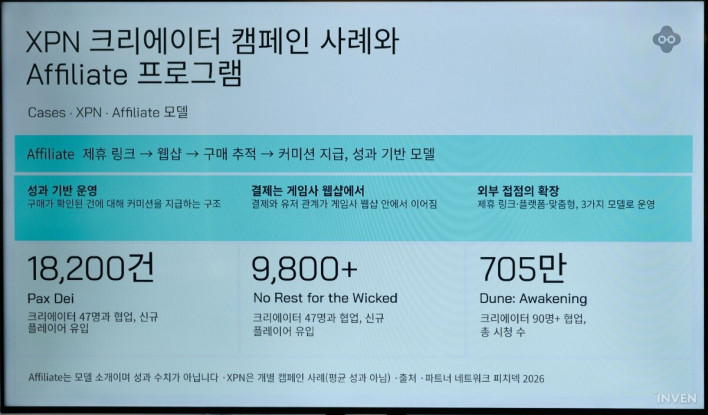
The final strategy is looking outside the game itself. One of the complaints heard most frequently from partners is that UA (user acquisition) and marketing costs have surged so high that everything earned is spent right back, leaving little profit. Yet relying solely on waiting for users inside the game has clear limitations. The speaker believes developers must build bridges connecting thriving external communities to their web shops and services.
To address this, Xsolla proposes Discord, affiliate platforms, and creator programs. The newly introduced affiliate program operates through link partnerships and platform partnerships, enabling games and web shops to be promoted jointly on portals with large audiences. In an XPN creator program collaboration case, the campaign generated transactions and new user influx while securing over 7 million hours of watch time. Both programs are performance-based, sharing revenue only when actual sales occur, allowing studios to start without upfront investment costs or risk.
The speaker advised that studios do not need to implement all three strategies at once. If repeat visits are a problem, consider the first method; if there is traffic but insufficient revenue, try Offerwalls; and if external promotion is blocked by UA and marketing costs, explore the third option. He concluded his presentation by expressing his hope that current and future web shop operations will act as growth engines driving real corporate revenue.
Brands Enter Games Through Rewards Instead of Ads Three Xsolla Executives Share Cost-Effective User Acquisition Methods
The third session took the form of a panel discussion. Moderated by Berkley Egenes, Chief Marketing & Growth Officer at Xsolla, Nic Ingham, VP of Performance Marketing & Publishing, and Chris Roution, VP of Partnerships, discussed whether methods exist to acquire and retain players without heavy costs. The first challenge VP Ingham put forward was discoverability.

Organic users are increasingly difficult to acquire, while the cost of buying users continues to rise. This issue, previously prominent on mobile, has begun spreading to PC as well. While noting the figures were approximate, VP Ingham pointed out that recent Sensor Tower data indicates UA costs surged by 24% this year alone, turning a $10 user into a $12.40 user. Because this figure reflects new users, retargeting costs are excluded.
The reasons for rising costs are overlapping. Consolidation in the ad-tech industry sees networks acquiring other networks, driving up bid prices. For a casual game to buy users in the same genre, it must compete in auctions against other casual games, while available inventory for traditional ad formats remains limited. Consequently, advertising costs for game companies inevitably keep climbing rather than coming down.
Moreover, spending money does not guarantee immediate cost recovery. While spending $10 might seem to require generating $10.01 to break even, that math excludes the 30% fee taken by Apple and Google alongside creative production costs. VP Ingham calculated that a $10 user actually needs to generate nearly $20 to reach break-even, requiring a longer timeline—exceeding a year—before turning a real profit.

Buying such users in volume—hundreds of thousands, millions, or tens of millions—is the next challenge. While the industry has long prepared for launching games, reaching the discoverability phase leaves studios feeling daunted by whether bringing a mobile game to market will cost $50 million or $100 million, or whether money is simply being wasted on untrackable influencer spend. Even if a game is great and boasts strong retention and IP, it may fail if it cannot be put in front of an audience.
The situation on the brand side is hardly easier. VP Roution noted that traditional methods available to brands have mostly resembled intrusive ads or sponsorships that interrupt gameplay. Surveys indicate that users ignore or skip ads and can develop negative sentiment toward the brand. Lacking a standardized approach, campaigns remain one-off activations with long production timelines, raising cost burdens for both game studios and brands. Above all, proving and measuring effectiveness remains a major hurdle.
What brands want is no longer just clicks and impressions, but measurable attribution. That is why Xsolla chose to transition from intrusive advertising toward intentional engagement. In the program created and introduced by the three executives this year, brands are perceived as rewards rather than sales promotions.

He noted that discussions at Advertising Week New York also highlighted how games are evolving beyond brand media channels into interactive commerce and customer acquisition channels. VP Roution outlined three ways brands and IPs integrate into games. The first is high-profile IP tie-ins that generate buzz, such as the Travis Scott concert or NIKELAND, which are short-lived, expensive, and yield high view counts but make measuring return on ad spend difficult. The second is interactive experiences inside brand-dedicated spaces, such as virtual concert venues or shopping malls.
The third approach, which Xsolla focuses on, is rewarded marketing. Here, brands engage gamers by offering real-world or in-game rewards. An example cited was Chipotle's activation in 'Roblox' several years ago, where players rolled virtual burritos to earn in-game currency and redeem codes for real burritos in stores. The activation generated 1 million plays in its first 24 hours and saw 100,000 codes redeemed in the first 30 minutes, allowing store visits to be tracked by cohorts. Conversely, McDonald's was cited as a reversed example, offering 'Genshin Impact' rewards inside its own mobile app.
The key term VP Ingham highlighted for this approach was also attribution. Traditional mass advertising yields views but makes it difficult to know how many products were sold, leaving room for external variables like weather to skew performance metrics. In contrast, Sponsored Quests attribute in-game events—such as leveling up, clearing stages, or engaging in combat—via MMPs or server-to-server integrations. Rewards range widely, from physical items and digital inventory in a backpack to promo codes, movie tickets, and pizza.
In this model, players receive tangible rewards, game studios gain new revenue streams, and brands obtain measurable engagement rather than skipped ads. Traditional rewarded video ads, which account for a large portion of existing UA, grant five gems for watching a video or force unrewarded video views before returning players to gameplay. In Sponsored Quests, players are rewarded for spending time while continuing their usual gameplay or being guided to purchases and new updates. Just as viewers leave to make tea during TV commercials, traditional in-game ads disrupt player flow—whereas Sponsored Quests drive metrics like playtime and battle counts upward together.

Reward design is equally crucial. VP Roution stressed that asking users to install an app or offering a meager 5% discount moves no one; clear incentives like free pizza are needed. In return, redeeming the pizza through the brand's app provides the brand with new user accounts and payment profiles, creating a value exchange where CPI and UA budgets offset product costs. Gamers receive pizza while playing their game, while brands obtain engagement data difficult to secure anywhere else.
The panel also emphasized that there is no one-size-fits-all formula. Chief Officer Egenes noted that goals can range from app installs to reinvigorating stalled metrics, stressing the need to A/B test rewards and assess compatibility between the game and brand. Citing the idea of linking a 'Chicken Dinner' in PUBG with KFC as a potential concept fell under this context.
The program itself is the result of 6–7 months of preparation by the trio, with Sponsored Quests, backpack items, and reward redemptions already live this year. Cases include offering gaming controllers from hardware peripheral manufacturers as rewards. On site, discussions surrounding promotions with Red Bull, Chipotle, and the movie 'Resident Evil' were mentioned, while ideas continue to expand—such as allowing players to bundle Red Bull and snacks at 7-Eleven, or DoorDash expressing interest in delivering food before a play session ends. VP Roution concluded the panel session by stating he looks forward to future collaborations, noting that Korea and the Asia-Pacific region harbor numerous brands closely tied to gaming culture.

Web Shops Are Live—Now It's Time to Bring In Users Eric Lee Introduces Disney Campaign and Affiliate Partnerships
The fourth session was led by Eric Lee, Head of APAC Partnerships at Xsolla. His and his team's mission is to help web shop partners expand revenue and find new partnerships to boost engagement and retention. The words he repeated throughout the session were also engagement and retention.
He first pointed to the scale of the Asia-Pacific market. Gaming revenue in this region—which includes Korea, Japan, and Southeast Asia—is roughly seven times that of the box office, boasting 1.9 billion players. The common question facing game partners, developers, and publishers was how to reach these users.
Xsolla is widely known as a payment company. However, its stance is to leverage the network and analytical capabilities built over 20+ years working with thousands of game partners to directly drive web shop engagement and retention beyond payments. Just 4 to 5 years ago, the concept of a web shop was unfamiliar. Now, the stage of reiterating basic explanations has passed, leaving the remaining challenge: driving users to the web shop.

He presented three methods. The first is an affiliate program that routes traffic from gaming and non-gaming platforms to web shops. The second is platform partnerships that receive traffic in exchange for revenue sharing. The third consists of customized partnerships, demonstrating a willingness to try novel approaches to drive web shop engagement and retention. The first case Lee brought up was this third category: a collaboration with Disney.
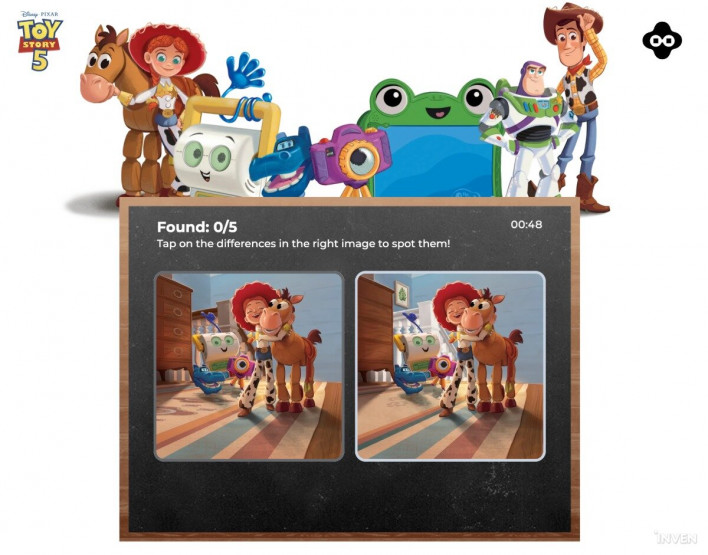
Web shop partners can leverage Xsolla's collaboration with Disney on their own web shops. The setup runs a Disney Experiences campaign targeting Korea and Southeast Asia, directing users to the web shop alongside promo codes. The launch IP is 'Toy Story 5'.
Before reaching the web shop, users complete a spot-the-difference mini-experience. Upon completing the task, they transition to the web shop to claim rewards and enter the code 'DISNEY2026' to receive a 5% discount on their next purchase. Lee personally demonstrated the process live on stage, finishing the task in 45 seconds—exceeding the 30-second time limit. The initiative aims to enhance web shop retention by layering in fun and engagement.
The campaign will run through the end of 2027. Going beyond 'Toy Story', Xsolla plans to sequentially roll out campaigns featuring over 20 Disney IPs. There are no costs for game partners. Because the landing page aggregates all necessary information, signing up allows immediate integration with their web shops.
Stacy Oh, Head of Disney Experiences for Korea and Southeast Asia at The Walt Disney Company Korea, highlighted the significance of the partnership in enabling Disney and Pixar IPs to connect with new consumer demographics. Disney boasts a history of over a century, with Mickey Mouse set to reach 100 years old in 2028. As platforms and technologies evolved, reaching both middle-aged and older generations who grew up with Disney IPs as well as younger generations had been a key task over recent years.
That challenge led to the creation of the Digital Experiences department five years ago. She noted that in Korea and Southeast Asia, digital revenue has grown so rapidly that it now accounts for over 50% of revenue compared to physical merchandise. Xsolla's proposed idea opened new consumer touchpoints for the Disney brand, culminating in a win-win partnership where brand growth also contributes to Xsolla's visibility.
While launching with 'Toy Story', the campaign is set to expand across Disney and Pixar IPs. Oh expressed a desire to co-create campaigns and events alongside upcoming series and films. Beyond Disney and Pixar, she anticipated opportunities to reach new consumers across Marvel, Lucasfilm, National Geographic, Fox, and even ESPN live broadcasts introduced a week prior.

Unlike custom partnerships like Disney, affiliate programs represent a more direct and budget-friendly pillar. Studios can reach users at non-gaming corporations such as banks and telecom carriers without additional development work, incurring costs only when results are generated. Among ongoing partnerships, US credit card company Capital One is opening web shop affiliate access to its 120 million users. It was also explained that VP Roution's team is opening traffic across North America, Europe, and Latin America using the same approach.
In the Asia-Pacific region, Thailand's Online Station, Korea's Inven, Southeast Asia's This Is Media, and Japan's Game8 were introduced as partners. The first affiliate partner Lee highlighted was Game8, which launched its campaign a couple of months ago at Tokyo Game Show. Hisanori Kato, CEO of Game8 Global, stated that the English website reaches approximately 100 million pageviews and 40 million users per month.
Under this structure, players visiting to check game guides, tier lists, and rankings transition from viewing character information directly to publisher web shops. Kato described it as a 'win-win-win' opportunity benefiting players, publishers, Game8, and Xsolla alike. Head of APAC Partnerships Lee explained that users visiting guide sites represent core players deeply engaged in the game, and direct links to web shops are embedded into the platform. When players need additional currency or a new skin before a boss battle, they can bypass intermediate steps, jumping straight to the web shop to make a purchase.

Onboarding is a straightforward process requiring partners to review and accept an additional 15% platform fee. The same model extends across various partners across regions: in Thailand, top gaming media outlet Online Station under CP Group was introduced, with True Digital also mentioned. Southeast Asian media outlet This Is Media was highlighted with 1.2 million monthly pageviews and 35,000 daily pageviews, featuring a partnership that attaches official web shop icons. In Korea, featuring web shops via a partnership with Inven is already available. Lee concluded the session by noting that partnerships will not end with today's announcements, promising that by 2027, more partners will emerge to target desired regions more directly.