
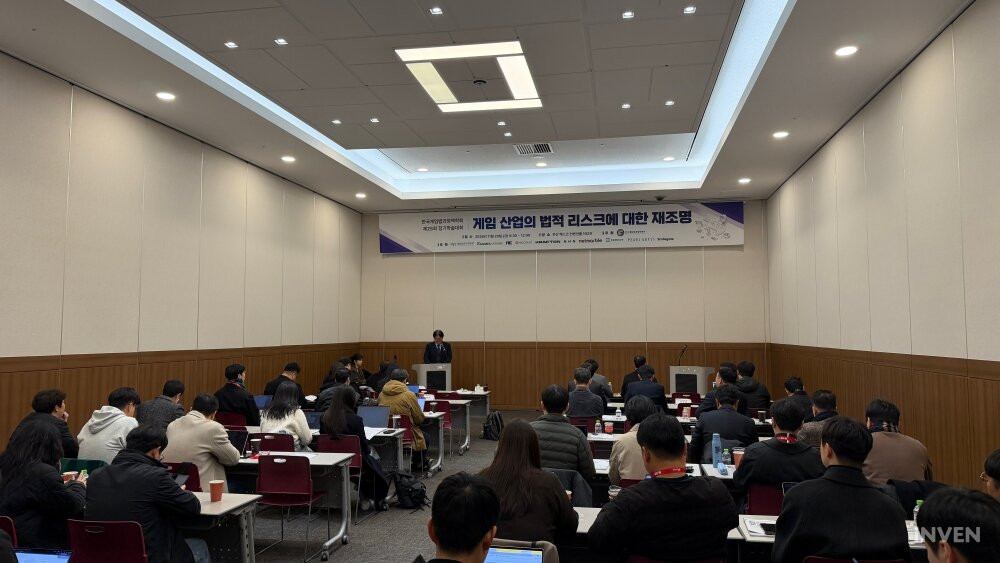
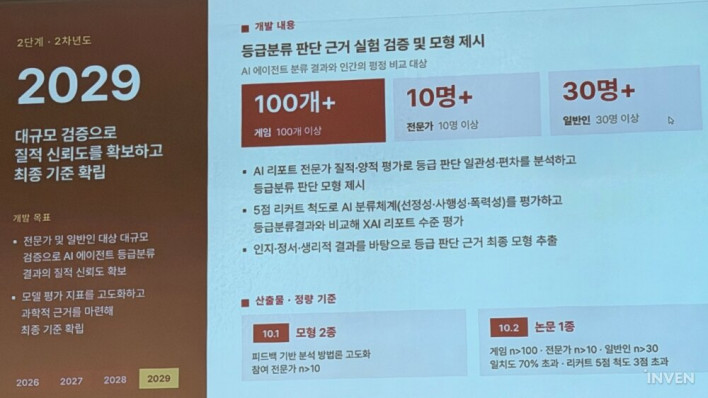
An industry-academic consortium led by Nexon revealed its first-year research findings and future plans for AI-assisted game rating technology at the 25th Regular Academic Conference of the Korea Game Law and Policy Society, held at BEXCO in Busan on November 20. Smilegate, a member of the consortium, provided 2,894 self-rating data entries from its PC gaming platform STOVE for the research and plans to validate AI rating determinations during the operator review stage starting in 2028. The framework allows AI to perform an initial sweep of game content that is difficult for human reviewers to inspect thoroughly, while humans make the final rating decision.
The consortium comprises four entities: Nexon, Myongji University, Korea University, and Smilegate. Nexon is developing the overall rating classification model, while Myongji University is in charge of data labeling and autonomous play AI agents. Korea University is researching psychological evaluation criteria and validity, and Smilegate will verify practical operations on STOVE.
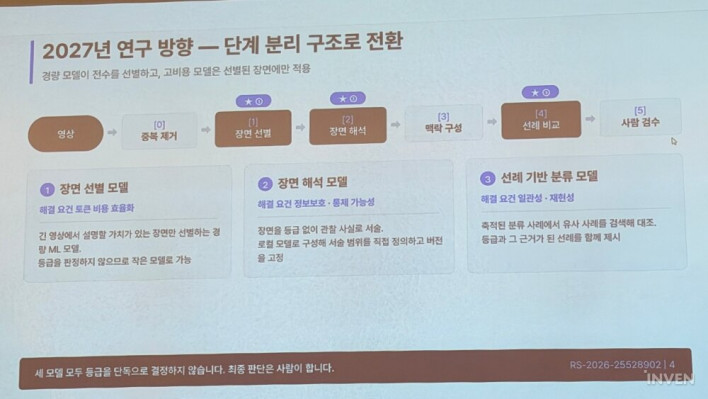
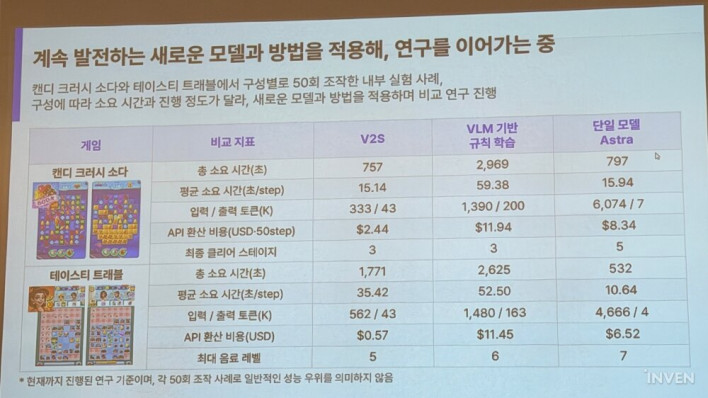
Bae Jun-young, lead researcher at Nexon, stated that the team established a rating classification pipeline during the first year. The system pre-processes gameplay videos, screenshots, audio, and rating application documents to evaluate seven major content criteria. The research process also revealed challenges. Feeding lengthy videos into the AI in their entirety significantly increased token costs. Security was another priority, as the data involved unreleased games. Furthermore, commercial models suffered from fluctuating criteria, making it difficult to maintain evaluation consistency.
Nexon plans to address these issues in 2027 by segmenting the processing steps. After splitting videos, an internal LLM selects only necessary scenes, leaving the interpretation of selected scenes to advanced models with higher consistency. Nexon intends to refine data standards, develop models with reduced token costs, and complete integrated verification to ensure functioning in real-world operational environments.
Training data is provided by the Game Rating and Administration Committee (GRAC) and Smilegate. Bae explained that due to the lack of publicly available rating data, review records collected by GRAC over time are being used for training. Considering that directly handling data on Nexon's internal systems posed security and objectivity risks, data from both entities undergoes de-identification of personal and sensitive information by Upstage before being utilized for research.
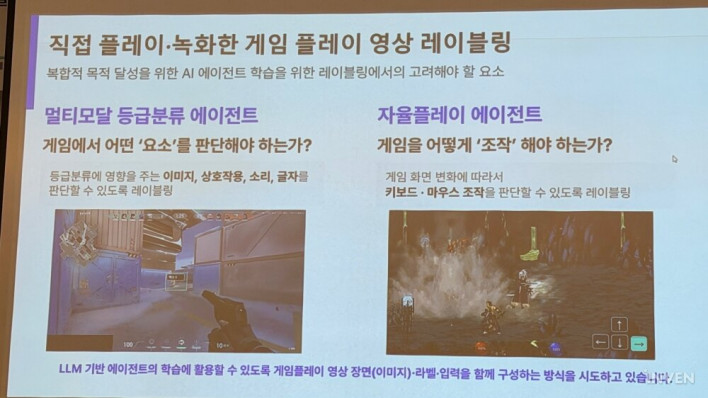
Professor Shin Hye-ryun from the College of AI and Software Convergence at Myongji University introduced the data labeling process. Around 40 personnel knowledgeable about games personally play the titles and input evaluation rationale frame by frame. Rather than using off-the-shelf commercial labeling tools, they developed a custom tool aligned with GRAC's seven content rating criteria. The initial subject of the research is 'Merge Cafe' in the casual merge genre. The labeling staff received training from GRAC rating operations personnel, and their output is further cross-checked by GRAC.
Myongji University is also developing an autonomous play AI agent. The AI plays games to completion in place of human players to identify scenes necessary for rating classification. Professor Shin emphasized that the goal differs from conventional game AI research, stating, "The objective is not to play well, but to accurately navigate and explore for content rating purposes."
Professor Jung Jae-bum of the Center for Intelligent Convergence Studies at Korea University incorporated psychological methodologies into rating classification. Recognizing the limitation of survey-dependent research, where respondents may answer untruthfully, the study employs physiological methods such as fMRI and EEG. Terminology refinement is also underway. Professor Jung pointed out that while psychology defines violence by observable violent behavior and distinguishes it from aggressiveness, the two concepts are often conflated in gaming context. The study also evaluates whether Korea's current standards remain appropriate compared to varying international rating systems. Professor Jung projected, "In three years, as technology advances, commercial application should become viable."
Smilegate researcher Moon Young-min explained that the company is handling field verification in its capacity as a self-rating entity. On STOVE, when a developer receives a preliminary rating through a questionnaire, platform operators re-examine the same survey and coordinate with GRAC to issue a rating classification number. Discrepancies occasionally arise among the developer, operator, and committee, or reported content differs from actual game content, leading to post-release reclassifications. The 2,894 data records provided by Smilegate preserve step-by-step histories of developer ratings, operator ratings, and post-release tracking, allowing researchers to examine both matched and mismatched evaluations.
Strict principles were established for data provision. Identifiable information is de-identified via hashing, used exclusively for research purposes, and never re-distributed elsewhere. Targeted areas for AI implementation include detecting survey discrepancies, assisting reviews, and post-release monitoring. In 2027, STOVE games with confirmed ratings will be added to the consortium's labeling dataset, and starting in 2028, the system's effectiveness will be measured by operator review match rates and review time before considering expanded operation. Moon drew a clear line, emphasizing, "AI results will be used solely as supplementary reference data for operator reviews."
During the general panel discussion, attendees acknowledged the potential of AI rating classification while agreeing that final decisions must remain with humans. Na Hyun-soo, Secretary General of the Game Self-Regulation Organization of Korea (GSOK) and a rating committee member at the Game Content Rating Board (GCRB), first highlighted where AI can be useful. For games requiring tens to hundreds of hours to access all content, ratings currently rely heavily on developer-submitted summaries, and AI can bridge this gap.
However, Na expressed skepticism regarding handing over rating classifications entirely to AI. He pointed out that some games may feature graphics and audio suitable for all ages yet contain anti-social themes, while others may display high levels of exposure without suggestive context. He noted, "Legal and institutional frameworks must first clarify who bears responsibility if AI conducts rating classifications."
Attorney Park Ju-sung of Bae, Kim & Lee LLC (BKL) noted that AI could assign ratings higher or lower than warranted. Consequently, beyond accuracy, it is essential to examine whether the rationale behind decisions can be explained, whether procedures exist to rectify errors, and where liability resides. Attorney Park emphasized, "A final review by a human after AI classification is indispensable," pointing out that government AI guidelines for the financial and public sectors also treat human final oversight as a primary factor in risk assessment.
Dr. Lee Sang-min of the Korea Information Society Development Institute (KISDI) outlined the role of AI from a legal perspective. He noted that the principle presented in the panel—"equal outcomes for equal cases, with grounds that can be explained and refuted"—mirrors the consistency and reasoning required in jurisprudence when interpreting ambiguous legal concepts. Dr. Lee suggested that rather than replacing human judgment, AI could record and aggregate evaluation rationale, helping developers understand vague standards in concrete terms.
Addressing how AI should handle domains requiring societal consensus—such as the boundary between suggestive and obscene content—Secretary General Na acknowledged that human judgments naturally vary. He explained that AI must thoroughly learn evaluation results and metadata from individual committee members, noting that even identical scenes can be evaluated differently depending on whether they pass by in the background or require sustained player focus. "Standards are constantly evolving," he remarked, emphasizing that even in the AI era, a framework where humans continuously evaluate and provide feedback remains necessary.