A single administrative guidance document from 2013 restricting game giveaways has been triggering a 13-year butterfly effect, according to an expert analysis. Unable to offer prizes based on gameplay results, game companies were forced to rely on foreign app stores and platform advertising, and the resulting ballooning ad spend now drags down companies sitting on the brink of operating profitability. Furthermore, the steep compliance costs attached to being labeled a "game" drive emerging services like AI chat apps to avoid game classification altogether—creating blind spots in user protection outside those boundaries. A single regulation blocking one marketing method has rippled through the industrial structure to compromise user protection.
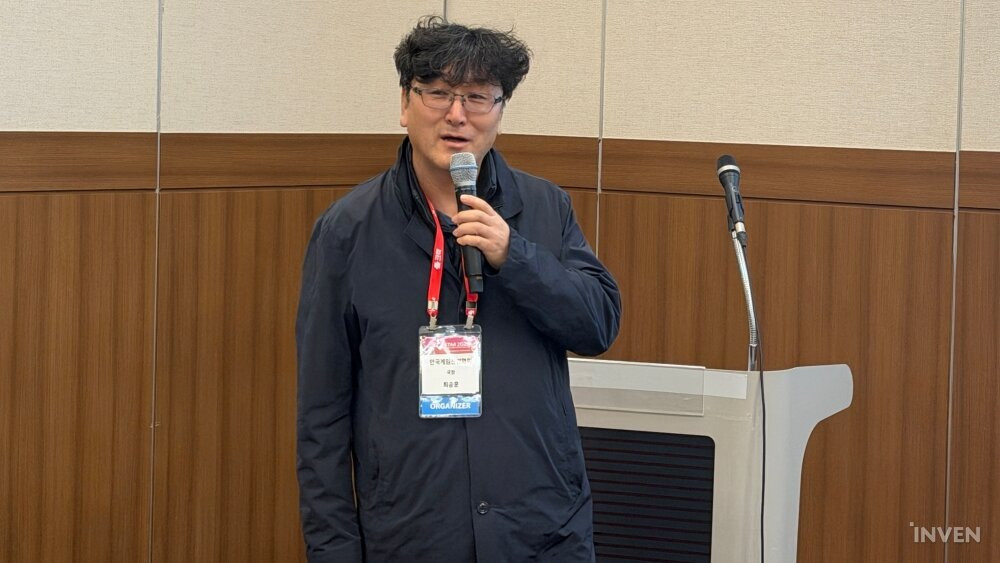
Choi Seung-hoon, Director of Policy at the Korea Game Industry Association (K-GAMES), delivered a presentation on "The Price Tag of Game Regulation" at the joint academic seminar "Game Technology and Law Crossing Boundaries," held on the 20th at BEXCO in Busan. The seminar was co-hosted by the 4th Industrial Revolution Convergence Law Association, the Korea Data & AI Law Policy Association, and the Hongik University GCT Center. Choi proposed viewing giveaway regulations as an economic cost imposed on the industry rather than purely through the legal framework of preventing speculative gambling, estimating the annual ad spend gap created by this regulation at 1.4 trillion won. He remarked, "The moment something is labeled a 'game,' a very steep price tag—a heavy cost—is attached to it." The panel discussion that followed saw a mix of agreement and cautious restraint.
"It Began with an Administrative Guidance, Not a Law"
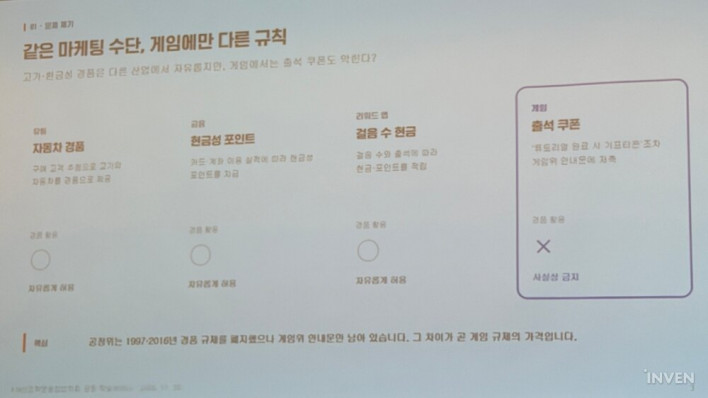
In other industries, giveaways are a common marketing tool. After the Fair Trade Commission (FTC) abolished its public notice on giveaways in 2016, the retail sector offered cars as prizes, the financial sector gave cash-equivalent points for using services, and reward apps offered incentives based on step counts. Gaming is a different story. Choi pointed out, "Gaming is virtually the only sector where giveaway marketing is almost completely blocked." What is blocked is offering prizes based on gameplay results. He added, "Giveaway marketing is actually most effective when awarded based on usage results."
The legal basis is Article 28 of the Game Industry Promotion Act (hereinafter referred to as the Game Industry Act), which stipulates that providers shall "not encourage gambling or speculative activity by providing prizes." However, what actually serves as the enforcement standard in the field is a 2013 administrative guidance document. According to Choi, this clause was originally enacted to block arcade game giveaways during the Sea Story scandal. However, because the law did not distinguish between online games and arcade games, it was applied to online games as well, and the Game Rating Board of the time issued guidance based on it, setting the regulation into full motion.
The guidance document was written while the FTC notice on giveaways was still in effect, borrowing heavily from its provisions. Although the FTC notice was repealed, the administrative guidance remained. Choi criticized that this guidance "has survived long after the abolition of the giveaway notice and continues to operate to this day." During the panel discussion, Adjunct Professor Jeong Jeong-won of Hallym University Graduate School of International Studies raised the same point, noting, "The giveaway notice was eliminated long ago based on social consensus, yet gaming is the only place where it lingers."
"With Giveaways Blocked, Only Advertising Remained"
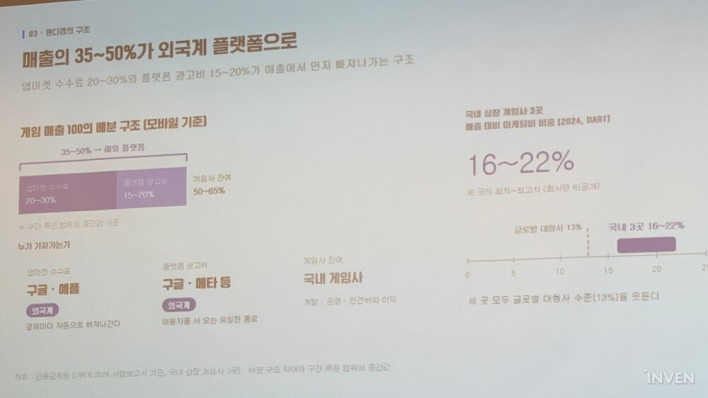
The first chain reaction described by Choi is platform dependence. Looking back at the expansion of mobile platforms, he noted that "games were the pioneers of mobile business." When the market was growing rapidly, app store commissions were manageable. However, as the mobile market saturated into a red ocean, 20–30% platform fees became burdensome. As competition intensified, app markets and web portals began taking promotional and advertising fees separate from platform commissions, which K-GAMES estimates at around 20% of revenue. Choi stated, "In the end, it created a market environment where companies must shoulder a 30% market fee alongside separate promotional fees."
Choi attributed this structure directly to giveaway regulations. With direct user acquisition through rewards blocked, game companies were left with no choice but to rely on advertising products offered by app markets and platforms. He presented figures showing that while major global game publishers spend around 13% of their revenue on marketing, domestic game companies spend 16–22%, averaging around 20%. K-GAMES calculated the financial gap caused by this discrepancy at 1.4 trillion won per year. Choi stated, "Even by conservative estimates, roughly 1.4 trillion won is being siphoned off to foreign platforms and app markets."
The chain reaction extends to data. Without the ability to acquire users directly via giveaways, building proprietary user data becomes difficult, driving companies right back to platform advertising. Choi remarked, "With companies forced to rely on portals and foreign app stores for user data, there is no way out of this vicious cycle." Because major app markets and platforms are operated by foreign companies, domestic developers are competing globally with a significant handicap, he argued.
Of course, these figures must be taken with a grain of salt. Choi himself qualified his statement, noting that while "we cannot say everything stems from this single cause, the marketing cost gap critically originates from a market environment that bans giveaway marketing." Major global developers with strong proprietary IPs and high console shares operate under vastly different business models than mobile-heavy domestic studios, limiting direct comparisons. Furthermore, the specific companies included in the domestic dataset were not disclosed. The 1.4 trillion won figure should be viewed not as a definitive measure of regulatory cost, but as a starting point for assessing its scale.
Game Developers on the Brink of Profitability
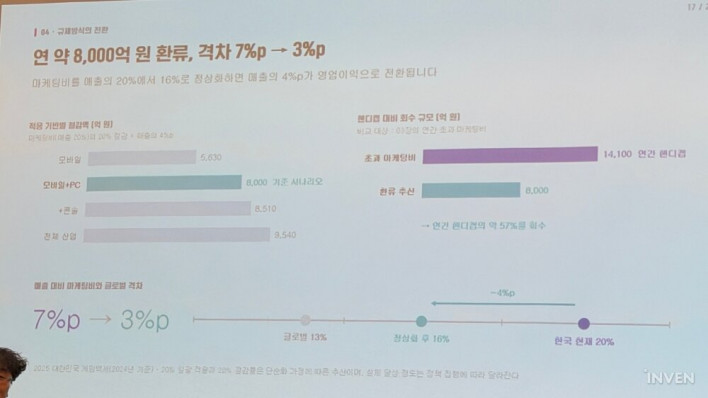
The second chain reaction touches profitability. Choi observed, "There are numerous mobile game studios currently hovering right on the edge of operating profitability," predicting that reducing ad burdens by just a few percentage points could turn many loss-making studios profitable. K-GAMES estimated that even under conservative assumptions for mobile games, approximately 800 billion won annually could be funneled back into the industry. Choi added, "The number of game companies eligible to pay corporate taxes could increase significantly."
For comparison, he brought up the government budget. Choi noted that the Ministry of Culture, Sports and Tourism's (MCST) budget for supporting the gaming industry "amounts to only 130 billion won a year, even when including overhead expenses for support agencies." His argument suggests that simply revising one regulatory system could inject several times that amount back into the industry without increasing state expenditure.
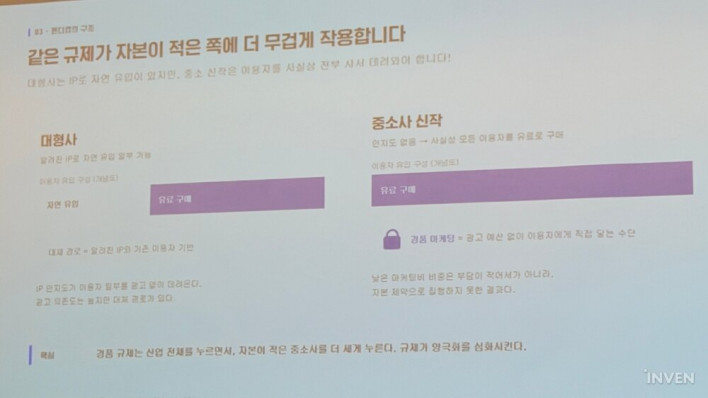
Panelists also suggested viewing the issue through the lens of competition law. During the discussion, Kim Jong-il, Senior Advisory Member at Yoon & Yang LLC, identified the restriction of giveaways leaving paid advertising as the only remaining route as the core of the presentation. He noted, "Online and mobile advertising are dominated by top apex predators like Google and Apple," adding that given they are among the biggest competitors to the domestic content industry, "it creates a major legal obstacle under competition law." He pointed out that domestic regulations have ultimately created a structure that bolsters the ad revenues of global competitors.
Costs Spill Beyond the Boundaries of Gaming
The most far-reaching chain reaction concerns services outside the boundary. Choi opened his presentation by highlighting "Krak," an AI service developed by Wrtn Technologies, the main sponsor of this year's G-STAR. While debates exist over whether Krak should be classified as a game, Choi assessed that "many operators offering services in Korea would not want to be called games," given the heavy costs attached to the classification. The closing question of his presentation pointed in the same direction: In a reality where high costs immediately follow a name, what is the point of debating whether a new service is a game or not?
Another presentation at the seminar illustrated what happens outside those boundaries. Attorney Jung Ho-sun of Yoon & Yang LLC concluded that while AI chat apps incorporate game mechanics like affinity, stats, and loot boxes, they fail to satisfy the video element requirements and are thus difficult to classify as games under the Game Industry Act. If a service is not classified as a game, the user protection provisions under the Game Industry Act do not apply. Jung analyzed that most protective provisions under laws like the Network Act require an official designation as harmful media to youth, and even the proposed bill on "relational AI services" pending in the National Assembly fails to cover obligations to disclose loot box odds.
Jung's conclusion represents a legal judgment based on the definition of a game product, rather than assuming an intent to evade costs. However, overlaying the two presentations reveals a clear picture: the higher the price tag attached to the "game" classification, the more new services will try to stay outside its boundaries. Outside those boundaries, services utilizing game mechanics like loot boxes while offering no game-level user protections could proliferate. This implies that a regulation originating from game developers' cost issues could ultimately lead to blind spots in user protection.
Choi cited giveaway regulations as a prime example of "how protective regulations mutate into economic burdens." Panelists also focused their recommendations on regulatory design. Attorney Jeong Sang-hoon of Bae, Kim & Lee LLC stated, "Clear criteria and periodic review procedures must be established right from the framework design stage." Professor Hong Jun-ho of Sungshin Women's University similarly asked whether institutional mechanisms should be put in place to regularly review and update existing administrative directives and guidance documents whenever laws are amended.
The Solution Lies in the Guidance; The Barrier is Persuasion
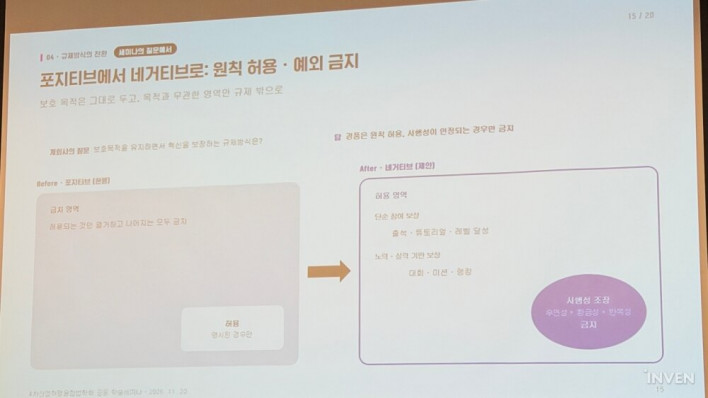
The solution proposed by Choi emphasizes steps that can be taken without amending the statute itself. The idea is to transition to a negative regulation system that explicitly defines and bans only specific types and methods of giveaways that encourage speculative gambling, while permitting the rest. He remarked, "If the problem started with an administrative guidance, we should reexamine that guidance and consider what can be fixed." However, he added that because legal precedents and administrative actions have accumulated since 2013, both the MCST and the Game Rating and Administration Committee (GRAC) find it difficult to intervene despite recognizing the problem. This formed the backdrop for his proposal to shift from a purely legal view of gambling risks to an economic perspective. Choi said, "We have not discussed the matter from that perspective until now."
Advisor Kim Jong-il outlined a concrete pathway, suggesting the industry utilize the Fair Trade Commission's (FTC) "pro-competitive regulatory reform process." Since identifying competition-restricting regulations is a key performance indicator (KPI) for the FTC, he noted there is room to table game giveaway regulations as a target for reform.
The biggest barrier remains the executive branch. Lee Do-kyung, Secretary General of the Youth Foundation, remarked, "There is hardly any clause that evokes as much resistance from the executive branch as the giveaway regulation." He emphasized, "This issue can never be solved without overcoming the MCST's stance and without persuading game users," suggesting that political negotiations might be necessary. Given that few statutes draw as much pushback from users as the Game Industry Act, winning over game users was also highlighted as a key challenge.
Pointed critiques were also made regarding the industry's arguments. Han Myeong-gwan, President of the 4th Industrial Revolution Convergence Law Association, noted in his closing remarks that government officials have an "allergic reaction" to giveaways due to lingering trauma from the Sea Story scandal. He pointed out that industry data "lacks compelling material to persuade public officials," calling for concrete examples such as how overseas jurisdictions regulate game giveaways.