
On November 20, legal and academic experts gathered to examine the shifting boundaries of game regulation being challenged by AI and illegal private servers. The central question was how to fill the regulatory gaps in user and rights protection as technology crosses traditional legal boundaries.
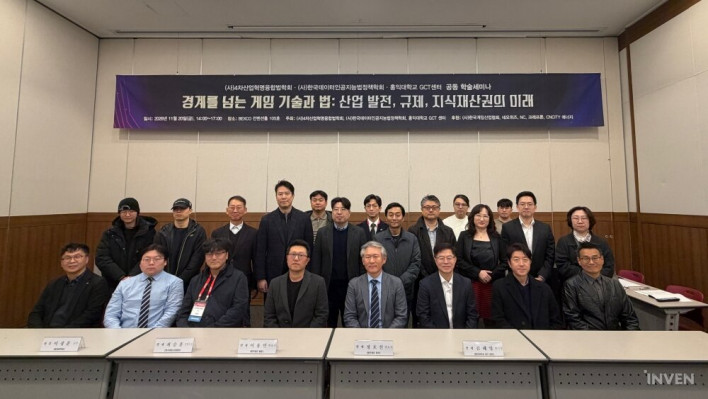
The Korean Association of 4th Industrial Revolution Law, the Korean Association for Data and AI Law and Policy, and the Hongik University GCT Center hosted a joint academic seminar titled "Crossing Boundaries: Game Technology and Law" at BEXCO in Busan during G-STAR 2026. Keynote presentations addressed sanctions against illegal private server users, whether AI chat apps qualify as game products alongside the EU Product Liability Directive, and game copyright protection in the AI era.
Attorney Lee Yong-min of Yulchon LLC pointed out that user sanctions are currently missing from measures against illegal private servers. The current Game Industry Promotion Act (hereinafter referred to as the Game Industry Act) only penalizes operators who build and provide private servers or distribute related software, while using such servers is not listed among prohibited activities. Punishments for operators are also light. According to data from Representative Im O-kyeong's office (submitted by the Game Rating and Administration Committee) presented by Attorney Lee, approximately 170,000 illegal private server cases were detected between 2019 and 2025, but only 61 individuals were punished, with 56 receiving only fines or suspended sentences.
Bills containing provisions to penalize users have been introduced every year since 2023, but none have passed the National Assembly. The pending comprehensive amendment to the Game Industry Act proposed by Representative Cho Seung-rae also lacks relevant provisions. Attorney Lee noted, "Instilling the awareness alone that users can face penalties for using private servers carries significant meaning."
Attorney Jeong Ho-seon of Yoon & Yang LLC concluded that AI chat apps such as Wrtn's 'Crack' and Scatter Lab's 'zeta' are difficult to classify as game products under the Game Industry Act. Even if they feature game mechanics like affinity, stats, or loot boxes, their text-accumulating structure means they fail to meet the "video content" requirement for game products. The issue is that if they are not recognized as game products, user protection provisions under the Game Industry Act do not apply to them. Attorney Jeong noted that while the "Relational AI Service" bill introduced by Representative Lee Ju-young fills much of this legal gap, its chances of passing are low due to provisions inconsistent with other laws.
The aspect Attorney Jeong emphasized most was the EU's new Product Liability Directive (PLD). The updated PLD includes software as a product and recognizes harm to mental health as compensable damage. This implies that addictive game design could be challenged as a product defect, while continuous updates and patches in live-service games could serve as grounds for ongoing liability. Attorney Jeong urged domestic game companies planning to expand into the EU to prepare from a compliance perspective ahead of its implementation next month.
The final presentation covered game copyright research by Director Kim Hye-young's team at the Hongik University GCT Center, presented by Park Jeong-min, a doctoral student in the Department of Game Design at Hongik University. The research team is studying technologies to track relationships between original works and derivative works using hashing, watermarking, and AI similarity analysis. However, a limitation remains that even when technology quantifies similarity, those numerical results do not automatically serve as legal proof of infringement. The team suggested documenting the origin of assets and the scope of AI usage starting from the development stage.
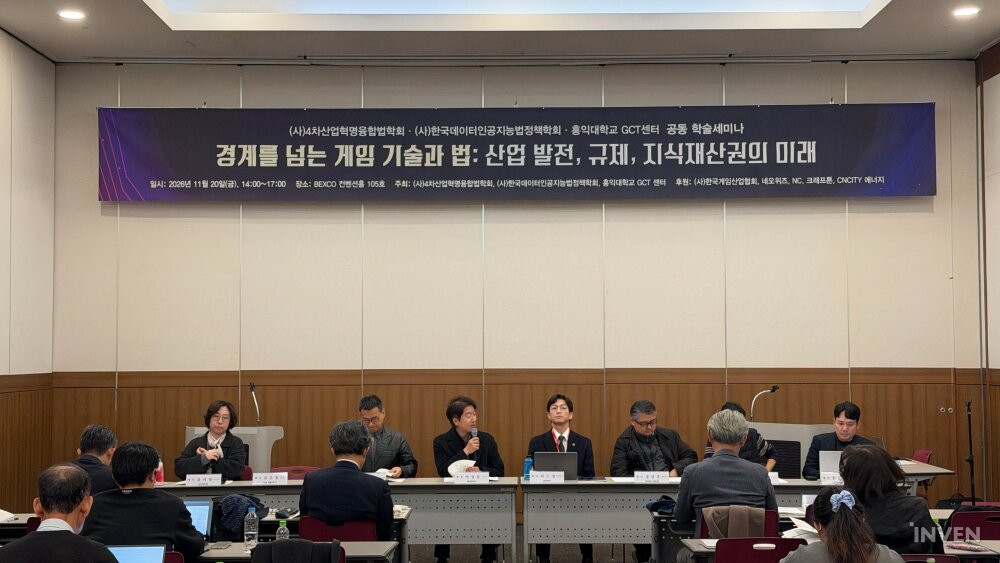
During the panel discussion, opinions were most divided over penalizing private server users. Lee Do-gyeong, Secretary General of the Youth Foundation, shared that when drafting the initial private server punishment bill in a congressional office during the 20th National Assembly, they attempted to include user penalties, but dropped them due to pushback from the National Assembly Legal Bureau. He noted that recent review reports on proposed bills have turned positive, making passage possible this time. However, he argued that liability should be differentiated between simple access, unwitting use, repeated intentional use, and active involvement in server operation or real-money exchange.
Kim Jong-il, Senior Advisor at Yoon & Yang LLC, suggested that grounds for sanctions can be found in the fact that, unlike users who illegally download movies or music, private server users interact with illegal operators in near real time.
A cautious stance was also voiced. Attorney Jeong Sang-hoon of Bae, Kim & Lee LLC stated that server operation and simple usage carry different degrees of responsibility and must be approached separately. Professor Hong Jun-ho of Sungshin Women's University pointed out that tracking operators is difficult in the first place due to overseas servers and cryptocurrency payments. He questioned whether creating new penalty regulations or overhauling the investigation and criminal proceeds recovery system is more urgent.
Regarding AI chat apps, panelists criticized regulations for failing to keep pace with reality. Guest Professor Kang Ji-myeong of Dongguk University noted that high school students are directly developing AI chat apps, paying API costs to operate them, and even creating merchandise featuring chat characters modeled after popular game characters to sell overseas in places like China. He remarked, "It feels as though the scope that state regulation believes it controls doesn't even exist in our minds," admitting that society is ultimately forced to rely on developers' ethics.
Opinions also continued over classification criteria. Secretary General Lee countered that using the lack of screen changes without user input as a decisive criterion for defining game products makes it difficult to account for turn-based titles like Fire Emblem or text-heavy games like Disco Elysium. Attorney Jeong Sang-hoon added that stakeholders must consider whether traditional pre-rating classification systems fit real-time generated content, as well as how to respond when AI analyzes user spending patterns to induce excessive microtransactions.
During the copyright presentation, voices questioned the premise of focusing solely on "AI". Senior Advisor Kim noted that discussions surrounding modding date back 25 years to the StarCraft era, suggesting that defining it specifically as an "AI-integrated environment" might be somewhat excessive. Professor Hong asked which factor among accuracy, error rate, reproducibility, and explainability must be tested most strictly if AI similarity analysis is to be used as legal evidence. Citing the Dark and Darker case, where the court recognized trade secret infringement rather than copyright infringement, Secretary General Lee suggested that asset provenance management templates and technical assessment support are needed for small and indie developers.
Attorney Jeong Sang-hoon remarked that rather than merely debating how far to expand the boundaries of games, "we must jointly consider what, why, and how to regulate." In his closing remarks, session chair Professor Lee Jeong-hun of Chung-Ang University School of Law observed that unclear legal boundaries, stretching like rubber bands, have created uncertainty and contraction within the industry. He concluded, "Someone drew a line, but game technology and the law are crossing back and forth over it".