Pachinko is a subject commonly encountered in Japanese manga and anime, but rarely touched upon in Korea. Ever since that fateful scandal years ago that choked the life out of Korea's arcade game industry, even bringing up the topic has been approached with caution. In fact, when I first started as a reporter, I was explicitly trained to avoid any words associated with such elements. Just typing that word a moment ago brings back a flash of memories of how hard I consciously tried to avoid terms like "slot machine," "slot," or "pachinko."
Generally, media depicting such themes—and the characters involved in them—hardly present a healthy image. They tend to follow a typical pattern of habitually killing time or greedily chasing a big payout only to lose even more. It is no easy task to embrace such a subject so boldly, let alone set it in a life-or-death game while keeping the experience lighthearted and enjoyable.
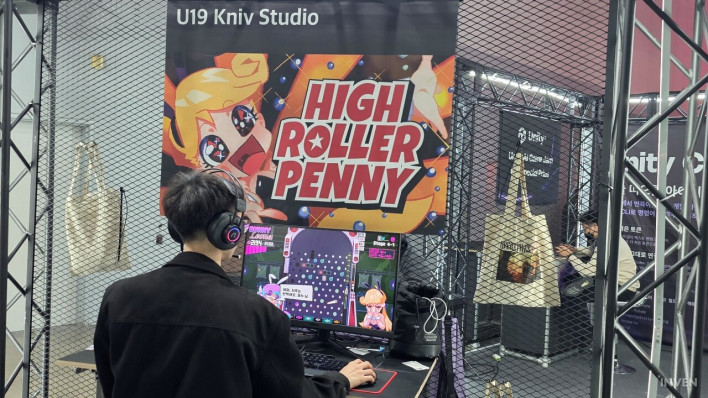
Kniv Studio, which garnered attention from indie fans with 'Stardust: Wish of Witch', showcased its newest title tackling this genre at G-STAR 2026: 'High Roller Penny'. While their previous title was a classic SRPG centered around youth and fantasy tropes, this new project makes a striking impression with its starkly contrasting tone right from the start. As a debtor dragged into the underground gambling organization 'Yami Pachi', the protagonist must become the gambler for bunny girl Penny and face life-or-death pachinko battles. Matching this setup, the visual presentation features a sharp contrast between vibrant neon colors and dreary tones, delivering a distinct visual punch.

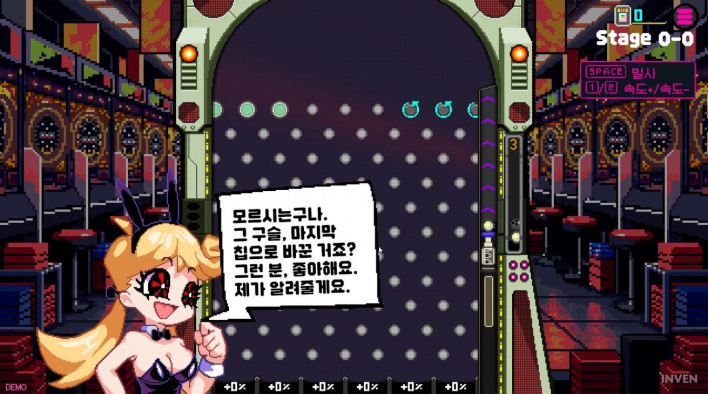

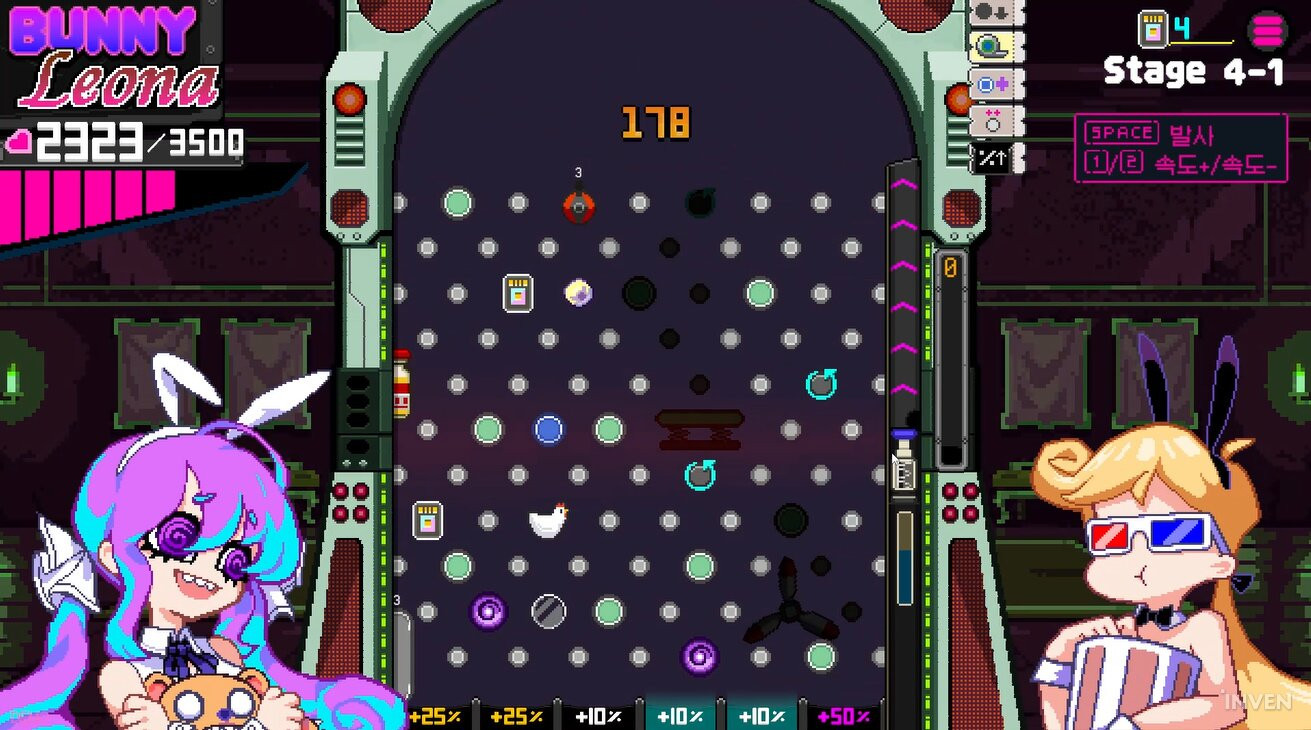
Following that initial impression, the gameplay loop unfolds in a remarkably intuitive fashion. Players use tickets to buy pegs with special effects, balls, or additional tickets, then pull back and launch a ball. As the launched ball bounces off pegs, points accumulate, and an additional multiplier is applied depending on which pocket it lands in at the bottom. The opponent's HP is reduced by the score earned, and reducing the opponent's HP to 0 or lower within a maximum of five attempts secures victory. Failing means instant death and restarting from the very beginning. Amidst all this, the unpredictable physics of where a ball might bounce combines with punchy kinetic feedback, making it impossible to look away.
Furthermore, the game avoids degenerating into pure luck by tightly weaving together three core build-up pillars: tickets, pegs, and balls. By placing pegs with special effects on the board, players trigger chain reactions whenever a ball bounces off them, combining different types of balls and ticket passive effects to skyrocket scores exponentially. In essence, it transposes the score-inflation roguelike formula—popularized by games like Balatro—straight onto a pachinko board. The spectacle of scores soaring vertically across the screen pairs with pachinko's distinctive visual feedback to unleash a massive hit of dopamine. In particular, peg positions can only be moved twice before starting a stage, and when those moves align perfectly to hit the jackpot, the rush is hard to put into words.
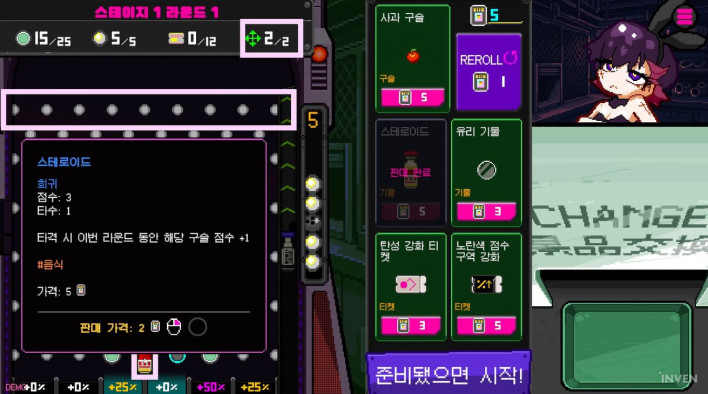
On top of this, a "cashing out" system acts as a key variable where players must use any means necessary to survive. When it is tough to clear the current round or funds are short for a desired build, players can liquidate owned pegs, tickets, and even their balls to raise cash. It forces players to run the numbers every round: abandon future scaling potential to survive right now, or take on risk to aim for a single big payout?
The rival debtors and bunny girls encountered in the back-alley casino also leave a strong impression by bringing their own tricks and gimmicks to disrupt the board state. Whether shifting peg positions each turn or randomly confiscating pegs, the ruthless nature of this gamble becomes clearer as you progress. As the required blood money to buy your life back escalates alongside it, both the tension and dopamine hits multiply.
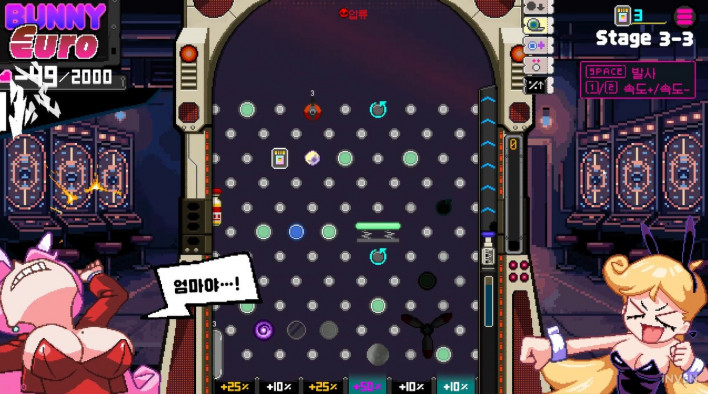
However, the inherent limitation of being a physics engine-based pachinko game introduces variables that are difficult to control. No matter how meticulously you position your pegs and design your synergies, subtle physics calculations and bounce angles can result in wide score variance. Crafting a solid build only to watch the ball drop into an unintended blind spot can feel far more frustrating than in a standard card deckbuilder. Conversely, when synergies detonate and the ball bounces relentlessly across the board to inflate your score, the dopamine rush is equally massive. It is a structure that perfectly fits the classic gambling mantra of "high risk, high reward." That said, balance issues like builds capable of generating near-infinite scores are still present, so polishing based on demo feedback will be essential.
Blending B-movie flair like bunny girls and an underground pachinko casino with intuitive rules, roguelike mechanics, and score-inflating dopamine, 'High Roller Penny' doesn't require lengthy explanations. Its structure is that straightforward, and the gameplay is even easier to grasp. That simplicity allows its sensational flavor to hit hard and unleash pure dopamine. While temporary bunny girl stand-ins are currently holding down placeholder spots ahead of full release, playing it at G-STAR 2026 naturally leaves you wondering what awaits on January 12 when those spots are fully filled.