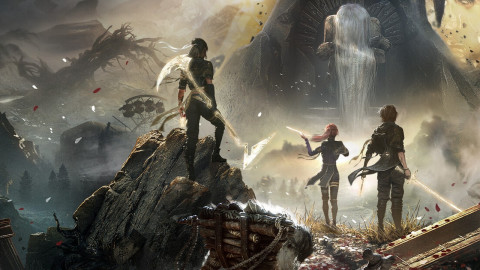
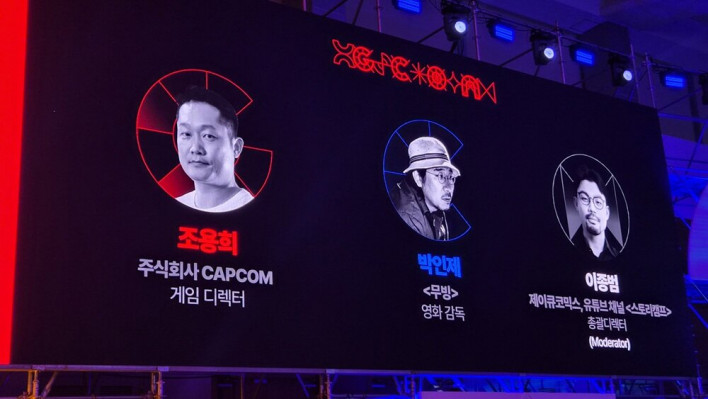
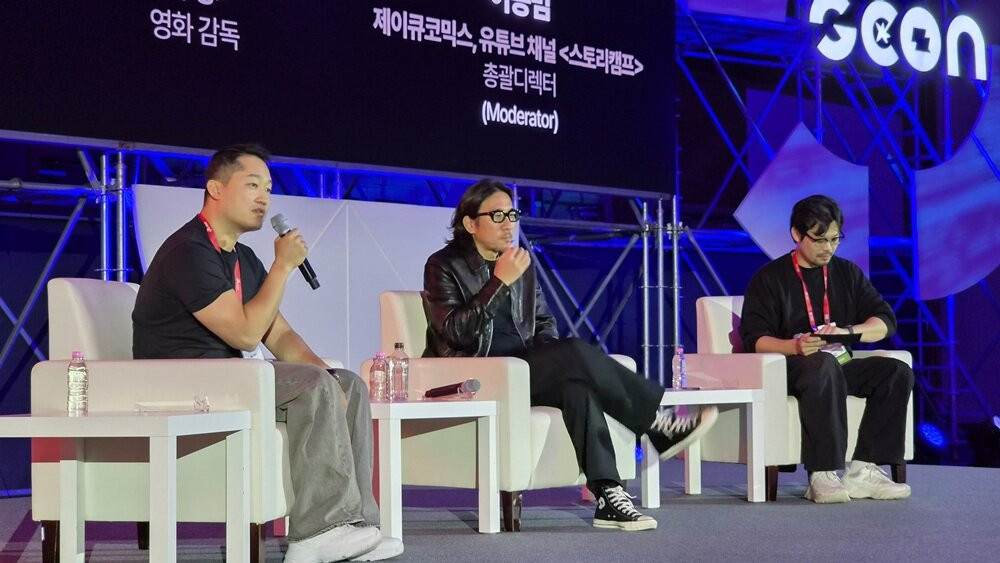
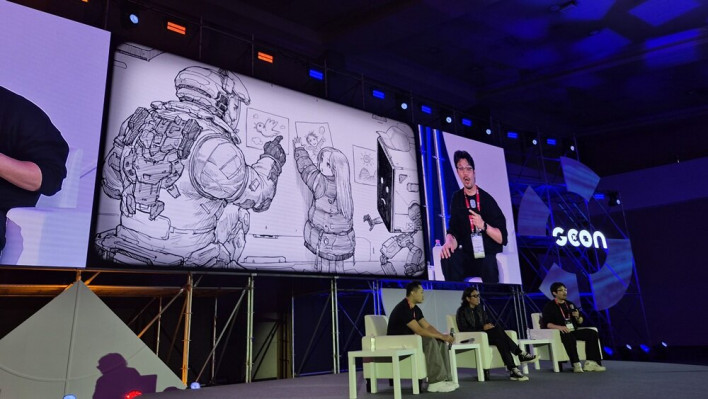
On the 19th, a unique session took place at GCON 2026, held at BEXCO in Busan. Yonghee Cho, director of Capcom's 'Pragmata', and Park In-je, director of the series 'Moving' and 'Kingdom' Season 2, took the stage, moderated by webtoon artist and storyteller Lee Jong-beom. The talk was themed 'How to Create Characters Who Outlast the Plot.'
The atmosphere was quite different from a typical developer presentation. As fans of each other's work, the three panellists started from prepared questions and naturally bounced off one another's stories. They praised each other's projects, shared behind-the-scenes stories, discussed character emotions with sincerity, and burst into laughter over unexpected jokes. Though working in different mediums—gaming and film—their struggles and joys in crafting stories were strikingly similar.
Rather than summarizing key points like a standard news report, this article presents the session through the dialogue shared by the three creators. For readability, the conversation has been organized into major themes, with repetitive expressions and colloquialisms slightly polished. However, the flow of questions and answers, spontaneous reactions, and jokes have been preserved as close to the original conversation as possible.
※ The following is an edited transcript of the panel discussion based on on-site audio recordings, organized by topic. For readability, repetitive remarks and filler words have been trimmed and some sentences refined, while fully maintaining the intent and flow of the conversation. Note that it contains major plot details and spoilers for 'Pragmata', 'Moving', and 'Kingdom' Season 2.
Where Does a Story Begin? A Director Seeking Novelty, A Game Director Starting from Situations
Lee Jong-beom: Today, we have two guests working in different fields: gaming and film. Even backstage, the vibe was fantastic as they kept praising each other's work. Director Park In-je is a fan of Capcom, and Director Yonghee Cho is a fan of 'Moving'. Since both have daughters, they spent quite a while talking about their kids as well. We've been jokingly calling this 'middle-aged guys' girl talk.' (Laughs)
My first question is about how you start a project. Some creators begin with characters, while others think of scenes or world-building first. Which side are you on, Director Park?
Park In-je: Ever since film school, I had a strong desire to do something new. In 'Moby Dick', I made a story centered around a reporter; in 'Kingdom', a drama about zombies; and in 'Moving', a full-fledged superhero narrative. At the time, there weren't many domestic works tackling those subjects.
Once I choose a new genre or story, I spend a lot of time contemplating the character's occupation. Then, when writing the script, I do hypothetical casting. Regardless of whether they can actually star in it, I write with a specific actor in mind. That way, their face, habits, and demeanor bleed into the screenplay.
Lee Jong-beom: It's interesting that you start with occupations. In 'Kingdom', being a high official (Daegam) could be considered a job too. Since they have to commute to Gyeongbokgung Palace, you could almost call it a specialized career. And depending on how many servants they have, it might determine whether they're a small-to-medium business or a major corporation. (Laughs)
How about you, Director Cho? In 'Pragmata', the relationship between the two main characters, Hugh and Diana, is crucial. Did you conceive both characters right from the start?
Yonghee Cho: Rather than characters, I tend to set up a situation I like first and then place fitting characters into it. For 'Pragmata', it started out as a story featuring just a man. It was a situation with Hugh all by himself.
But then I thought, wouldn't that be too lonely? At first, I tried to make a sci-fi game about building a friendship with a floating machine like a drone, but when I thought more about it, it didn't seem very entertaining.
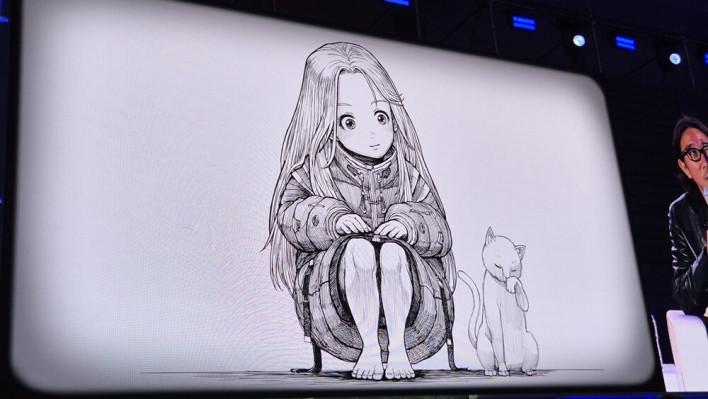
So I decided to create a more lovable character. First it was a dog, then we considered a cat, and various other animals. However, scenes where animals get shot or put in dangerous situations are difficult to depict in a game. It naturally put too many restrictions on gameplay. Eventually, it evolved into a human-looking robot, and that's how Diana was born.
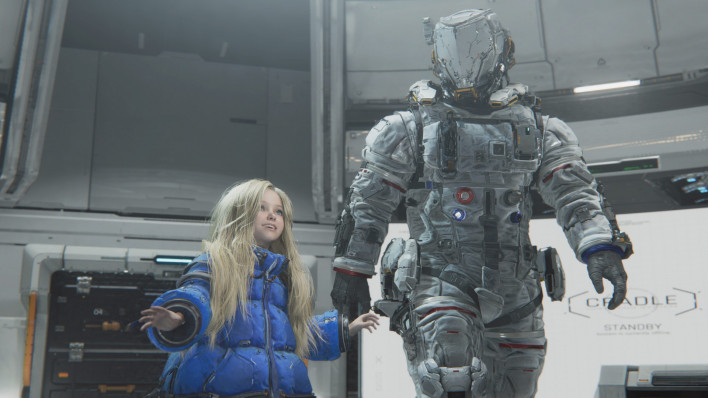
Lee Jong-beom: So an animal getting shot is off-limits, but a robot that looks like a little girl is okay? It sounds a bit odd when you think about it, but as part of game development, it's a completely understandable dilemma. (Laughs)
The Conditions for a Compelling Character Director Yonghee Cho on the Appeal of a 'Pitiful Character'
Lee Jong-beom: As time passes, people often forget details of a plot but remember specific characters for a long time. What do you think is required to make a character compelling?
Park In-je: That's a really difficult question. Charm or appeal is often judged after the fact. If a project becomes a huge hit, its characters are remembered for a long time. Of course, every creator strives to make compelling characters, but I think the criteria vary based on personal taste or the specific work.
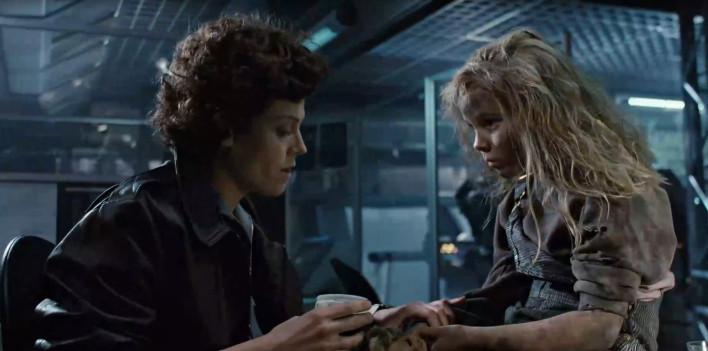
However, when I played 'Pragmata' and saw Diana's initial appearance, a scene from 'Aliens' came to mind—the moment Sigourney Weaver's Ripley discovers the young girl Newt. I think people feel drawn to characters who evoke a desire to protect them like that.
Lee Jong-beom: You're praising Director Cho again! You two really take every chance to compliment each other. (Laughs) What about you, Director Cho? Do characters you like share any common traits?
Yonghee Cho: When I thought about this question, I realized I do have a precise common thread: pitiability. I think empathy or compassion for a character is essential.
I like characters that make you feel deeply sorry for them, wishing things would turn out well and that they could find happiness. It doesn't matter whether they're a hero or a villain. When you see a character like that, you wonder what will happen to them next and if they'll find even a bit of happiness. That's how you grow attached to them.
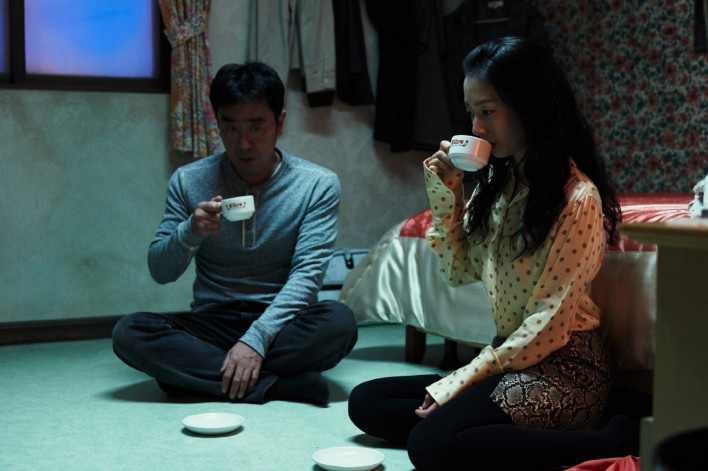
That's why when watching 'Moving', I loved Jang Ju-won, played by actor Ryu Seung-ryong. He was so pitiful. Watching him endure so many hardships, I kept thinking, 'I really hope this man finds happiness.'
Lee Jong-beom: Did the final scene of 'Pragmata' stem from that line of thinking as well? The scene where Hugh sends Diana away on the cargo transport shuttle was extremely memorable.
Park In-je: I wanted to ask about that scene too. In 'Moving', Jang Ju-won's storyline was a sequence I directed with the deliberate intention of creating genuine melodrama. For the final scene in 'Pragmata', did you intend that emotional impact right from the start? Or were there alternative endings?
Yonghee Cho: The ending was fixed from early in development. The point I stressed most strongly to the team was that this story had to be about Hugh being a pitiful figure. I kept emphasizing that by the end, players needed to cry for Hugh.
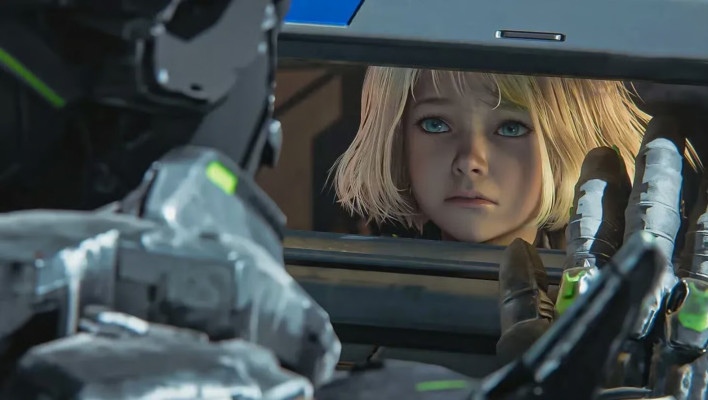
Lee Jong-beom: Then I think you succeeded completely. People with daughters would have resonated with it especially, but even for someone like me without a daughter, that emotion hit tremendously hard.
How to Build Relationships That Stay with Readers Hugh and Diana's Evolving Dynamic, and Relationships Crafted by Actors
Lee Jong-beom: Let's talk about character relationships next. Nowadays, many people love dynamics where characters dislike each other at first and gradually grow closer. Do you meticulously design relationships like that from the planning stage, or do they often form naturally as you work?
Yonghee Cho: Actually, Hugh and Diana were originally meant to start with a strained relationship. Hugh didn't trust robots, so he suspected Diana, but they had no choice but to travel together.
However, expressing that relationship naturally in a game proved to be quite difficult. In movies or comics, the creator can convey intended scenes and emotions directly to the audience, but in a game, players build their experience through their own actions.
Because of that, the relationship portrayed in the story must align with how the player actually feels. Conveying the transition from distrust to trust through gameplay required a significant amount of time. In the end, we shifted toward a simpler approach.
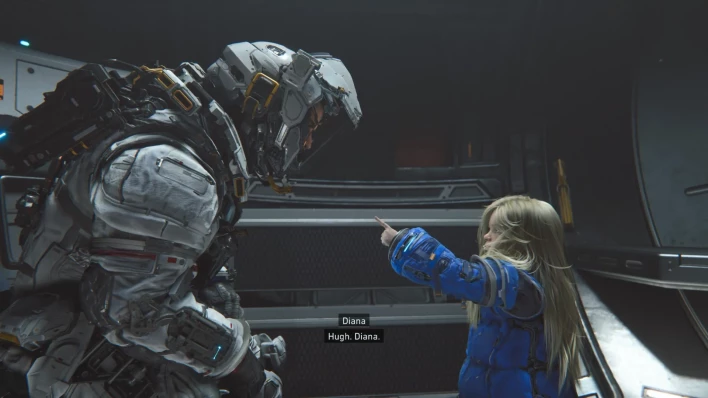
Lee Jong-beom: But I heard that the idea for the final scene—where Hugh sends Diana off on the spacecraft—came from Director Shoji Kawamori of 'Macross' fame.
Yonghee Cho: That's right. Originally, we brought him in to consult on sci-fi settings. We wanted to ask technical questions—like what kind of things are possible on the Moon, or whether specific action moves are feasible in different gravity environments. But contrary to expectations, he gave us many ideas regarding the story and direction. We ended up receiving huge help from an unexpected angle.
Lee Jong-beom: How about you, Director Park? Do you tend to design character relationships from the start?
Park In-je: Apologies for complimenting him again, but it's been a long time since I played a game like 'Pragmata' where you could truly feel the bond between characters.
In film and drama as well, relationships are something you must constantly keep in mind. Without interpersonal dynamics, a story can't move forward. However, in film, a huge portion of those relationships is shaped by the actors.
For example, if you were to shoot a scene of Hugh and Diana conversing for a film, the dynamic could completely change depending on who is cast. So casting isn't just a matter of hiring famous actors. Finding actors who fit the characters is one of a director's most important duties.
When actors perform brilliantly, they can create relationships far richer than what I wrote in the script. People even say over 80% of directing performance is decided by casting.
Lee Jong-beom: In that case, relationships might also shift on set when actors pitch ideas or deliver unexpected performances.
Park In-je: Absolutely. If an actor suggests a better idea, we embrace it on set. However, the fundamental direction is thoroughly agreed upon beforehand. Actors are professionals and so are we. They show up to set with far more preparation and thought than people might imagine.
It's not like in movies where the director suddenly gets furious or yells at actors all the time. Real film sets are often far less dramatic than people think.
Lee Jong-beom: That shatters a few movie myths! (Laughs) In games nowadays, actors also do motion capture alongside voice and facial acting. What is the casting process like?
Yonghee Cho: We also cast real actors to do motion capture and facial performance together. Sometimes schedules don't align because actors are working on other projects.
So we first ask them to send sample voice recordings. We listen to them, and if it feels like 'This person is the Hugh I envisioned' or 'This voice is Diana,' we make the casting decision.
Same Story, Different Languages Player Experience and Serendipity on the Film Set
Lee Jong-beom: Gaming and film tell stories using different tools. First to Director Cho: When do you think players feel connected to a game character as if it were themselves and get immersed in the story?
Yonghee Cho: Games have cutscenes and active gameplay segments. Surprisingly, a lot of players skip cutscenes. As developers, we put hard work into them and hope players watch until the end, but players just want to jump straight into playing.
To be honest, I skip cutscenes when I play other games too. (Laughs)
So I believe the moment of deepest immersion comes not from cutscenes, but during active gameplay itself. As players hear character dialogue or encounter events while playing, emotional resonance naturally gets conveyed.
In 'Pragmata', we tried not to make cutscenes overly long. Instead, we worked to express their relationship through conversations with Diana in the shelter, chatting while moving, or talking during combat.
Lee Jong-beom: That was exact aspect I really loved. While tinkering with gear in the shelter, Diana suddenly shows a drawing she made. It wasn't a cutscene constructed specifically to force an emotional reaction, but something that happened naturally while playing, which made it all the more memorable.
Yonghee Cho: To be honest, I didn't think that scene would be so moving. But player reception turned out to be overwhelmingly positive. I was surprised myself.
Lee Jong-beom: Diana drew a picture of *me*—how could that not be touching? (Laughs) But who actually drew that picture? Was it your daughter, Director?
Yonghee Cho: Originally, I wanted to include a real child's drawing. So I asked team members to bring in drawings done by their kids at home. We held an internal audition of sorts to pick one, but sadly, not a single one was chosen.
Asking children to draw something with a specific intent turned out to be harder than expected. In the end, a first-year junior developer drew a picture mimicking a child's art, and that's what made it into the game.
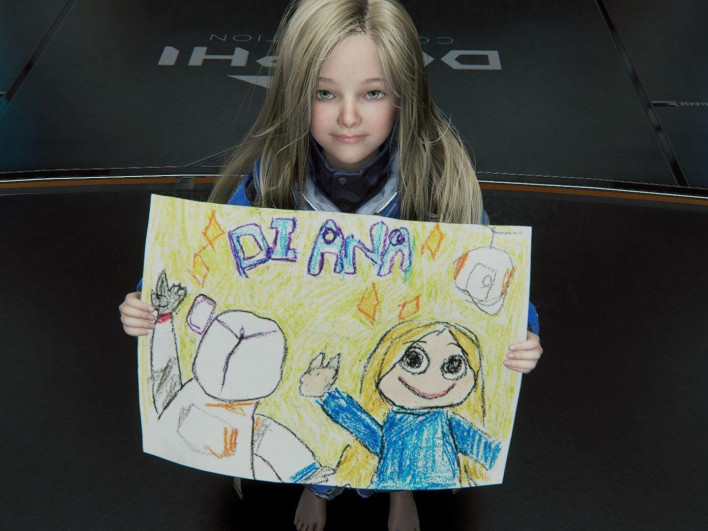
Lee Jong-beom: So every actual child's drawing was rejected, and a drawing by a junior developer pretending to be a kid got picked instead! (Laughs)
Yet thanks to that relationship, collectibles felt completely different. Collecting items can often feel stressful, but in 'Pragmata', it felt like giving gifts to Diana. You want to decorate her playroom and get her a swing set.
Director Park, what do you focus on most when conveying character emotions in film?
Park In-je: That's a really tough question. Film shoots involve far more variables than you might expect. People often describe sets as battlefields, and that's genuinely true.
However, I actually love moments when unexpected outcomes occur. Earlier, Director Cho mentioned how Diana's drawing received a better reaction than anticipated. The same thing happens frequently in filmmaking.
For example, in 'Moving', there's a scene where actor Ryu Seung-ryong collapses in tears at a funeral home. To film that scene, we secured an actual funeral hall, but renting an entire funeral home is harder than you'd think.
At first, it was empty so we could shoot, but during filming, two real funerals actually arrived. We couldn't cause any disturbance to the grieving families, so we had to shoot as quietly and quickly as possible.
While we originally planned for a long take, time on set became extremely tight. So as we quietly tracked with the camera, actor Ryu Seung-ryong broke down sobbing, to the point where his pants even slipped down.
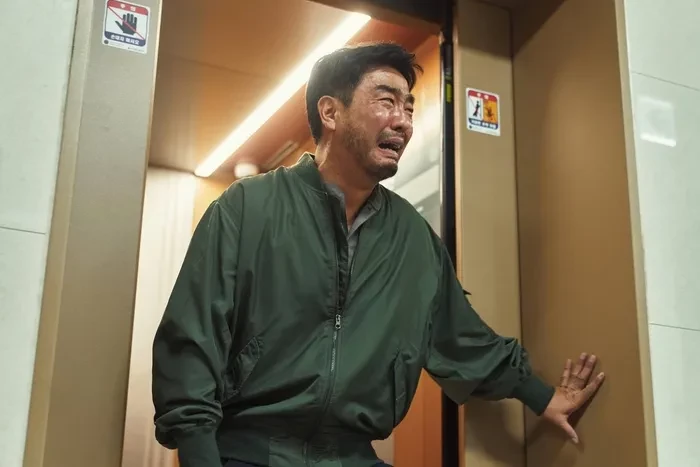
Lee Jong-beom: So that famous scene was born under those circumstances.
Park In-je: Yet watching it on the monitor during filming, I had my doubts. It felt almost too direct in throwing raw emotion at the audience. I wondered if throwing tears straight into the viewer's face would truly land as sad.
Lee Jong-beom: In baseball terms, you threw a fastball, but it turned out to be a 200 km/h fastball! (Laughs)
Park In-je: Exactly. It connected far more powerfully than anticipated. I think that unpredictability is the joy of creation. Outcomes turn out different from initial plans, and those often become even better scenes. That inability to perfectly predict the outcome is the driving force that keeps me making movies.
Inspiration Drawn Across Different Media From 'Asura's Wrath' to 'Kingdom'
Lee Jong-beom: Now let's talk about drawing inspiration across different mediums. Director Park has enjoyed games for a long time, and Director Cho is a massive film buff. First to Director Park: Have you ever taken inspiration from a game and incorporated it into a movie or drama?
Park In-je: Games have gotten so difficult nowadays that I hesitate to call myself an ardent gamer. (Laughs) I love classic games. I'm especially fond of Falcom's 'Ys' series. I've played since titles like 'Ys II', back when we loaded games from MSX computers or cassette tapes.
Those experiences accumulated over time to shape who I am today. The fantasy, knighthood, and adventure stories I loved as a kid influenced my filmmaking as well.
To give a specific example, there's 'Kingdom' Season 2. You remember the scene where Lord Ahn Hyeon turns into a zombie and charges at Cho Hak-ju, charging forward relentlessly despite taking endless attacks? The game that inspired me when creating that scene was Capcom's 'Asura's Wrath'.
When playing games, I sometimes skip cutscenes, but I really enjoy watching trailers—like those for 'Diablo' or 'Cyberpunk 2077'.
The trailer for 'Asura's Wrath' was truly mind-blowing. Asura sprints forward while enduring a barrage of attacks, and a colossal figure from space presses down with a giant finger. The imagination was so overwhelming that I watched it over and over again.
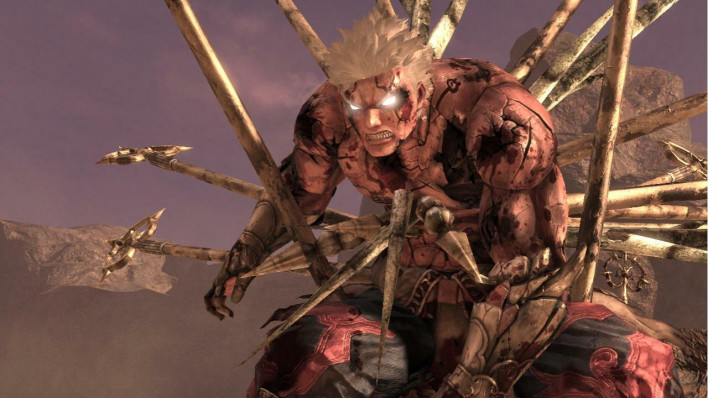
That lingering impression eventually led to the scene in 'Kingdom' Season 2 where Lord Ahn Hyeon charges forward while under attack.
Lee Jong-beom: That's such a rare story. Unless hearing it directly from the creator, nobody would have guessed that iconic 'Kingdom' scene was influenced by a Capcom game.
Park In-je: Film draws inspiration from countless mediums. It could be a short phrase from classical music, a line of poetry, a novel, or a painting. For me as well, experiences accumulated from gaming and other media often get re-expressed in new forms.
Lee Jong-beom: Director Cho, have you conversely been heavily influenced by movies or television?
Yonghee Cho: I've loved movies since I was young. When I was in elementary school, I'd go to the video rental store every weekend and rent about eight tapes. From Saturday morning until Sunday night, I did almost nothing but watch movies.
I loved animation and manga too, but movies provided the biggest inspiration. They heavily influenced how I craft stories, characters, and world-building. When creating 'Pragmata', I referenced scenes from many movies I've watched over the years.
Lee Jong-beom: That brings up an interesting question. Cutscenes could be seen as translating cinematic visual grammar directly into games. But as mentioned earlier, players often skip cutscenes. So in games, weaving narrative into active gameplay must be far more crucial. How do you approach that?
Yonghee Cho: Game and film storytelling appear similar on the surface, but they differ fundamentally. In film, the audience absorbs the story as a third-party observer, whereas in a game, the player experiences the situation firsthand.
Therefore, narrative design in games must be grounded in player experience. If a developer attempts to tell the entire story through cutscenes alone, it's likely to fail—because players might not watch them.
Of course, cutscenes are effective for conveying essential information. But the ideal method is enabling players to absorb the story naturally as they play. We try to deliver character dynamics and emotions through that process whenever possible.
Lee Jong-beom: For a storyteller, games sound like a challenging yet deeply fascinating medium. Showing imagery and playing dialogue isn't enough; you have to embed the story within the experience of player agency.
We actually had one more topic prepared, but time has almost run out because the conversation was so engaging. Let's wrap up with closing thoughts from each of you.
Park In-je: I feel like a successful fan today. Being able to sit down and talk with a director who creates games for Capcom—a studio I've loved since childhood—is an immense honor. I had a wonderful time today, and thank you for having me.
Yonghee Cho: Same here—I genuinely feel like a successful fan. In fact, this is my first time visiting G-STAR in my life. Coming to Korea to attend G-STAR and meeting fellow game developers in person whom I'd only seen on YouTube was an incredible experience.
I've also been subscribed to Author Lee Jong-beom's channel for nearly ten years, and 'Moving' is a show I deeply love. Sitting down to talk with people I admire was an absolute joy.
Lee Jong-beom: Because of the name GCON, people might imagine an academic or dry conference talk. But today was really a delightful chat among three enthusiasts who genuinely love each other's work.
It also reaffirmed that while working in different fields like games and film, the fundamental quest to craft memorable characters and stories isn't so different after all. Thank you to everyone who joined us.