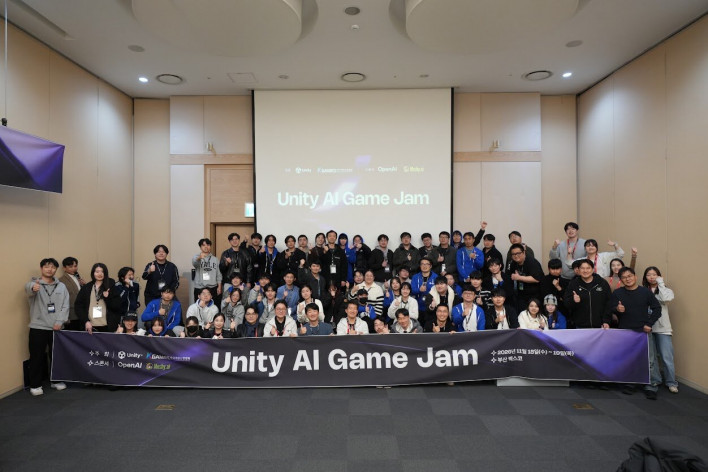
Unity, in co-organization with the Korea Association of Game Industry, hosted the Unity AI Game Jam—a non-stop 24-hour hackathon—at BEXCO in Busan from November 18 to 19. Kicking off the day before the opening of G-STAR 2026, the event gathered 54 creators selected through a document review to build games within a limited timeframe using various AI tools, including Unity CLI and the Codex plugin.
The top honor, the Unity AI Game Jam Winner award, went to Swing & Swing by Team Byeolkkot, which took first place in the on-site popularity vote. Combining 2D and 3D elements, the game earned high praise from fellow creators and mentors for effectively expressing the event's core theme of collaboration.
Lim Eun-soo, leader of Team Byeolkkot, shared her thoughts: "Because it was held alongside G-STAR, just participating was meaningful, so I'm thrilled to win an award. There were so many experienced industry professionals here that I'm still stunned, from being selected to winning."
Category special prizes were also announced. The Unity CLI Special Prize went to Colla-Zoo by Team Slipper Hunter, which actively integrated Unity CLI throughout the entire development process, from prototype building to custom tool creation.
The OpenAI Special Prize was awarded to Dungeon Tycoon, developed by Team We from Another Star. OpenAI praised the game for turning the theme of collaboration into a core gameplay element, as "heroes" inside a player-created dungeon engage in conversations and make tactical decisions on their own judgment.
Dungeon Tycoon is a simulation game in which a party of AI "heroes" makes autonomous decisions to battle the "Demon Lord" inside a user-designed dungeon. The development team structured the system by pre-implementing actions the AI could take and having the OpenAI API only select which action to execute. As a result, they spent just $0.26 in API costs out of the $500 credit granted for testing.
Na Jae-heum explained, "I joined out of curiosity about how game developers collaborate in the AI era. The efforts we made to minimize token usage worked out well, making it a very satisfying development experience."
The venue was filled with enthusiasm from developers with diverse backgrounds. Kim Ji-min of Team Slipper Hunter, who majored in sculpture, had long been interested in blending art and games, and used this competition to develop a game incorporating AI.
Yang Myung-jin, a game planner for Team Yugoehan Sai and a former visual designer participating in his 38th game jam overall, cited a sharp instinct for curating ideas and decisive execution capability as key competencies for completing a game within a short timeframe.
Yang emphasized, "In a game jam where you must finish a game in a short time, having an instinct for what makes something fun, the judgment to select ideas with high fun potential, and the execution power to make them playable are more important than anything." He added, "I have taken on whatever roles the team needed, from planning to art, animation, and visual effects, and recently I've been expanding my boundaries by handling programming and game development myself using generative AI."
Participants who left game companies to strike out as solo developers also drew attention. Park Dong-jun of Team 'Ready, Co-?, Of course, -operation!' said, "While working as a developer at a game company, I realized that using AI could allow me to create various games quickly on my own, so I left to develop games independently. I joined to challenge how far I could go with AI in a short time and to see how other developers leverage AI."
The three winning games from the competition will be showcased to attendees at 'Unity World,' Unity's exhibition booth during G-STAR 2026. Each winning team will receive a one-year subscription to ChatGPT Pro in their respective category, along with interview opportunities on Unity's official global and Korean blogs.
OpenAI and Meshy.ai participated as official sponsors of the event. OpenAI engineers joined Unity mentors on-site to assist participants throughout the development process. OpenAI provided development credits, while Meshy.ai supplied credits to generate 3D assets from text and images. Unity also supported creative efforts by offering all participants $50 worth of credits to utilize Unity AI tools.