Turning a story where the protagonist falls into a game world and survives using their knowledge of the game back into a real game is trickier than it sounds. While Ash in the original work relies on his experience clearing 'Protect the Empire'—notorious for its brutal difficulty—as his weapon, players launching the game for the first time have no such prior knowledge. Striking a balance between the tension created by the fictional 'game' in the original work and the baseline expectations of new players is the key challenge facing 'I Became the Tyrant of a Defense Game: LAST STAGE' (hereafter 'Tyrant of a Defense Game').
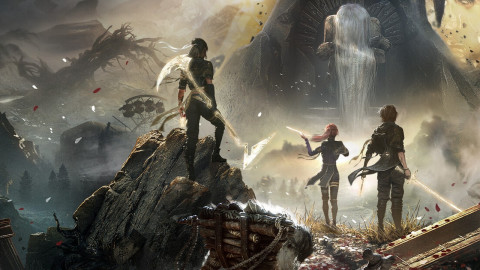
The G-STAR 2026 demo build offered part of that solution. The diorama pixel art, layering pixel-art characters onto 3D backgrounds, along with a gameplay loop spanning exploration, territory management, and defense battles, faithfully matched the atmosphere of the original work. However, for those expecting the novel's signature desperate battle for survival, the initial difficulty might have felt somewhat tame, and the pressure of racing against time until the next invasion was not prominently featured in the demo.
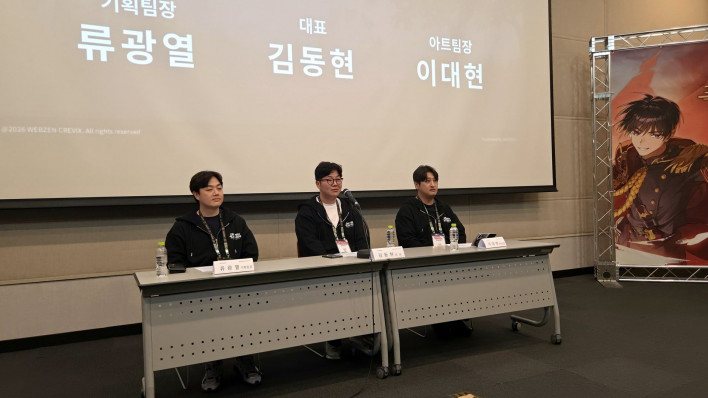
Was this gap an intentional choice? At G-STAR, we met with Webzen Crevix CEO Kim Dong-hyun, Lead Designer Ryu Kwang-yeol, and Art Director Lee Dae-hyun to hear more about the rationale behind the demo build, visual techniques used to complement pixel graphics, principles for maintaining lore fidelity, and the game's direction post-launch.
Translating the Original Through the Philosophy of 'Command' From Character Retirement Mechanics to Defense Battles and Difficulty Tuning
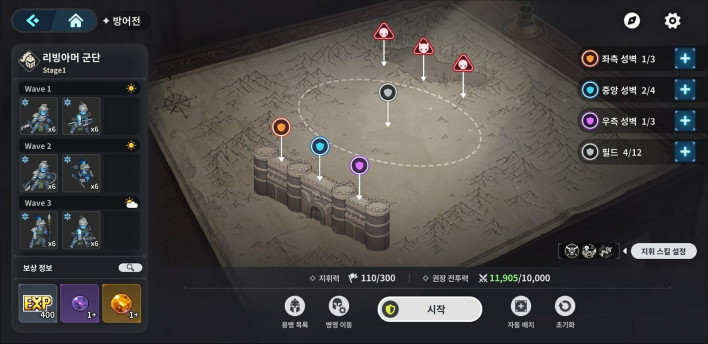
In the original work, a major draw was watching the protagonist, Ash, overcome crises using game knowledge known only to him. Is allowing players to make their own judgments and build strategies just like Ash designed to be the core fun of the game?
Ryu Kwang-yeol, Lead Designer: I take this as a question about our core gameplay appeal. We defined the genre as a 'command strategy RPG' and gave a lot of thought to how we could make players feel like they are truly 'commanding'. As a result, we felt that giving players choices at key moments in every content pillar—and delivering the satisfaction of proving those choices right—was the best way to define 'command.' As you mentioned, making the most appropriate choices for one's situation across various content elements is the core of commanding.
It seems you tried to faithfully follow the narrative of the original work. In the original story, there are major events such as companions dying or becoming retired. How did you implement these aspects in the game?
Ryu Kwang-yeol, Lead Designer: In the original work, there are many instances where things deviate from the intended path. However, if a character dies and becomes completely unusable in the game, we felt that would present a major obstacle that halts game progression. Thus, we chose an approach that captures the emotional resonance of the original without impeding progress. For characters who die or retire, we are considering adding a distinct visual indicator to their portrait in the in-game UI. Also, as you saw in the demo, characters following Ash engage in speech-bubble conversations matching their original personalities; we are planning to handle deceased characters separately in these casual dialogues so different lines appear. Of course, since some players might prefer not to see these dialogues at all, we plan to provide a toggle option in the settings.
The original web novel alone spans over 800 chapters, with side stories reaching 80 chapters, while the webtoon has reached 195 chapters across Season 2 before taking a hiatus. Given the vast narrative, how much content will be included at launch, and how do you plan to expand it afterwards?
Kim Dong-hyun, CEO: The launch build will cover up to the 'Evangeline' arc. After launch, we plan to continuously add stages through regular updates in line with the progression of the web novel and webtoon. Additionally, there are time skips in the original story, and we are preparing original story content to fill those gaps so the narrative flows seamlessly.
The original novel itself revolves heavily around strategy for repelling monsters. Does knowing the original story give players an advantage when playing the game?
Ryu Kwang-yeol, Lead Designer: Rather than 'advantageous,' 'familiar' would be a more accurate word. While we incorporated many environments that fans of the original will find familiar, knowing the lore won't serve as explicit gameplay hints or create a massive disparity. For players unfamiliar with the original work, we will implement various UI/UX features to ensure they can obtain all the necessary information within the game.
Given the content structure and hardcore gameplay, it gives the impression of a premium packaged game rather than a mobile live-service game. What are your plans for launch platforms and business model (BM)?
Ryu Kwang-yeol, Lead Designer: Making it feel like a packaged game was one of our key design goals, so hearing you say that makes us proud. As for platforms, we are planning for mobile and PC cross-platform play. Regarding the BM, since the original story revolves around various heroes, hero-collection mechanics will be included, similar to the original narrative's depictions. However, rather than setting high hurdles for acquiring heroes like conventional hero-collector games, we are designing system mechanics so that players who actively play the game can obtain all characters featured in the original work.
Which content pillar required the most effort during development, or caused the most deliberation?
Kim Dong-hyun, CEO: Initially, we put the most effort into Exploration. Because the title is 'I Became the Tyrant of a Defense Game,' most people focus on the defense aspect, but while reading the original novel, we felt that progression actually occurs through exploration and management, which ultimately feeds into defense. Since party composition and character growth stem from exploration, we placed immense importance on making exploration fun. The feature we deliberated on the most was Defense Battles. From the moment I first read the original work, I felt that large-scale battles with massive hordes of monsters were essential, and we spent a very long time figuring out how to implement that. There were various opinions, such as disappointment over not being able to deploy troops on top of the ramparts or suggestions to switch to a top-down view. However, after numerous trials, we decided that the current format best captures the sense of a grand defensive war. While Exploration took the most effort, Defense Battles definitely caused the most deliberation.
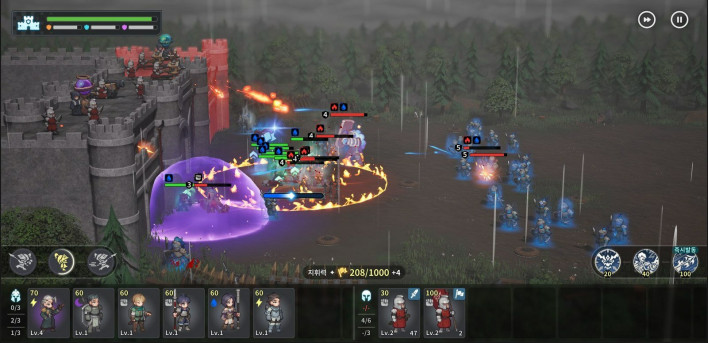
The original work depicts a desperate struggle for survival, but during actual gameplay, those dramatic elements felt somewhat muted. How did you structure the game to bring out the atmosphere of the original?
Kim Dong-hyun, CEO: We agonized over the difficulty level. We felt it would be difficult to showcase that level of desperation in the G-STAR demo build. If we spiked the difficulty to evoke desperation, it would have created significant frustration for players trying the demo on-site. In this version, we wanted to demonstrate how faithfully we adapted the original work and how we interpreted it. After all, showing everything right from the start would spoil the fun. We are preparing those hardcore content elements for later.
This is a unique work that drives the narrative through the bonds between companions rather than traditional romantic subplots. What discussions did you have with the original author when adapting this story into a game?
Kim Dong-hyun, CEO: Story and presentation were our top priorities. While the narrative is already familiar to fans of the original, we put great effort into delivering inter-character relationships and narrative arcs intact, focusing on how emotionally we could convey those scenes in-game to evoke the original feelings. So we hope you view this as building something different from existing adaptations. I'm not sure if we should speak for the author, but we thoroughly studied the original work and continuously sought the author's input throughout development, and the author is very pleased and supportive of our progress.
There are quite a few titles based on game-world settings. What was the reason for choosing 'Tyrant of a Defense Game'?
Kim Dong-hyun, CEO: We reviewed several works, but the moment I read this one, the game vividly formed in my mind. It didn't just feature defense; it encompassed diverse elements like exploration and territory management. Furthermore, even without romantic subplots, the bonds between characters and the narrative resonated deeply with us.
Overcoming Pixel Art Limitations Through Direction, Moving Forward into Live Service Camera Work, Original Art Presentation, and the Roadmap for CBT and Launch
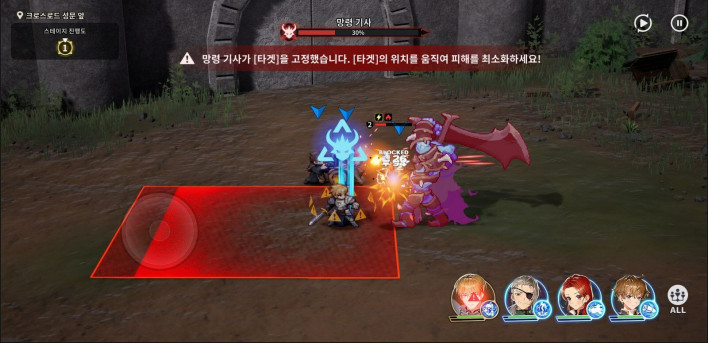
You adopted diorama pixel art, placing pixel characters on 3D backgrounds. The original work frequently features overwhelming giant monsters and flashy effects. What visual direction techniques did you research to complement elements that are difficult to express with pixel art?
Lee Dae-hyun, Art Director: Pixel art might not be the most ideal graphic style for expressing the deep, complex battles of the original work. However, to preserve that visual presentation as much as possible, we implemented large battlefields as 3D maps and made extensive efforts to scale up pixel assets so they convey a sense of grandeur.
Kim Dong-hyun, CEO: Trying to realize the battles we envisioned came with various constraints, but the solution we found was camera work. As a result, we have been studying camera angles used in film and video production. Even with pixel-art characters, proper camera work and presentation can effectively convey a sense of grandeur. Rather than trying to make the pixel models themselves massive, we use the surrounding environment and camera angles to expand the scale, while implementing 3D effects for flashier presentations.
Many games nowadays utilize AI during development. Is AI being used in the development of 'Tyrant of a Defense Game' as well?
Kim Dong-hyun, CEO: We utilize AI across all areas. However, we consider pixel art to be our core strength, so specialized artists are currently crafting every single frame by hand. It's not that we haven't tried AI for art, but it still cannot match the human touch. Therefore, we do not use AI at all on the art side; it serves as a support tool for design and programming.
In the original work, the remaining time until the next invasion is fixed, which creates tension. How is this mechanic applied in the game?
Ryu Kwang-yeol, Lead Designer: That is a very difficult question to answer. In the original novel, dates count down to the invasion like D-30, D-29, D-28, creating scheduling elements where players must complete exploration, training, and defenses within that window. In the early design stage, we included all of these elements, but we concluded that it turned the game into a schedule management game, which didn't align with our current direction. Therefore, in the current build, players face no time constraints while progressing through the main story. However, we agree that the tension you mentioned is a vital point. So instead of tying it to the main story or main quests, we plan to deliver that experience through a different content format. We will reveal that content through separate channels once it is ready.
Kim Dong-hyun, CEO: What you saw in the demo represents the story-driven mode. Elements from the original work where you might wonder, 'How will this be implemented?' are mostly planned for development as new standalone or seasonal content.
The characters' faces are already visible on the pixel models, yet original artwork portraits also appear inside the speech bubbles. Did you have much deliberation over this design choice?
Lee Dae-hyun, Art Director: We agonized over that as well. First of all, we determined that there are limits to character expression with pixel art alone. Therefore, to ensure distinct character recognition, we added 2D artwork portraits inside speech bubbles alongside the pixel sprites.
Kim Dong-hyun, CEO: As mentioned during the presentation, we wanted players to feel the emotions, but subtle facial expressions like frowning were difficult to distinguish on pixel heads. So we experimented with placing character faces in speech bubbles, aiming to convey emotional arcs more clearly through expression changes in the original artwork.
The demo felt strongly like a single-player main story experience. As a live-service game, how are you preparing cooperative or competitive content for long-term engagement?
Ryu Kwang-yeol, Lead Designer: We believe competitive elements don't necessarily require direct head-to-head encounters between players. Instead of real-time PvP, competitive elements can be created around who clears the same challenge more efficiently or with a higher score. However, direct player-to-player cooperative content is absent in the original work, and since respecting the source material is our top priority, we are not considering co-op at this time.
Voice acting was absent in the demo build. Are there plans to add voice acting in the future?
Kim Dong-hyun, CEO: We did not consider voice dubbing. We deliberated between classic and modern trend directions for our game, ultimately deciding not to include voice acting. The sound presentation in the G-STAR build reflects our intended vision.
You mentioned preparing original elements unique to the game. The original work is also featured as a Naver Webtoon. Are you preparing cross-media collaborations, such as adapting game stories into the webtoon or reflecting webtoon storylines in the game?
Kim Dong-hyun, CEO: We are having many discussions. While nothing is finalized, we believe this is an area both sides can collaborate on effectively. We are discussing possibilities such as incorporating game storylines into the webtoon or revealing narrative elements in the game before the webtoon. We'll be able to share more details closer to live service.
Playing the demo build gave the impression that there is a lot to do. What features are planned to alleviate player fatigue, and who is your primary target audience?
Ryu Kwang-yeol, Lead Designer: Since the demo build covers an early segment where players follow the main story, grasp the narrative, and learn game systems, it's natural to feel there's a lot to do. As you progress, the game reaches a repetitive gameplay loop phase, which the original work resolves through automated growth content called 'Autonomous Exploration.' We plan to introduce this system, which will significantly reduce the burden of manually re-clearing previously explored regions to farm resources. As for our primary target audience, since this game is based on an existing IP, our priority is demonstrating to fans of the original work how deeply we respect the source material. We view fans who will enjoy both the original work and the game as our primary audience, and we believe satisfying them will naturally expand our player base.
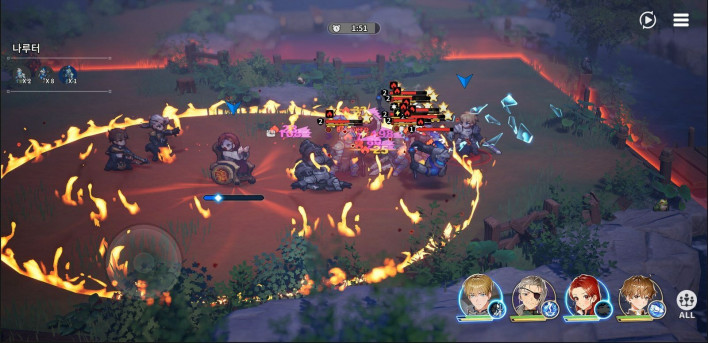
With a closed beta test (CBT) coming up soon, what additional elements can players expect compared to this demo version?
Kim Dong-hyun, CEO: While the G-STAR build focused on demonstrating how faithfully we adapted the original work, the CBT will aim to showcase just how fun the game is. Story elements will naturally be included, and we plan to open up our core content pillars to focus on delivering maximum engagement.
Because it uses pixel graphics, some of the original work's atmosphere might not come across fully. Are you planning to add more cutscenes or presentations utilizing original illustrations?
Lee Dae-hyun, Art Director: Rather than relying solely on pixel art, we plan to add story presentation through various mediums including webtoon panels and illustrations. Players will be able to see scenes illustrated that were never shown in the original work.
Kim Dong-hyun, CEO: In this demo, we mainly showcased pixel art, but in the CBT, we will be able to show much more character and dialogue illustrations. We hope everyone looks forward to enjoying the CBT.
We understand the game is aiming for release next year. What is the specific launch schedule?
Kim Dong-hyun, CEO: We are planning for a launch in the first half of 2027.
You mentioned implementing original content for segments that were skimmed over in the original work. Does this mean completely new original storylines are being created?
Kim Dong-hyun, CEO: There are time skips in the original story, and for those sections, we plan to draft storylines, propose them to the author, and create connecting narratives through mutual agreement. Alongside the main storyline, we are also preparing our own original stories. What we consider most crucial is fidelity to the original lore. Without breaking the lore framework, we are interpreting and weaving unrevealed stories that readers were curious about into the game.