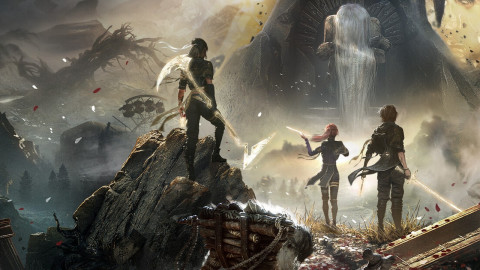
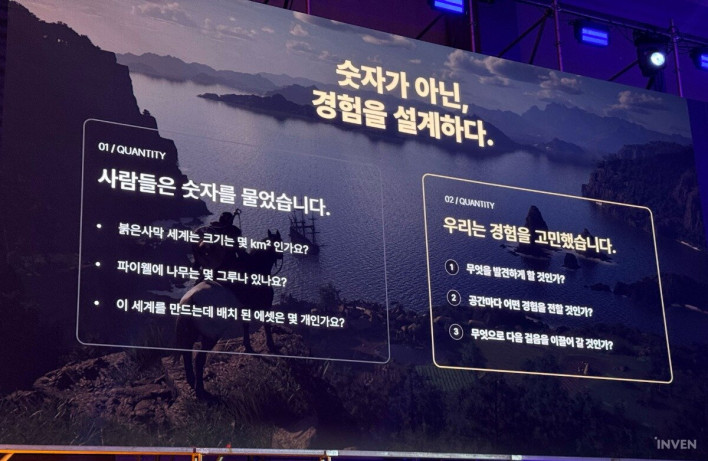
How many trees were planted? How many assets were used? These are questions developers who create massive open worlds are always asked. For Pywel, the continent that serves as the setting for Crimson Desert spanning approximately 200 square kilometers, these numbers are even more intriguing.
However, the question Pearl Abyss pondered longest while creating Pywel was not about numbers. Without a single line of dialogue, what story is this land telling the player?
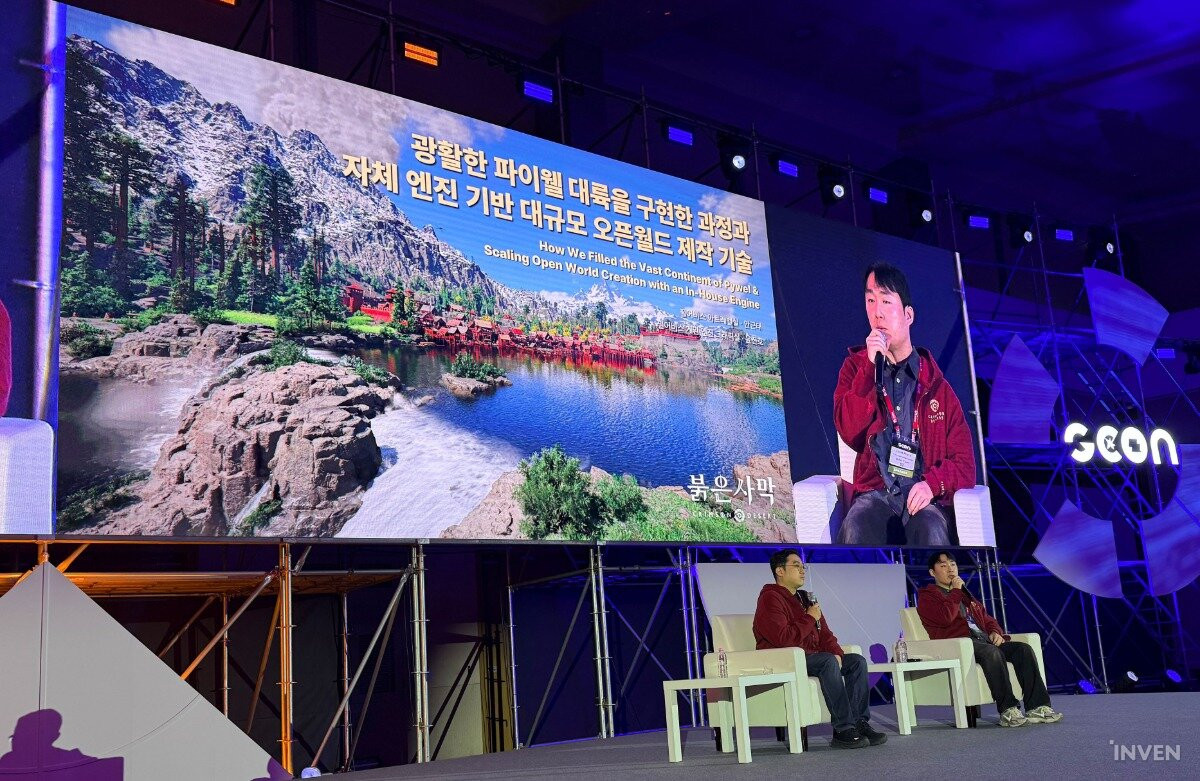
Ahn Keun-tae, Lead of the Art Level Division, and Yoon Jin-ho, Lead of the Graphics Division at Pearl Abyss, took the stage on November 19 during Day 1 of the G-STAR conference, G-CON, to unpack the answer. The session was split into two parts: Ahn discussed the artistic considerations behind shaping the continent of Pywel, while Yoon covered the technology of their proprietary BlackSpace Engine supporting it.
An open world designed so that even a single forest can be 'read'—this is how Crimson Desert filled the continent of Pywel. Here is the story of building a path that reaches beyond the horizon.
Instead of the most realistic forest, the most readable forest Designing density by separating what to reveal and what to hide
Ahn Keun-tae oversees the overall environment and background levels for Crimson Desert in the Art Level Division. To him, the environment is not merely a level, but a narrator that speaks to the player first. This is because the initial landscape encountered upon climbing a hill, the atmosphere of a forest path, and the distant silhouette of ruins tell a story long before any dialogue does.
Thus, Gavin's questions were split into three parts: What to show, what to fill it with, and what is needed to make the player feel like they want to go there.
The first answer came from nature. It is easy to think that a denser, more overgrown forest makes for a more realistic and better environment. However, what Pearl Abyss encountered during development was quite the opposite: actual nature does not fit players as well as one might think.
What would happen if a player were dropped into the middle of a real forest and told to walk to a tower 500 meters away? They would likely give up in less than 10 minutes pushing through tree branches. Vision would be obstructed, direction easily lost, and landmarks hidden behind trees.
The problem does not end with inconvenient movement. If it cannot be seen, the story cannot be conveyed either. No matter what history a distant tower holds, if it never catches the eye, that story cannot even begin.
Of course, it is not nature's fault. Nature was simply never created to be read by a player holding a controller in the first place.
So they shifted their objective: instead of recreating nature, they focused on creating a nature that is playable and capable of speaking to the player. Sightlines needed to flow naturally, distant landmarks had to catch the eye, and minor occurrences like animals or gatherable resources needed to be visible. Most importantly, players had to be able to move and fight freely within it.
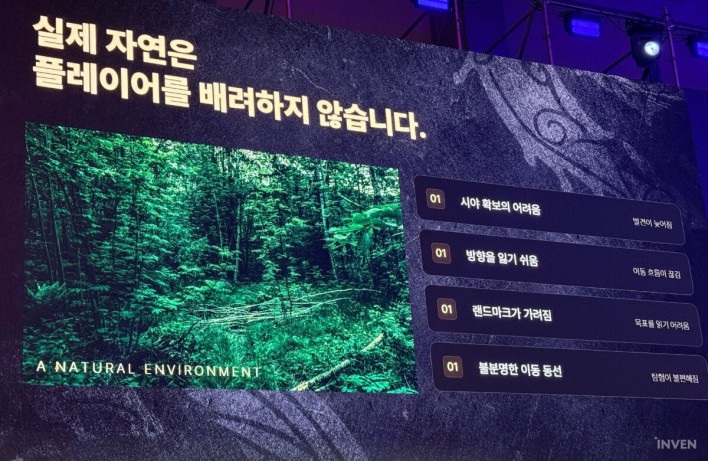
The solution lay not in planting trees, but in designing density. Pathways open up the line of sight, locations to be discovered close and then reopen vision, and combat spaces leave room to maneuver. Players then intuitively read without explanation, 'This is a place to pass through, and this is a place where something lies.'
Not the most realistic forest, but the most readable one. When working properly, a player scanning the forest from a ridge can spot three or four places worth visiting even without UI markers.
Ahn explained that quiet sections with trimmed-down details were deliberately created for players to take a breath. Just as underlining every sentence highlights nothing, a forest that is interesting everywhere feels special nowhere. Empty space allows the next dense scene encountered to feel like a meaningful event.
Modify one sample, and the continent changes Automation as a quality multiplier, not a shortcut
The next challenge was scale. The continent of Pywel was simply too vast to populate entirely by hand, no matter how much the team was expanded or the schedule extended.
In the early stages, quality varied widely across regions, and even within the same region, results differed significantly depending on the developer. Similar tasks were endlessly repeated, and revision costs grew higher over time.
Thus, they adopted sample-based production. A small representative area capturing the exact desired mood, density, and readability was crafted by hand first. Rules were then extracted from that sample, such as how vegetation thins out near roads, the relationship between slope and erosion, or how landmarks near water should appear.
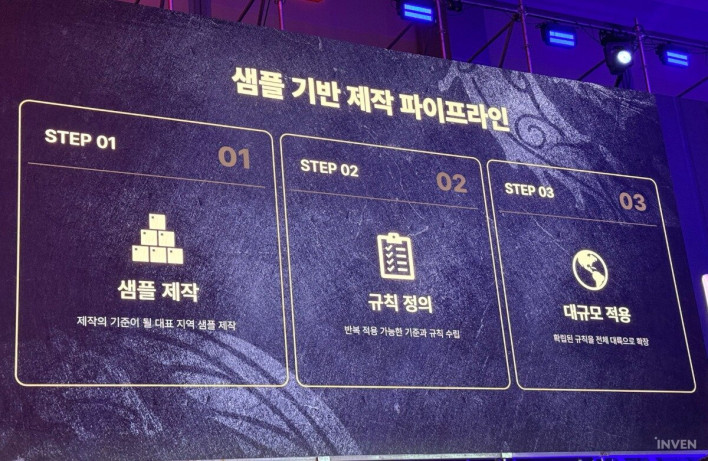
Procedural generation tools built in Houdini distributed these extracted rules across the entire continent, while the team continuously elevated the quality of the sample area.
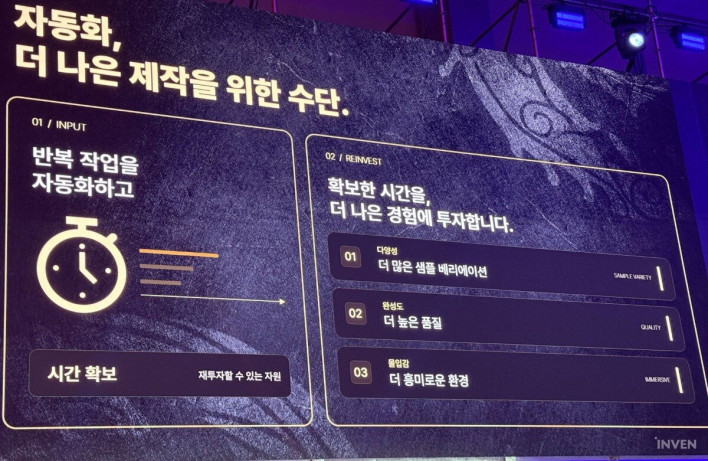
Though the initial goal was automation, the time saved through it was not wasted. By reinvesting that time into creating a wider variety of samples, higher quality, and more engaging environments, a structure was built where modifying a single sample improved the entire world simultaneously.
The team's core question shifted as well: instead of asking how to build the continent faster and in larger quantities, they asked how to create an original worth replicating. Technology was not a tool to write the story for them, but a tool to translate a well-written scene across the entire continent. In this way, automation became a method for amplifying quality rather than taking a shortcut.
If you see it in the distance, you must be able to reach it The opening sentence from 1 km away, the body text from 10 m away
Pearl Abyss envisioned an environment that did not remain a mere background, but became content in itself. Climbing a hill reveals something in the distance, inspiring curiosity to walk toward it. And before even arriving, another landscape catches the eye, prompting the player to step forward once again.
Ahn viewed this loop of discovery, movement, and exploration as a story written by the player. Discovery is a question, movement is deduction, and arrival is the answer. That answer then sparks the next question, such as 'Where does that road lead?' Because these are questions posed by the players themselves rather than sentences written by an author, they resonate far longer.
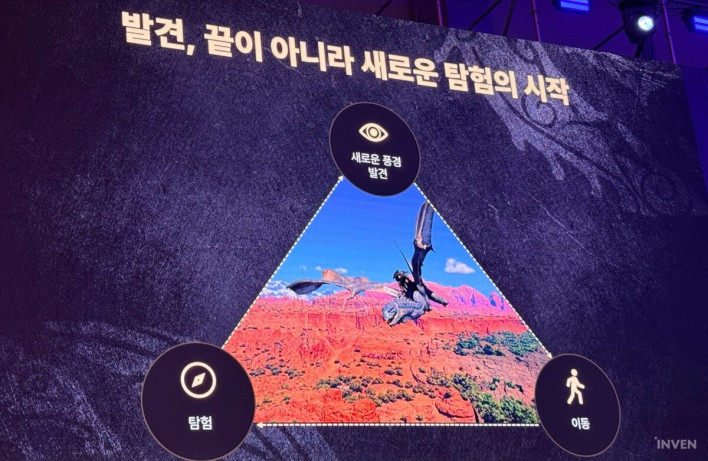
The core principle established was that 'if it can be seen in the distance, you must actually be able to go there.' The development team repeatedly tested this promise by selecting a distant point from a ridge and walking to it. After just a few hours of play, players begin to trust the horizon and move without quest markers. Ahn described this as trust more valuable than anything else.
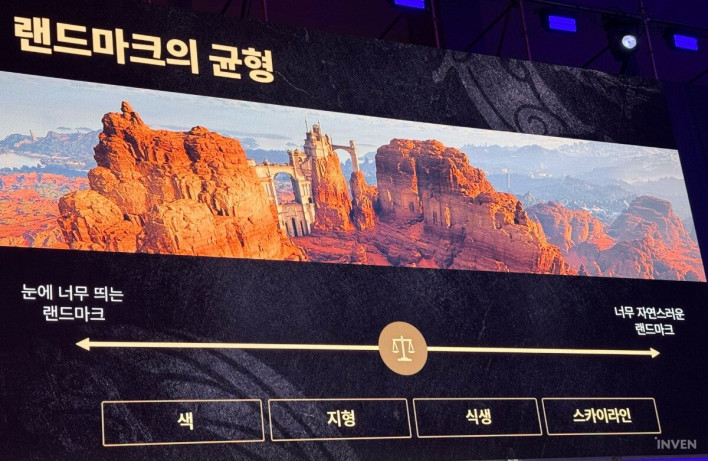
So, is a good landmark simply one that stands out? That is half right and half wrong. If it stands out too much, it looks out of place like a postcard pasted onto the middle of a map; if it is too natural, no one notices it, and even that balance point shifts depending on the situation.

Because of this, key landmarks were designed twice. From 1 km away, they spark curiosity like the short, impactful opening sentence of a story, and from 10 meters away, they become the main body text. Details such as the manner of collapse, remaining traces, and accumulated time quietly reveal what occurred in that place.
The skyline proved far more important than expected. Human eyes read silhouettes against the sky long before identifying carved stones or flags. This is why terrain elevation, tree placement, and landmark silhouettes were checked repeatedly at dawn, midday, on foggy days, and from three or four different approach angles.
When executed well, no one notices; when off-balance, players feel 'Something is odd here' without knowing why. That instinctive reaction was precisely what the developers pursued.
Ironically, the greatest lessons came from failed forests. Locations that drew admiration during review meetings when shown in screenshots collapsed entirely upon actual gameplay. The forests were so dense that animals and gatherables carefully placed over weeks were completely hidden behind leaves.
Players frequently got lost due to overly complex terrain or tripped over obstacles inserted purely to look cool. Sections that appeared sufficient when viewed from above looked completely empty at character eye level. What mattered was not the drone camera, but the perspective at character eye level.
Every failure shared a single common trait: designing from the perspective of an observer rather than a walker. Ahn's philosophy is that while beauty and explorability can certainly coexist, if one must be chosen, explorability wins.

Returning to the initial question: how many trees were planted? Pywel features a vast array of assets, including trees, rocks, ruins, and wildlife. However, what mattered was not the count, but designing what players see, where they go, and what they discover.
Through sightlines instead of dialogue, density instead of explanations, and the horizon instead of cutscenes—Ahn concluded his presentation by stating that he filled the continent of Pywel not with assets, but with reasons to explore.
From beneath player feet to the horizon: BlackSpace Engine Rendering and streaming 200 square kilometers seamlessly
The presentation was then handed over to Yoon Jin-ho, Lead of the Graphics Division in charge of environment rendering. This was the story of how technology fulfilled the promise made by art.
The BlackSpace Engine is Pearl Abyss' proprietary engine developed to create various games, including Crimson Desert, DokeV, and PLAN 8. It was designed with the goal of delivering a consistent game world and play experience across PC, PS5, Xbox, and Mac.
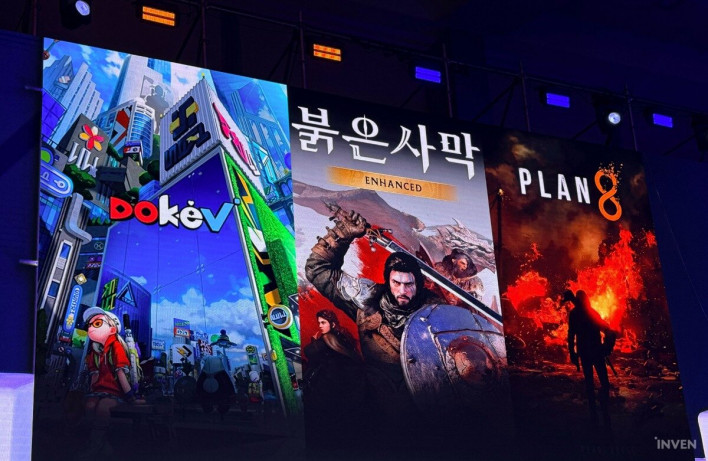
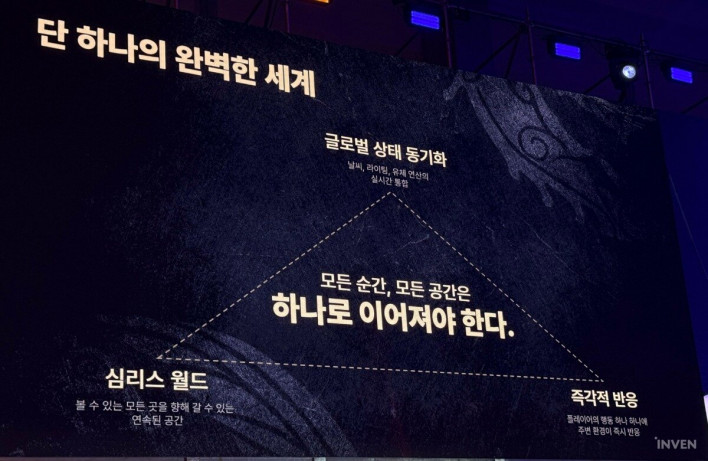
One of the key goals was rendering a seamless open world in real time, reaching from the player's immediate surroundings all the way to the horizon. Seamlessness meant that anywhere visible must be reachable, making Ahn's principle the engine's core objective as well.
The conditions were quite demanding. First, terrain, structures, and vegetation had to blend seamlessly all the way to the horizon while displaying a level of detail appropriate for distance and importance. When time and weather changed, lighting, vegetation, rivers, seas, and atmosphere had to shift consistently while responding immediately to player actions.
All of this had to be processed within a designated single-frame performance budget. Pearl Abyss addressed this through three pillars: vast environment rendering, dynamic environmental representation, and interaction with the world, putting effort into binding all three so they would not operate in isolation.
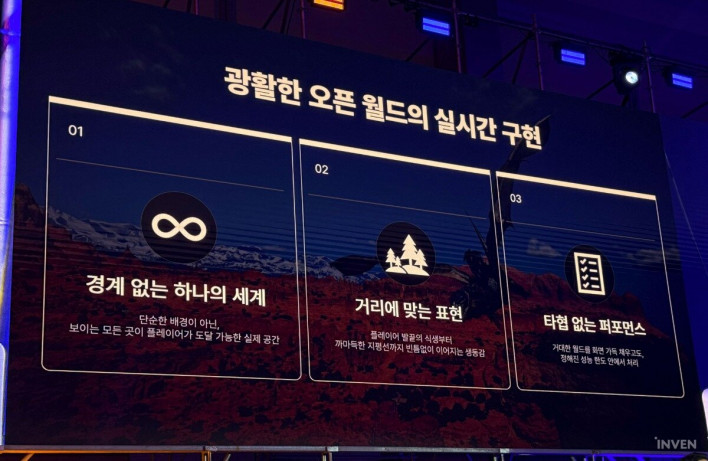
The challenge in environment rendering was displaying a world of roughly 200 square kilometers all at once regardless of distance. Landscapes spanning 1 km, 3 km, and beyond 10 km were captured in a single frame. Up close, interactive objects and dense vegetation remain sharp, while at medium range, terrain and villages appear clearly, and in the far distance, the outlines of forests and landmarks are distinct.
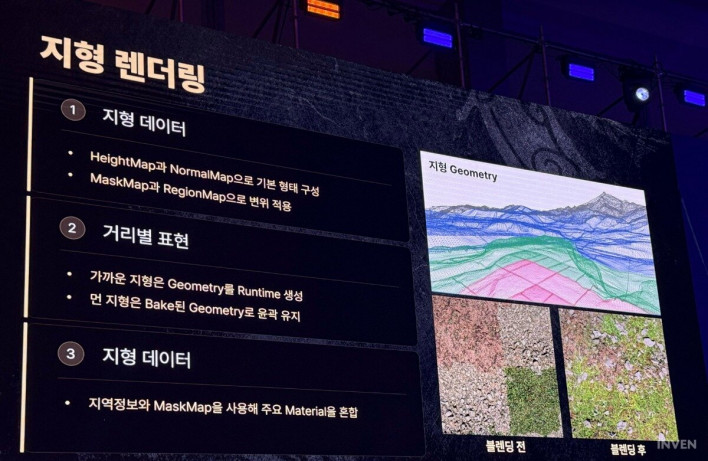
Terrain is built on height maps and normal maps, adding mask map and region map data to create height variations. Nearby terrain generates geometry at runtime, while distant terrain maintains its outline using pre-baked proxy LOD meshes.
Surfaces are rendered using region data read from region maps. Each region has four material sets containing textures, displacement, vegetation settings, and physical information; the engine checks the player's position and surrounding area to blend two materials based on mask map weights.
However, height maps alone make it difficult to represent vertical cliffs or complex rocks. These areas were handled by dedicated terrain meshes. The top surfaces render in the same manner as terrain, while region data alters the patterns and colors of cliffs to seamlessly connect with surrounding terrain. By creating presets for these, a wide variety of mountains and cliffs was achieved using a small number of mesh and texture types.
Vegetation filling forests, fields, roadsides, and villages is placed via GPU-based procedural generation. Treating numerous elements individually as unique objects would impose an unbearable load on the GPU. Once artists set rules for density, species, size, slope, altitude, and exclusion zones, vast areas are populated with vegetation.
Naturally, placement was manually adjusted in key locations to preserve unique regional atmospheres. The core principle is that elements generated this way are not stored separately as data, but generated at runtime by the GPU. For separate procedural tasks, external tools like Houdini and Blender exchanged data with the engine, automating everything from asset creation to placement.
In distant forests, seeing the types, shapes, and distribution at a glance was more important than the detail of an individual tree. The impostor system pre-prepares long-distance replacement images for over 100 tree species and selects the appropriate representation based on distance and viewing angle. Thanks to this, up to 500,000 trees can be rendered in a single scene while preserving forest density and distant mountain ridge outlines.
This vast world is managed by a scene level system. Objects are grouped into over 20,000 uniform level units based on size and location, and the engine streams in only the necessary levels according to the player's position. Content requiring independence—such as villages, interiors, quests, and situation-specific mechanics—is managed in separate standalone levels.
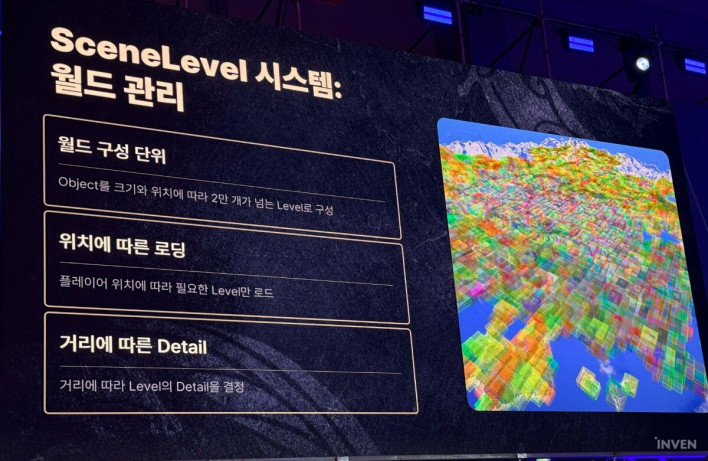
LOD is divided into five stages based on distance; nearby objects show detailed geometry and materials, while detail is reduced as distance increases. Much farther targets are handled by proxy meshes pre-built on a per-level basis. This is the secret to preventing distant objects, plants, and terrain from abruptly popping out of view.
Resources are also loaded only as needed according to designated LODs. Texture streaming delivers required mipmaps, while mesh streaming provides situation-appropriate geometry LODs. Unneeded resources are unloaded from memory, and file I/O, release, and preparation are all processed asynchronously so as not to impact frame rate.
The final key was work division: the GPU utilizes GPGPU technology for mass computation to cull off-screen targets and process vast numbers of objects and vegetation. Async compute overlaps computation and graphics workloads to minimize GPU idle time.
The CPU distributes game world and engine updates across multiple cores. It organizes dependencies and task ordering, grouping similar tasks to constantly feed the GPU. As the CPU prepares frame tasks, the GPU processes them in parallel, allowing even complex scenes to render stably within the allocated frame time.

Sky, light, and water all inhabit the same world From physics-based atmosphere to real-time global illumination
Form alone cannot convey the full sense of depth for distant scenery. Thus, the BlackSpace Engine renders atmosphere and clouds using physics-based models. It calculates how sunlight scatters and attenuates passing through the atmosphere according to the player's viewing direction. As sky color, brightness, and contrast change with solar position and distance, foreground and background naturally separate.
Clouds are split into two layers by altitude, with varying heights and shapes for each layer to enhance vertical depth and scale during weather changes. Froxel-based volumetric rendering adds light scattering in space, while height fog incorporates altitude-based fog density, seamlessly connecting the ground to the high sky in a single frame.
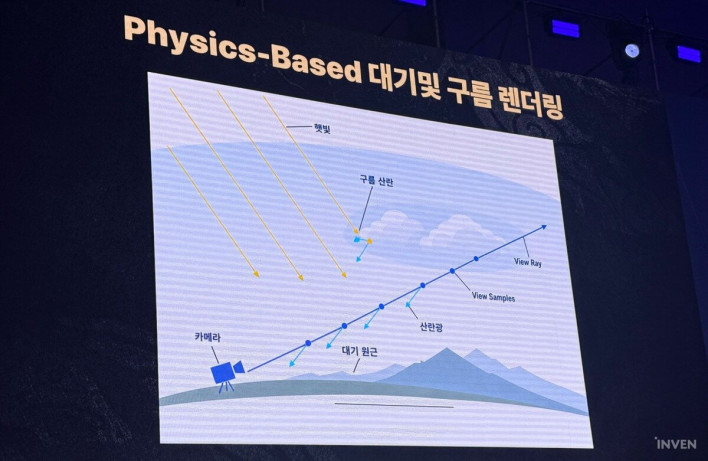
Lighting is not pre-baked. The dynamic global illumination system updates lighting information in real time via hardware ray tracing or software ray marching. Surfel-based radiance caches and tile cluster-based caches reduce noise, and the ray count used for lighting calculations can be adjusted according to quality settings.
Numerous light sources generated across villages, combat, and various effects are handled by the Many Light rendering system. It expresses light shape, brightness, and flickering based on particle simulation results while adjusting computation loads according to the situation.
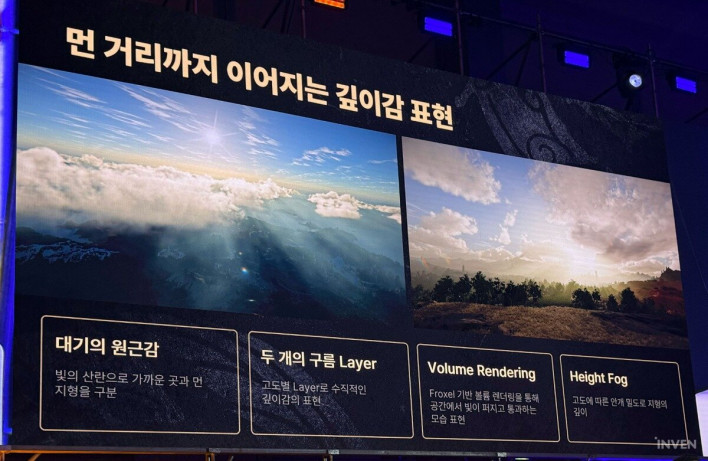
Water is rendered differently depending on its type. Water enclosed by terrain, such as ponds and rivers, captures depth, boundaries, and flow, while vast oceans express distant waves and swells through an ocean wave system. Though techniques differ, all water shares the same lighting, wind, and weather data.
Shallow water near the player is calculated in real time using shallow water simulation. It calculates head drops to generate foam and uses terrain data to model collisions. In contrast, distant water transitions to pre-baked flow maps for performance, ensuring direct interaction up close while maintaining a natural, connected look in the distance.
Time of day and weather are shared across the entire world. During the day, distant terrain remains crisp; as the sun sets, shadows, contrast, and atmospheric colors shift in unison; and at night, artificial lights, stars, and the Milky Way emerge.

When rain falls, rain streaks, wet surface reflections, and visibility adjust to regional weather; when snow falls, sky brightness, atmospheric density, and draw distance adapt accordingly.
Forests bending in the wind, severed by blades Fluid simulation and a unified interaction system
Underpinning these environmental changes is a fluid simulation system. As simulation fields regulate flow direction and strength depending on location, the results are passed simultaneously to vegetation, cloth, fog, dust, and particles. Elements in the same space do not behave independently, but react consistently to the exact same forces.
Yet this force does not act identically across the whole world. Direction and intensity vary by location, and as the field shifts, nearby grass and trees sway accordingly. This is possible because vegetation and particles share the same computation output.
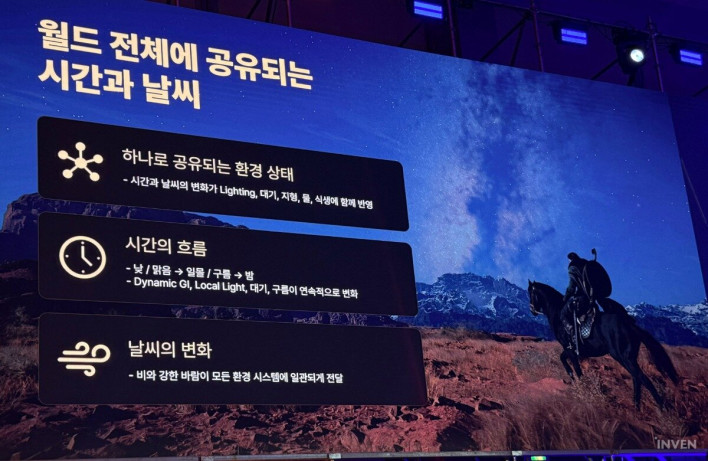
Player interactions are also tied into a unified system. Rather than creating standalone reactions for each environmental element, information such as contact location, force direction, and player action is dispatched to multiple targets simultaneously. Receiving entities react in real time according to their respective physical properties.
Plant reactions follow three forms: upon contact, they temporarily bend in the direction of force before returning; upon impact, they remain cut or broken; and while grabbed, pulled, or climbed, they continuously react along the contact surface. As a character passes by, grass sways and restores itself, while grass struck by an attack transitions from bent to severed.
Pulling on a tree causes its trunk and branches to flex together, while climbing triggers continuous responses corresponding to where hands and body make contact. Heavy impacts cause trees to shake and break, and that destroyed state persists in the world. Vegetation is no longer a static background, but another gameplay element reacting to the player.
Yoon revisited the session's overarching goal to recap what Pearl Abyss aimed to realize: anywhere visible on screen must be reachable, while time, weather, lighting, water, and vegetation must share a single world state and change together. Furthermore, the environment must react immediately to player actions while maintaining world continuity.
Art that enables players to reach whatever they see in the distance, and an engine that captures that promise within a single frame. In response to the question of how many trees were planted, Pearl Abyss offered not a number, but a reason to keep walking.