The government and the National Assembly have spoken with one voice regarding tax credits for game content production costs. Choi Hwi-young, Minister of Culture, Sports and Tourism (MCST), stated during his congratulatory address at the 2026 Korea Game Awards ceremony on the 18th that he would persuade relevant ministries to introduce the tax credit. Cho Seung-rae, Chairman of the National Assembly's Finance, Economy, and Planning Committee, which handles tax matters, said that this issue is currently on the committee's table.
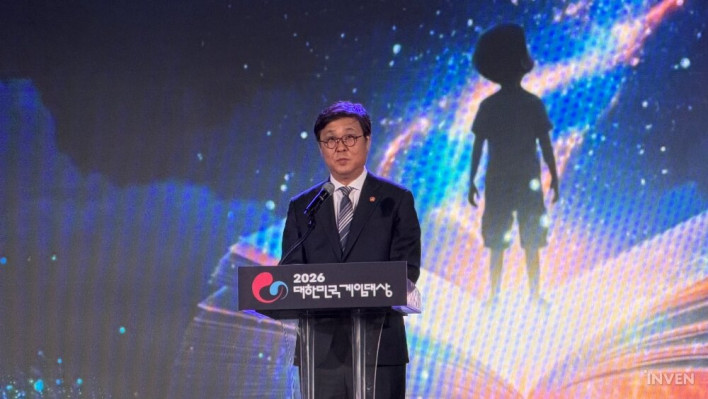
Minister Choi stated, "We will consult and persuade relevant ministries more diligently so that various institutional supports, such as tax credits for game content production costs, can be established." Judging by the word 'persuade,' negotiations with tax authorities do not yet appear to have reached a conclusion. Chairman Cho said, "The issue of production tax credits is on the table of the committee I chair," adding, "We will actively support developers so they can work under favorable development conditions." This means the minister in charge of the primary ministry and the chairman of the relevant standing committee brought up the same task on the same day.
Production support will be expanded into two tracks: indie and major games. Minister Choi explained, "To ensure that creative ideas and innovation lead to the birth of new games, we will significantly expand support for indie game planning and production, and plan to launch new support starting next year for major games capable of leading the global market." Considering that government game production support has previously centered around small-and-medium and indie developers, this is interpreted as an intent to broaden the scope of support to large-scale projects. However, specific details regarding the scale and methodology were not disclosed.
Plans for manpower and funding were also outlined. Minister Choi stated that the youth internship program would be expanded to 500 participants so young people can gain hands-on experience and continue to grow within the gaming sector. According to Minister Choi, the newly established 120 billion won IP fund this year is being invested primarily into the game industry. Next year, a fund of 1.5 trillion won and loans worth 600 billion won will be injected into the content sector. Minister Choi emphasized, "We will do our utmost to support the game industry so it can become a key player in the 400 trillion won era of K-Culture."
Lee Jae-jung, Chair of the National Assembly's Culture, Sports and Tourism Committee, also promised institutional support. Chair Lee remarked, "The future of the gaming industry will not always be smooth sailing," citing rapidly changing technology and global market competition as key challenges. She then stressed, "As Chair of the National Assembly's Culture, Sports and Tourism Committee, I will support your efforts institutionally so you do not stand alone." Regarding the industry's achievements, she evaluated that "they were accomplished not merely by export numbers, but through the courage of standing up again after new challenges and failures."
Chairman Cho Seung-rae defined games as "a composite art form and a comprehensive industry." He explained that scenarios, art, music, and engineering come together to create a world, which then communicates with the outside world through marketing. Chairman Cho added, "The simple fact that the MCST Minister and the Culture, Sports and Tourism Committee Chair are sitting together at this venue shows that love and interest in the gaming industry are greater than ever."