TiMi Studio Group's 'Monster Hunter Outlanders' welcomed attendees at TGS 2026 once again this year, following its appearance last year. Having recently wrapped up its 3rd CBT, 'Monster Hunter Outlanders' offered virtually no new content additions in its TGS 2026 build. Looking solely at its systems and content structure, it was practically identical to the previous CBT.
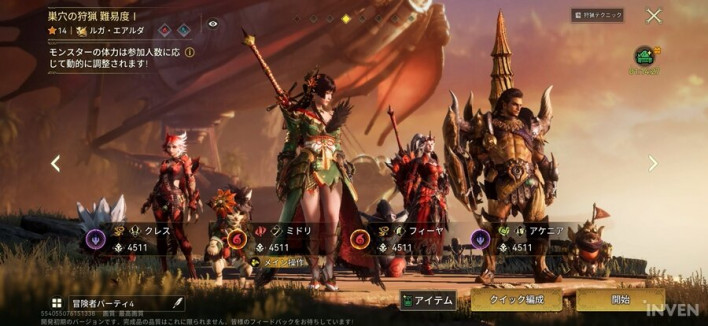
That is not to say there was nothing to see in this hands-on demo, however. Attendees were able to go head-to-head with Luga Ealda, the recently revealed core monster and original Elder Dragon of 'Monster Hunter Outlanders'. In this build, players could form up to a four-player party with NPC companion Adventurers to challenge Luga Ealda, while also directly testing out the newly added Starter Mode and Adventure Mode.
Since the game's fundamentals have already been established through multiple CBTs, this impression focuses more on the changes felt during gameplay rather than revisiting every system from scratch. In particular, it examines how the two control schemes differ in actual hunts and what it feels like to battle Luga Ealda, 'Monster Hunter Outlanders'' flagship addition.
Prior to the hands-on session, a presentation provided a detailed introduction to 'Monster Hunter Outlanders', spanning its world, key systems, Adventurers, and monsters. Here is a brief summary of what was shared during the presentation, followed by impressions from the hunt itself.
A New Protagonist: Adventurers, Not Hunters Inherits Hunter Combat Action, Differentiates with Crafting and Active Skills
'Monster Hunter Outlanders' is a mobile title developed by TiMi Studio Group under official license from Capcom. Rather than playing as a traditional 'Hunter' from the main Monster Hunter series, players step into the role of an 'Adventurer' to hunt various monsters across Isolesia Island.
As a mobile game, it supports both single-player and multiplayer modes and will operate under a Free-to-Play (F2P) model. Plans are in place to continuously expand content through post-launch updates.
Four regions have currently been revealed on Isolesia Island, the game's primary setting. Each region features distinct environments and characteristics, allowing players to roam the island to hunt monsters and explore. New regions will also be added in future updates.
Notably, players can utilize the crafting system while exploring the field. For instance, setting up ropes in specific spots or placing wind-generating devices can make traversal significantly easier. Once deployed, these structures persist even after leaving and returning to the area, aiding the player's exploration.
Various minigames are also scattered across the map. By allowing players to enjoy minigames alongside monster hunting during exploration, the overall gameplay experience has been rendered more diverse.
Enhancing Accessibility with Two Control Schemes Adventure Mode for Deep Action Experience and Starter Mode for Simplicity
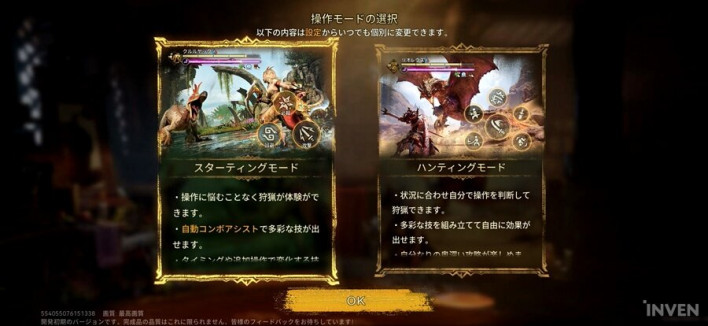
The hunting system offers two control schemes—Starter Mode and Adventure Mode—allowing players to choose based on their action gaming experience.
Adventure Mode is built on the control scheme of the traditional Monster Hunter series and designed for players accustomed to mobile action games. It maps the diverse actions of each weapon type from the mainline series into a single button layout, enabling varied attacks on mobile. Taking the Long Sword as an example, separate buttons are assigned for Overhead Slash and Thrust, allowing players to wield the weapon with a feel similar to the original series.
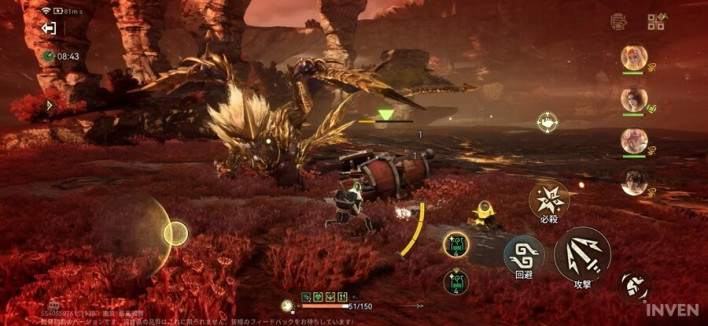
Starter Mode is tailored for newcomers or players unfamiliar with mobile action controls. Its biggest feature is that instead of mapping different buttons to individual move inputs, all attack motions are mapped to a single attack button. Continuously tapping the attack button seamlessly chains combos based on the situation. Built around three primary buttons—Attack, Dodge, and Ultimate—it allows players to unleash diverse actions without complex inputs.
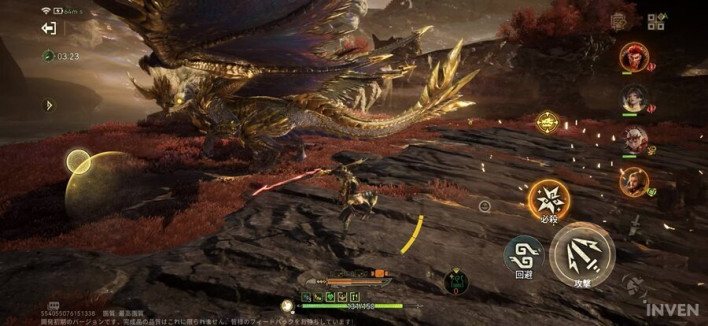
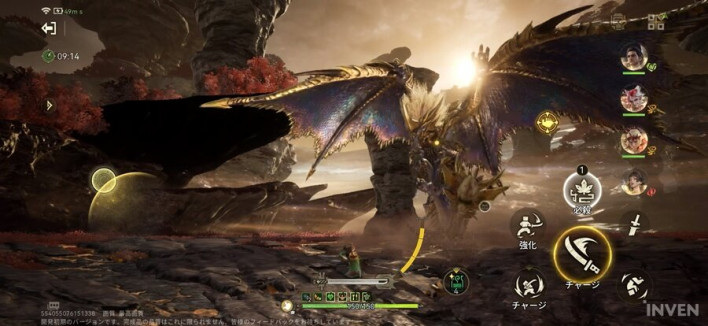
A hunting system specialized for mobile environments has also been implemented. During hunts, the camera automatically tracks the monster, and holding down the lock-on button brings up a wheel. Players can then navigate the wheel to select targeted body parts, such as the head, left/right wings, left/right forelegs, hind legs, or tail. However, selecting a part on the wheel does not automatically guarantee a hit. To land strikes accurately, manual positioning remains necessary, just as in traditional Monster Hunter titles.
To ease difficulty on mobile devices, visual indicators—such as glowing effects when monsters prepare specific actions—have been introduced. Serving as telegraphed cues, these enable players to gauge attack timings more easily and execute dodges.
Seven Weapon Types and Three Roles DPS-oriented Assault, Debuff-inflicting Disruptor, and Support-specialized Support
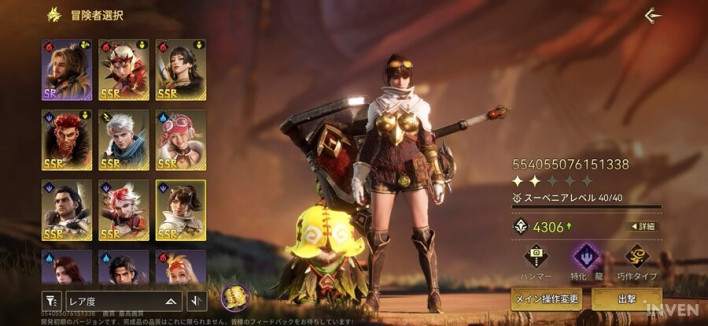
The main protagonist Adventurer that players first encounter supports custom character creation and can equip all weapon types in the game. Seven weapon types are currently available, with new weapons planned to be added in future updates.
Adventurer roles are divided into three main categories: Assault, which focuses on deal-making combat with high attack power; Disruptor, which inflicts debuffs on monsters; and Support, which specializes in aiding allies.
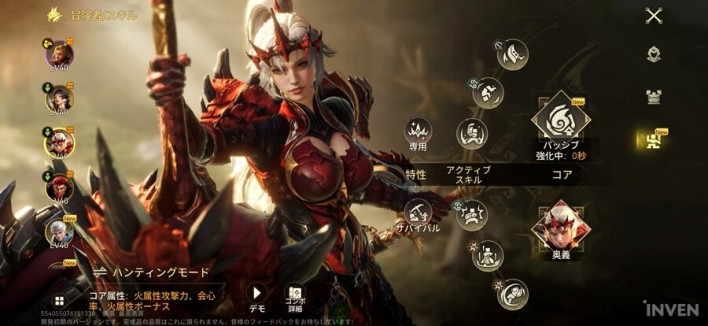
'Adventurer' here is the overarching term for playable characters, much like how players and party members were called Hunters in prior Monster Hunter titles. In addition to the fully customizable base Adventurer, companion Adventurers with distinct personalities—previously showcased in trailers—are also available for selection as playable characters.
The primary protagonist Adventurer serves as the player's avatar, offering versatility by freely swapping weapons and roles. In contrast, companion Adventurers have limited customization but feature set roles, weapon types, and exclusive Ultimate skills (active skills), specializing them for particular functions. Consequently, they can outperform the base Adventurer in specific scenarios.
Diverse Roster and Title-Original Monsters New Elder Dragon Luga Ealda and Monster Hunter Online's Estrellian Join the Fray
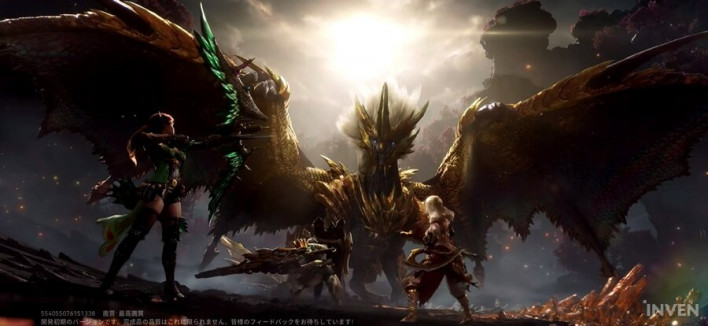
Monsters form another core pillar of 'Monster Hunter Outlanders'. In particular, Radiant species monsters—altered by the influence of unique substances on Isolesia Island—make their debut. Compared to their standard counterparts, Radiant monsters feature altered appearances, modified movement patterns, and unique visual effects when executing specific moves.
Beside Radiant species, numerous returning monsters from past Monster Hunter titles are featured. Dozens of species were included as of the 3rd CBT, and additional monsters will be introduced following the official release.
Furthermore, original monsters unique to this Monster Hunter entry make an appearance, led by the Light-Prism Dragon Luga Ealda, revealed in previous trailers. Serving as the flagship monster of 'Monster Hunter Outlanders', it boasts an appearance that resembles armor made of golden scales. Luga Ealda holds special significance in-game, and its backstory, alongside the broader lore and narrative of Isolesia Island, will be fully introduced upon official release.
Original Elder Dragon Luga Ealda Exclusive Attack Patterns Confirmed, Not Quite as Bizarre as Expected
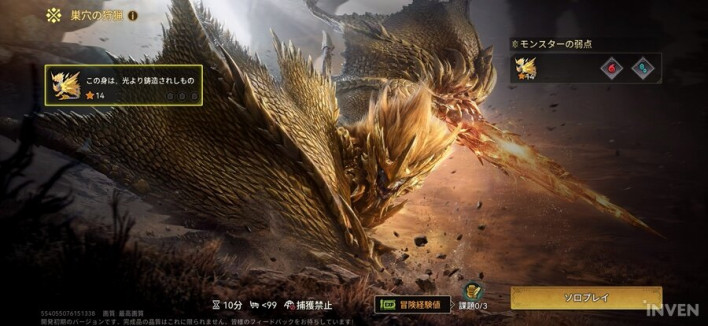
This hands-on demo comprised a single mission: hunting Luga Ealda. Before diving into the details of the Luga Ealda hunt, let's look at the control systems first. Players in this demo could choose between the mobile-optimized Starter Mode and Adventure Mode, which aligns closer to traditional Monster Hunter entries.
Truth be told, apprehension preceded the mode selection. Precision control is a defining trait of the Monster Hunter series, where players frequently frame-dodge monster attacks or roll through roars without Earplugs. However, that baseline assumes PC or console platforms. Independent of 'Monster Hunter Outlanders', mobile touch controls inherently present challenges for high-precision inputs—ranging from accidental input errors to the delayed responsiveness inherent in using two thumbs.

Because of this, there were concerns about whether 'Monster Hunter Outlanders' would play properly regardless of mode, or if it had been oversimplified. Yet such worries proved unfounded as combat in 'Monster Hunter Outlanders' turned out to be remarkably well-crafted. Since Adventure Mode employs controls close to classic Monster Hunter games, using the Long Sword required alternating between two buttons for Overhead Slash → Thrust → Rising Slash. Additionally, once the Spirit Gauge filled, repeatedly tapping the Spirit Blade button was required to build gauge levels; while fingers were kept busy, the flow itself felt surprisingly natural on mobile.
The same was true for dodging. Timing dodges against monster attacks is crucial in Monster Hunter, and likely owing to the mobile platform, the dodge timing window felt relatively generous. This resulted in a satisfying sense of mastery, making successful evasions feel rewarding. A particularly nice touch was the subtle slow-motion effect triggered upon a successful dodge, intuitively signaling that the evasion landed correctly.
The lock-on feature was also impressive in several ways. Holding the lock-on button summons a wheel displaying targetable parts like the head, left/right wings, forelegs, hind legs, and tail. Being able to select any part freely made targeting specific zones straightforward, even on a mobile screen.

Starter Mode compresses multiple attack inputs into a single button. Taking the aforementioned Long Sword, executing Overhead Slash → Thrust → Rising Slash normally requires two buttons alongside a separate Spirit Blade button. In Starter Mode, however, everything is condensed into one button; mashing it three times automatically chains the Overhead Slash → Thrust → Rising Slash sequence.
Up to this point, there were no major issues. The real surprise came next. In this session, playing in Starter Mode with the companion Adventurer Ryunosuke revealed a surprisingly unique character kit.
It was already known that companion Adventurers feature distinct visual designs, active skills, and ultimate abilities rather than standard Monster Hunter skill sets. Still, one expected them to adhere somewhat to base weapon playstyles. Midori, revealed earlier, is a prime example: a classic Yamato Nadeshiko-style character wielding a Long Sword who uses an exclusive skill instead of standard Spirit Blade strikes to expend Spirit levels on timed iai draw attacks. In essence, her Spirit Blade is replaced by draw attacks, keeping her control feel in Adventure Mode largely consistent with base Long Sword. Ryunosuke, however, was a completely different story.

First off, his attack animations were completely different. Whether this was an artifact of Starter Mode or unique to Ryunosuke himself was hard to tell, but instead of the expected Overhead Slash → Thrust → Rising Slash sequence, he mid-combo suddenly performed a quirky motion that looked like eating meat, raising doubts as to whether he was even wielding a Long Sword. Different animations alone would be fine, but blindly mashing the single attack button under the assumption of an easy combo occasionally triggered unexpected skills, leaving vulnerable openings. It was quite jarring at first.

Ultimate skills are triggered by tapping the character portrait in the top-right corner of the screen. Gauge builds during battle, and once filled, the skill becomes available. Each Ultimate proved formidable; some almost guaranteed a heavy stagger on the monster. Depending on the situation, they serve as excellent tools for interrupting specific monster patterns or creating offensive openings.

A welcome improvement regarding Ultimate skills was also observed: cutscene presentation. Previously, executing an Ultimate triggered full-screen cutscenes similar to anime action RPGs, which interrupted combat rhythm. This has been revamped into a small picture-in-picture character camera in the upper-left corner. Preserving visual clarity for skill animations while maintaining fluid battle pacing felt like a significant upgrade over prior builds.
Telegraphed attack indicators were another positive addition. While dodge timings were generous, the nature of mobile gaming occasionally caused subtle wind-up animations to be missed. To mitigate this, 'Monster Hunter Outlanders' visually highlights monster attack wind-ups. Monsters glow red immediately before attacking, intuitively indicating when players should prepare to dodge.
However, the system was not entirely flawless. Attacks did not always follow the telegraph warning immediately. While some attacks triggered instantly, others involved hovering before charging. The issue was that the red glow appeared before launching into the air rather than right before the mid-air charge, leading to initial confusion regarding dodge timing. Nevertheless, fine-tuning these timings prior to launch should easily address the issue, making it a minor quirk rather than a fatal flaw. Overall, pre-warning players of incoming danger remains a welcome feature.
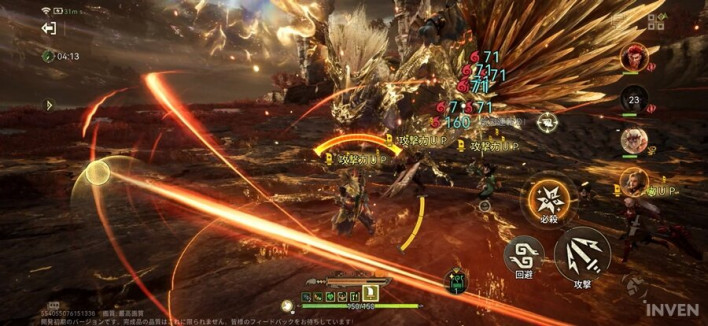
Regarding Luga Ealda, rather than dissecting every minor attack pattern—such as listing three foreleg swipes followed by a tail sweep, which offers little insight in a preview—focusing on its standout mechanics yields a clearer picture.
Before addressing attack patterns, its design—which received mixed reactions upon reveal—did not feel nearly as unusual in person. Small mobile screen dimensions might make subtle details less prominent, but camera framing and overall visual presentation softened the initial oddity. If anything, its core concept as a "golden armor-clad Elder Dragon" stood out far more effectively.
Two key attack patterns highlighted Luga Ealda's arsenal. The first utilizes its wing-arms, forming spear-like golden crystals at the wingtips to deliver thrust attacks—devastating moves capable of knocking down a hunter in a single blow if struck cleanly.

What stood out here was the inclusion of a counter mechanic. Striking back at the precise moment Luga Ealda attacks triggers a counter animation that shatters the crystal spear, inflicting a heavy stagger on the dragon. Rather than merely evading a lethal strike, well-timed counterattacks turn defensive moments into offensive opportunities.
The second pattern is a quintessential "wipe mechanic." Luga Ealda ascends into the air and charges energy; failing to deal sufficient damage within a tight window to interrupt the channel results in a devastating blast capable of wiping out the entire party.
In summary, this hands-on demo made it clear that substantial thought went into adapting 'Monster Hunter Outlanders' appropriately for mobile platforms. Some purists may still argue that capturing authentic Monster Hunter combat on mobile is impossible, or dismiss companion Ultimates and active skills as antithetical to Monster Hunter gameplay.
Setting personal preferences aside, 'Monster Hunter Outlanders' delivered combat worthy of the Monster Hunter name in this demo. The core satisfaction of managing attack windows and evasions against formidable monsters with diverse attack patterns remains faithfully preserved from the original series. Furthermore, mobile optimizations—such as streamlined controls, attack telegraphs, and lock-on targeting—were thoughtfully integrated for accessibility.
'Monster Hunter Outlanders' has entered its final polish ahead of its official release on October 29. Reassuringly, the drawbacks observed during this demo felt more like polish opportunities than fatal flaws. While areas like telegraph timing require fine-tuning, there remains ample time before launch to address these refinements.
It will be worth keeping a close eye on how much these rough edges are smoothed out for the launch build, and how Capcom and TiMi's vision of Monster Hunter on mobile ultimately takes shape.