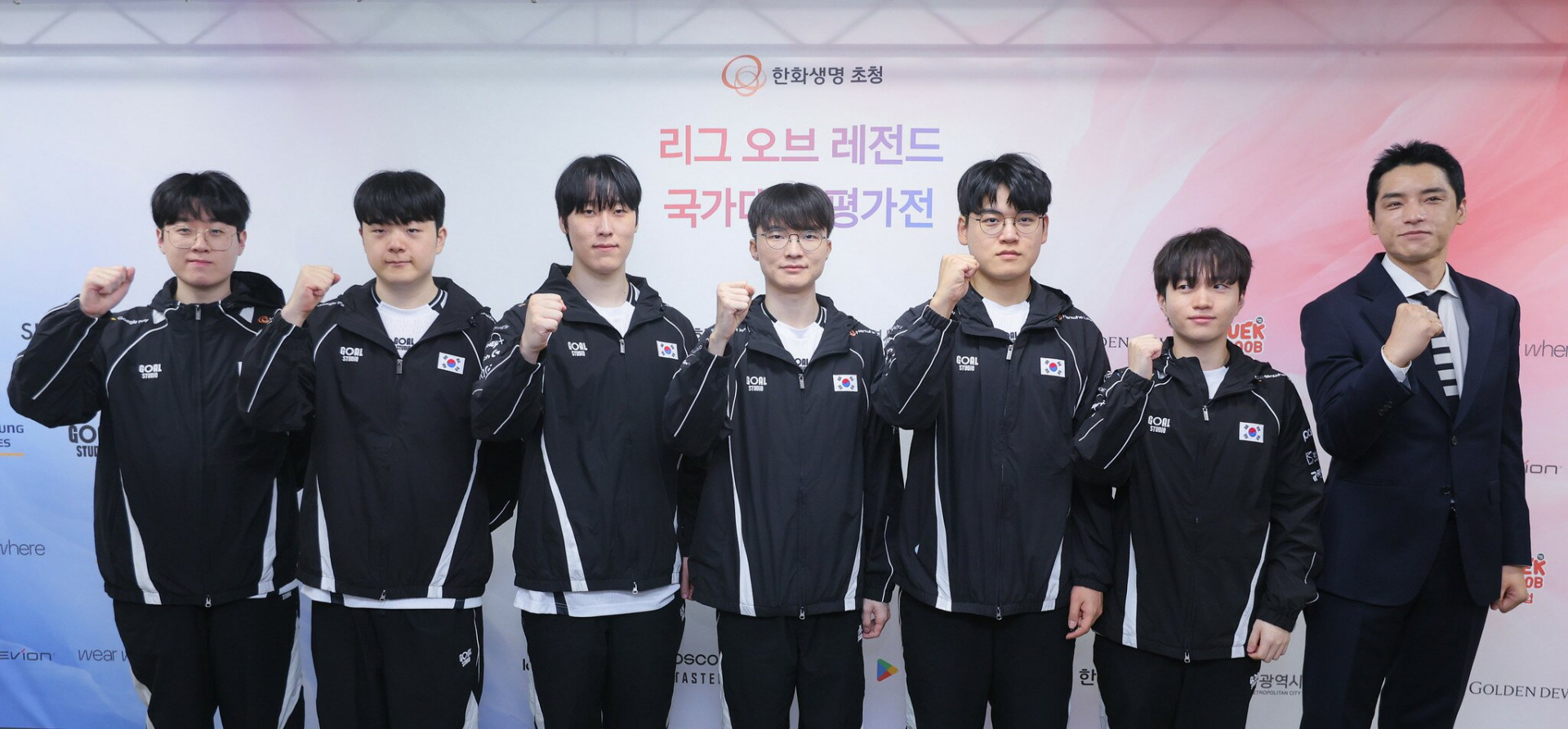
They beat them once in the group stage. To win the gold medal, they must beat them three more times. The South Korean League of Legends national team faces Chinese Taipei once again as they aim for the top of the Asian Games.
South Korea will face Chinese Taipei in the 'LoL' final of the 2026 Aichi-Nagoya Asian Games at Aichi Sky Expo Hall D in Tokoname, Aichi Prefecture, Japan, on October 2 at noon. The match will be played in a best-of-five format. South Korea, which won gold at the Hangzhou Games, is aiming for back-to-back titles.
Leading up to the final, South Korea has not dropped a single game. On September 30, they defeated Chinese Taipei, India, and Hong Kong in order during the group stage, and defeated Saudi Arabia 2-0 in the semifinals on October 1. Chinese Taipei advanced as second place in Group B and swept Group A's top-seeded Vietnam 2-0 in the semifinals. Although they lost their first match against South Korea, they did not allow a single game to Vietnam on their path to the final.
The South Korean players are also not equating their group stage victory directly with the final's outcome. Lee "Gumayusi" Min-hyeong noted that he considers both Chinese Taipei and Vietnam to be strong teams, calling Chinese Taipei's 2-0 victory surprising. He emphasized, "The Chinese Taipei players are so skilled that they are a team we must never drop our guard against."
What will change from the first match is team composition. Kim "Canyon" Geon-bu evaluated Chinese Taipei's composition from the group stage as one that needed to seal the win within a specific timeframe. He believes that if the opponent drafts a proper composition in the final, they are fully capable of showing their true potential. Unlike the group stage, where the outcome was determined over a single game, the final requires adapting to the opponent's choices and adjustments over multiple games.
Chinese Taipei's mid-jungle duo is also a major point of caution. Kim "Zeka" Geon-woo views Chinese Taipei as a team centered around mid laner 'HongQ' and jungler 'JunJia'. Expecting the opponent to revise their strategy after their group stage loss, he stated that South Korea must also prepare for those adjustments. However, his confidence remained clear. Zeka stated that he believes South Korea's mid-jungle duo is better, adding that if they trust each other and perform at their true level, they can win the gold medal.
The strength South Korea demonstrated in the semifinals was their in-game synergy and ability to shift choices on the fly. In Game 2 against Saudi Arabia, after confirming the opponent's Sylas and Illaoi picks, they sent Nidalee top and assigned Olaf to the jungle. Canyon explained that the players communicated and swapped positions regarding the two champions. Choi "Zeus" Woo-je also recalled that although it was an improvised situation, they had kept the position shift for Olaf in mind with the coaching staff, enabling them to find a good option.
The synergy among players assembled from different clubs also forms the foundation for the final. Canyon mentioned that because the players possess solid fundamental skills, they built chemistry quickly during scrims. Ryu "Keria" Min-seok explained that even reunited with Gumayusi after a long time, muscle memory of each other's playstyles meant there were no big issues. Head Coach Kang Dong-hoon evaluated that while there were early losses in the semifinals, the in-game communication and process of finding their direction were solid.
The starting lineup for the final is also a decision tied directly to pick-and-ban strategy. South Korea fielded Zeka against Chinese Taipei and Hong Kong in the group stage and against Saudi Arabia in the semifinals, while Lee "Faker" Sang-hyeok played in the match against India. Coach Kang stated that since the final is a best-of-five, he plans to decide the starting lineup in discussion with the players during pick-and-ban meetings, taking player condition into account.
They have also been preparing for the match starting at noon. Zeus explained that by shifting his daily routine forward by about six hours compared to usual, he is fully awake and alert by noon. Under the head coach's guidance, he began adjusting his wake-up time little by little a month ago and now wakes up around 6:00 to 7:00 AM. Adapting to a schedule different from their familiar afternoon matches was also part of the national team's preparation.
All that remains is one final match. Gumayusi shared his expectations for the gold medal, saying that winning the final would fulfill a long-cherished dream. Coach Kang's goal was the same. When asked what he considers most important in the final, he replied, "I will think of nothing but the gold medal."