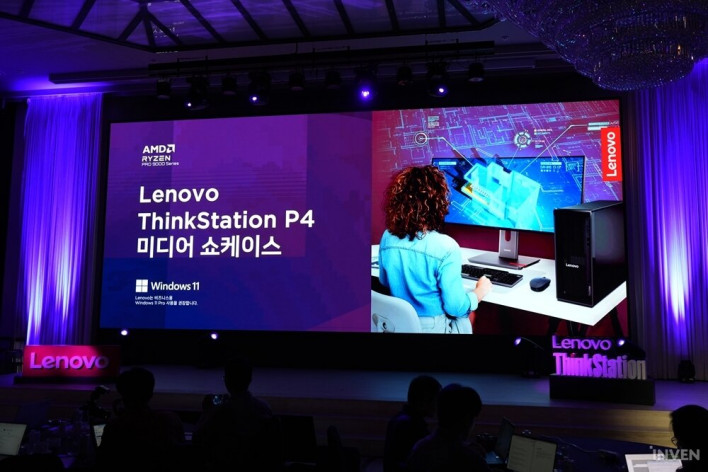
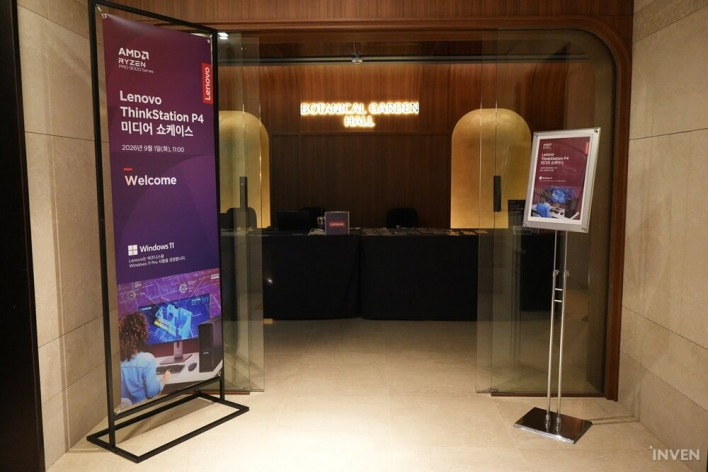
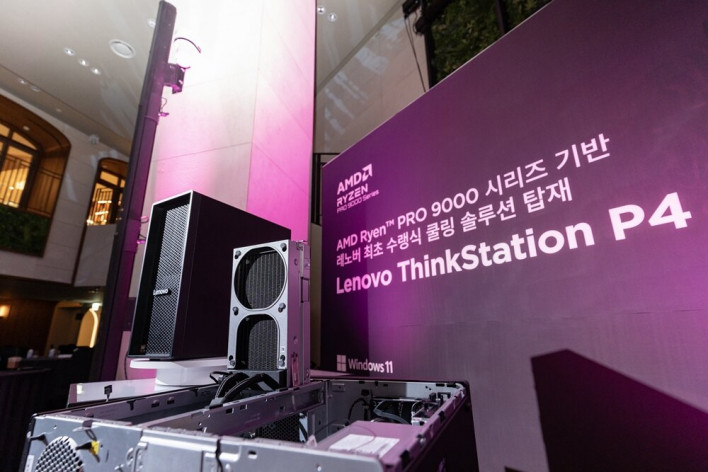
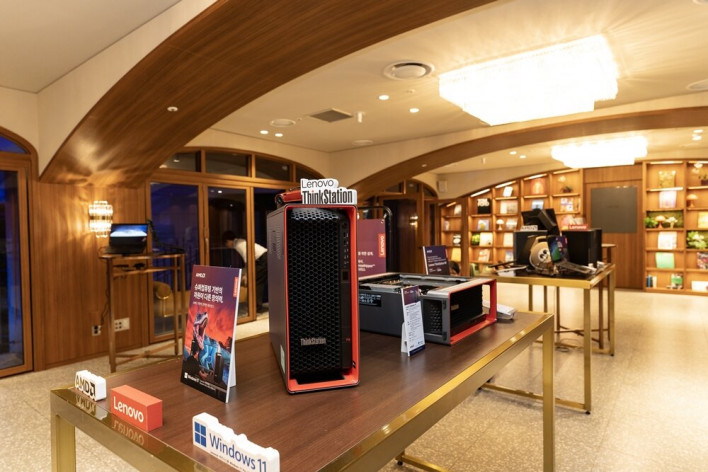
On September 1, Lenovo Korea held a media showcase at Mondrian Seoul Itaewon in Yongsan-gu, Seoul, announcing the domestic launch of the ThinkStation P4, a new workstation powered by AMD Ryzen PRO 9000 series processors.
Workstations are, as the name suggests, professional desktops built for work. For average gamers who already find the price of flagship graphics cards steep, the knee-jerk reaction is often, "Isn't that just a supercomputer?" In fact, when researching them for work, many models start in the millions of won, making it true that they feel distant from typical consumers.
However, the ThinkStation P4 felt a bit different. We live in an era where inflation and surging demand for key components push high-performance gaming PCs to roughly 2.7 million won. Yet, the launch promotional price for the ThinkStation P4 unveiled yesterday landed right around that level. Of course, this is based on initial promotional pricing, and given the nature of professional computing environments, users will likely need extra expenditure on additional memory or SSDs rather than running stock specifications. Nevertheless, it is quite interesting that the barrier to entry feels psychologically much closer than before.
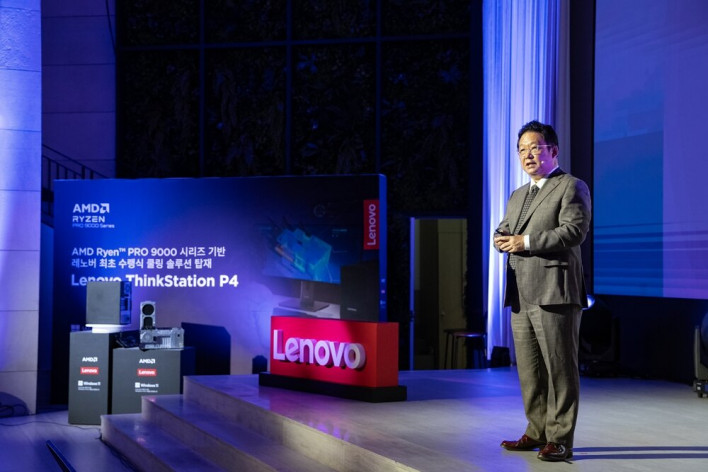
The event kicked off with welcoming remarks from Shin Kyu-sik, CEO of Lenovo Korea. Shin emphasized, "As AI technology spreads across industries, demand for on-device AI-based high-performance computing is surging," adding, "Powered by AMD Ryzen PRO 9000 processors, the ThinkStation P4 is a professional workstation that delivers powerful performance and scalability. It will further boost productivity and efficiency across various professional fields such as design, engineering, and content creation."
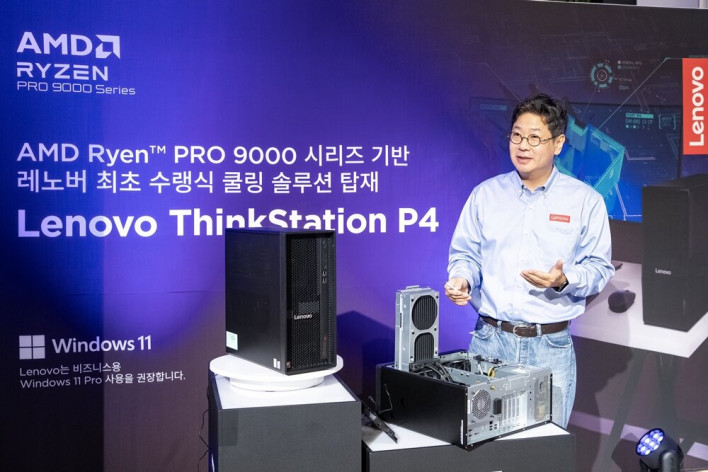
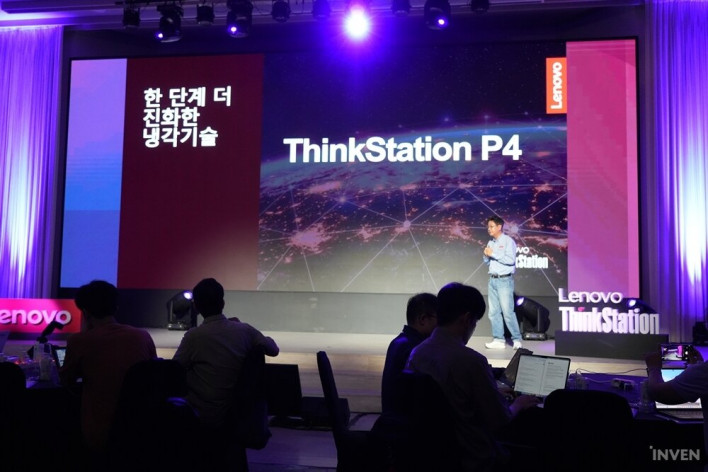
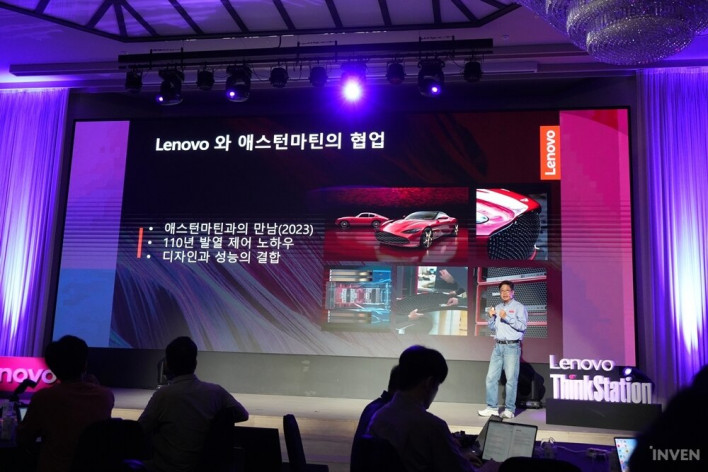
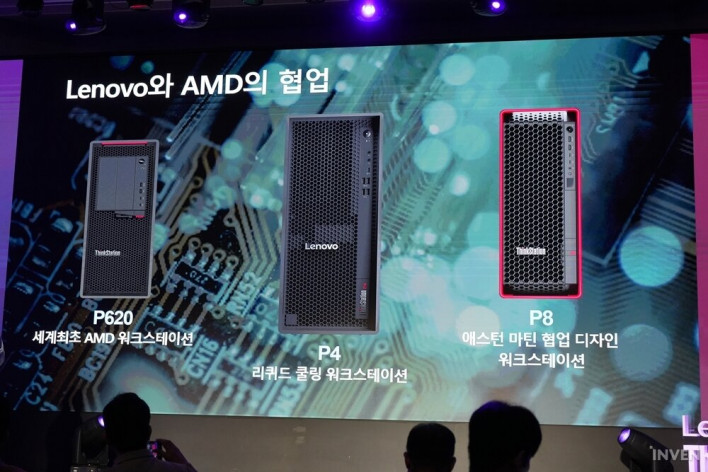
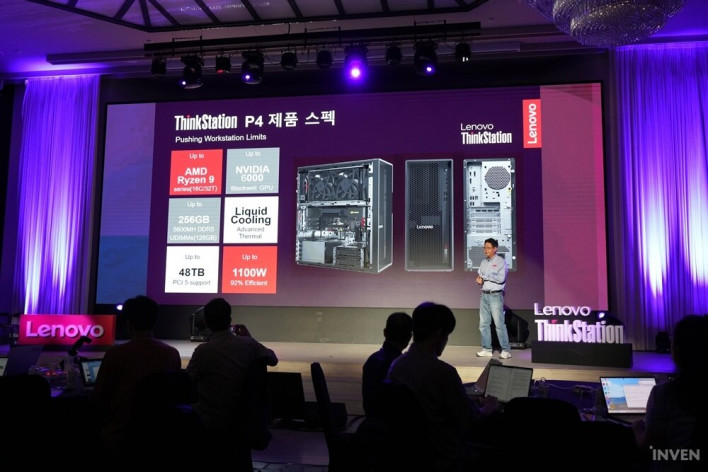
Following the welcoming address, Lee Hyung-woo, Managing Director at Lenovo Korea, delivered the main product briefing. Lee explained the history and characteristics of the ThinkStation lineup, recalling the 2023 collaboration with Aston Martin that incorporated racing thermal management expertise into the front grille and airflow design.
The ThinkStation P4 marks the culmination of this thermal management technology, featuring an all-in-one sealed liquid cooling system—a first-of-its-kind level for desktop and mainstream workstations. He explained that coolant directly absorbs heat generated by the CPU, transfers it to the radiator to dissipate heat, and then recirculates. Designed as an integrated assembly module structure that requires no coolant replacement or maintenance by the user, it thoroughly eliminates leakage risks, according to Lenovo.
Actual test data was also revealed. Under test conditions with an ambient temperature of 25°C and 100% CPU load, the system stably handled approximately 23% higher CPU power (TDP) compared to air-cooled environments while maintaining the same temperature. By effectively controlling heat, it prevents thermal throttling during extended high-load computations and significantly lowers operational noise. While this may translate into increased productivity in a home setting, for enterprise customers operating tens to hundreds of workstations, it represents a point where direct cost savings can be expected.
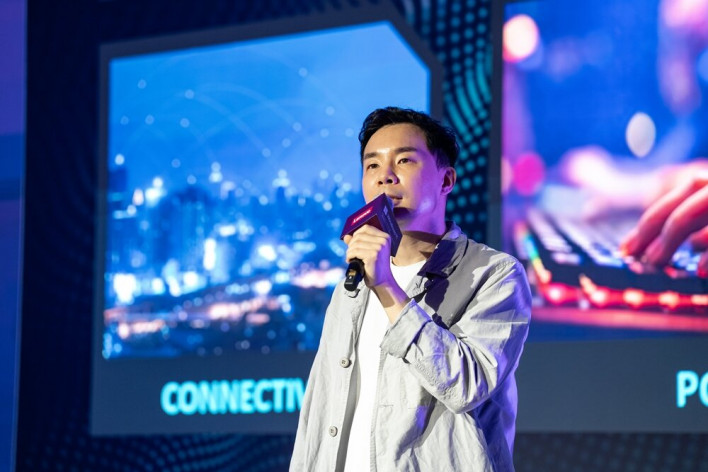
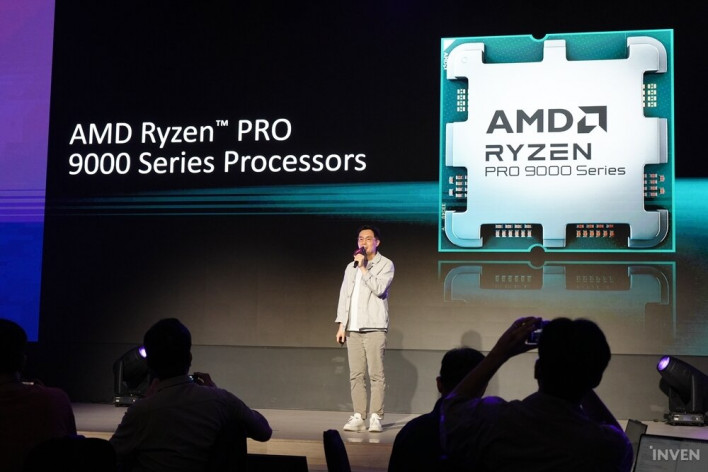
Next, Song Sung-woon, Executive Director at AMD Korea, introduced the included processor line, the AMD Ryzen PRO 9000 series. Built on the Zen 5 architecture, this series supports up to 16 cores and 32 threads and features AMD's proprietary 3D V-Cache technology. By stacking cache memory vertically, total capacity is expanded up to 144MB, minimizing DRAM access bottlenecks and significantly boosting large-scale computation speeds, Song stated.
According to benchmarks presented by AMD Korea, models featuring 3D V-Cache demonstrate outstanding efficiency in areas such as AI and machine learning (up to 15%), data science (up to 21%), CFD fluid dynamics simulation (up to 19%), and matrix factorization operations (up to 20%). In addition, the systems come equipped with the AMD PRO platform—a multi-layered security system—offering robust security, remote management convenience, and supply stability.
Lenovo emphasized that the ThinkStation P4 is not limited to a specific industry and can be deployed across diverse fields. It accommodates a wide spectrum of tasks, including architectural design (CAD/BIM) and simulation, media and entertainment rendering, healthcare medical image analysis, as well as edge-side AI inference and fine-tuning, which have seen rising demand recently. In particular, regarding the relatively accessible P4 model, Lenovo revealed the behind-the-scenes backstory: "We actively pursued the launch in South Korea after reflecting feedback from field professionals in Korea's media and content industry representing K-Culture."
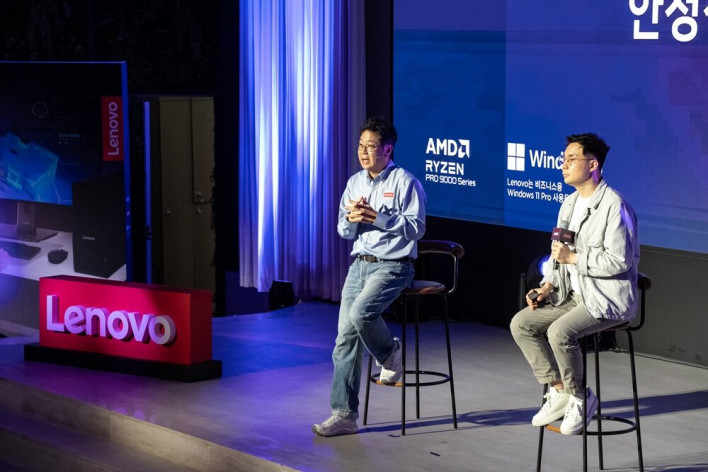
[On-Site Q&A]
Q: What are the performance gains and differences compared to the existing ThinkStation P3?
Lenovo Representative: The ThinkStation P4 is not a mere successor to the P3. It is a newly established platform created to strengthen our AMD lineup separately from the Intel-based lineup. Therefore, rather than direct metric comparisons with the P3, we would appreciate it if you focus on the platform evolution: the transition from air cooling to liquid cooling, the world's first adoption of AMD Ryzen PRO 9000 processors, and reliably housing high-performance GPUs like the NVIDIA RTX PRO 6000 class inside a compact chassis.
Q: When applying liquid cooling, what are the risks of coolant leakage and the service policy for customer support?
Lenovo Representative: It is designed as a fully integrated, sealed unit that requires no manual coolant injection or replacement by the user. Through internal testing, we have fundamentally eliminated the possibility of leakage. Even in the unlikely event that an issue arises, users do not repair individual components; instead, they can receive comprehensive modular inspection and replacement support through Lenovo service centers.
Q: What are the structural advantages of the AMD Ryzen PRO 9000 series compared to competing processors?
AMD Representative: By offering more physical cores and threads (up to 16 cores and 32 threads) than competitors, it has an advantage in background tasks and multitasking environments. In particular, the 3D V-Cache technology with up to 144MB significantly reduces DRAM bottlenecks in memory-intensive professional applications such as simulations, CAD, and data analysis, delivering superior real-world compute performance ranging from a minimum of 10% to over 30% higher.

Sort by:
Comments :0