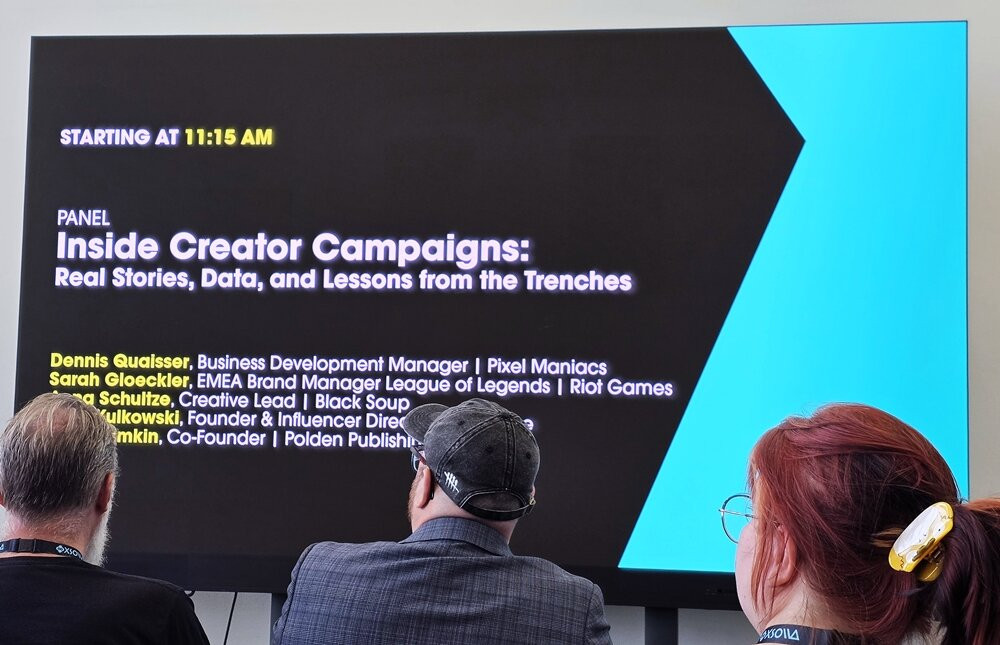
In late August, gamescom dev—Europe's largest game developer conference held in Cologne, Germany—hosted an intriguing session unpacking the realities of creator marketing. The panel discussion, titled "Inside Creator Campaigns: Real Stories, Data, and Lessons from the Trenches," took place on August 25, the second day of the event.
The discussion highlighted influencer campaign strategies based on data and practical experience, moving away from cookie-cutter marketing backed by massive budgets. It covered the real-world hits and misses of creator marketing across various scales and environments—from new IP launches by major publishers to local community charity events and zero-budget cold email outreach by small indie developers.
The panel featured Jake Kulkowski of Guillotine, Sarah Gloeckler of Riot Games, Anna Schultze of Black Soup, and Kirill Akimkin of Polden Publishing. The speakers shared practical marketing insights without filter, detailing specific metrics and failures from their own campaigns.
Limitations of New IP Creator Programs and Practical Marketing Strategies
Speaker Jake Kulkowski is the founder and director of Guillotine, an agency specializing in creator partnerships. Active in the field since 2019, he has participated in marketing over 250 games, including Baldur's Gate 3, Elden Ring, and Persona 5.
During his session, Kulkowski shared three major marketing failures during the campaign for Clair Obscur: Expedition 33 that were buried due to poor timing. The first was poor timing for merch distribution. 33 handmade Verso necklaces crafted by jewelry designer Hannah Martin were delivered to top influencers, but without a follow-up amplification plan, they ended up as little more than press release fodder. The second was hosting a launch party too early. Because the party was held before the game released, attending creators had little to talk about regarding the game, resulting in just a few Instagram stories that disappeared after 24 hours.
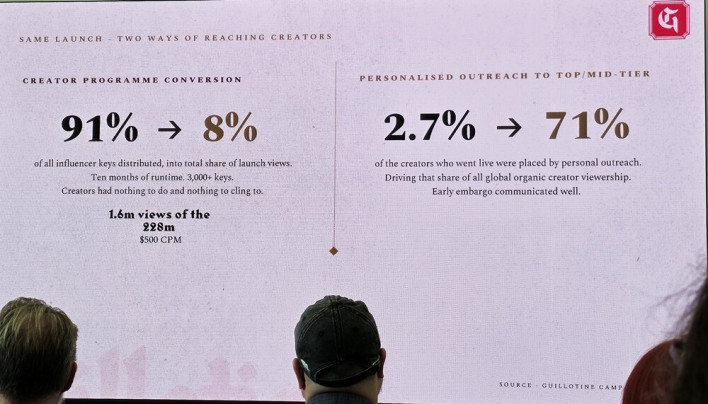
The third and most painful mistake he highlighted was running a "creator program" too early. He pointed out the inefficiency of assembling and running a dedicated team well before launch for a new IP from a new studio. Over 10 months, 91% of all influencer distribution keys were used on this program, yet it accounted for a mere 8% of total views at launch. In contrast, personalized direct outreach to top and mid-tier creators used only 2.7% of distributed keys while driving an overwhelming 71% of global organic creator views.
Regarding this, Kulkowski noted, "Creators do not equal the entire community; they are merely the starting point for building a community." He added that it is unrealistic to expect creators to blindly become fans of a new IP that no one has played yet. While large-scale programs consume significant budgets, personalized outreach directly inviting them to play the game is far more effective at encouraging immediate gameplay and securing early momentum.
Furthermore, he advised, "Don't try to sell a game too early when no one has experienced it yet." Creator programs, he explained, are tools to "organize" an existing fandom rather than "create" one from scratch. For a new IP, he emphasized that it is far more effective to concentrate the budget right before and after launch rather than wasting it 10 months prior to release.
Five Years of Insights from VALORANT Charity Tournament 'Fragging for Charity'
Sarah Gloeckler of Riot Games and Anna Schultze of creator marketing agency Black Soup shared case studies from "Fragging for Charity," a VALORANT charity community event held in Germany over five years starting in 2020. The three core objectives of the initial planning were "raising awareness and brand perception," "securing trust among the core target audience," and "empowering creators."
To overcome the limitations of the default game modes, they introduced new mini-games such as "King of the Range." In this mode, each training bot eliminated using a Sheriff pistol accumulated €50 in donations. Additionally, rather than driving one-off donations, they designed a "Donation Pass" system where reaching specific community donation milestones unlocked merchandise or additional funds.
In the early days, fierce competitive tournaments and casual mini-games were mixed across two days, but this resulted in long wait times and operational burdens for creators. Gloeckler recalled, "We realized that viewers were split between those who wanted to see high-level plays and those who wanted casual entertainment. It would have been better to hold two separate events with distinct tones." Meanwhile, she added that spending €3,500 to produce personalized animated intros to honor unpaid participating creators contributed significantly to driving active promotion and high satisfaction among participants.
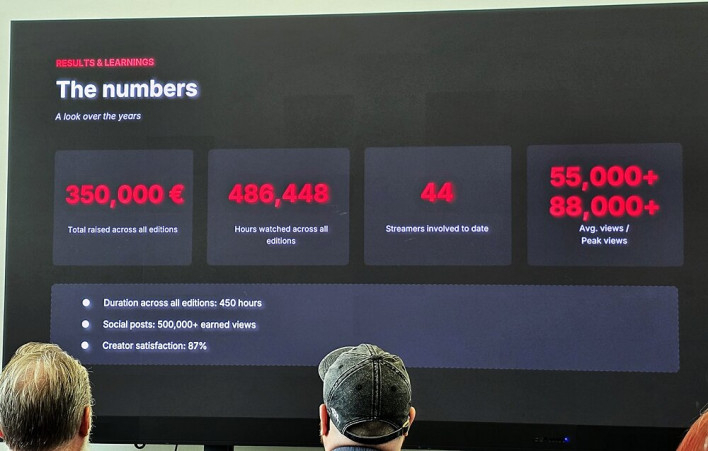
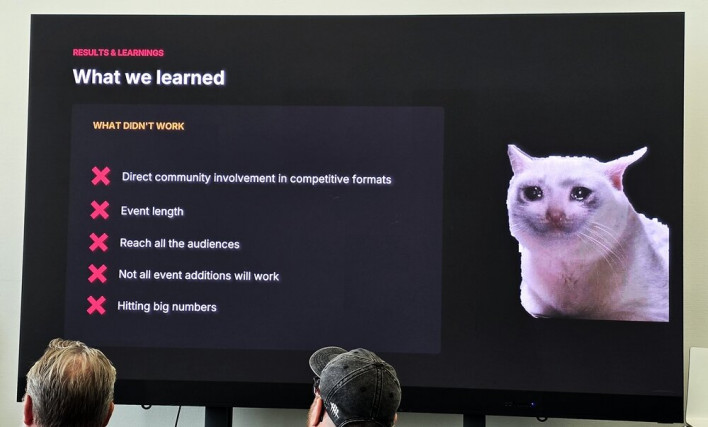
As a result, the event raised a cumulative total of €350,000 (approx. 558 million won), with 44 streamers participating to record a cumulative 486,448 hours watched. However, the failures and lessons were equally clear. Involving the general community directly in competitive formats caused balance issues, and early multi-day event schedules led to viewer drop-off. Gloeckler particularly pointed to a steep drop in viewership when inserting a heavy topic like a "Mental Health Panel Talk" amid a cheerful atmosphere, emphasizing the importance of planning that matches the event's overall nature and tone.
Cold Email Survival Strategies for Small Indie Publishers
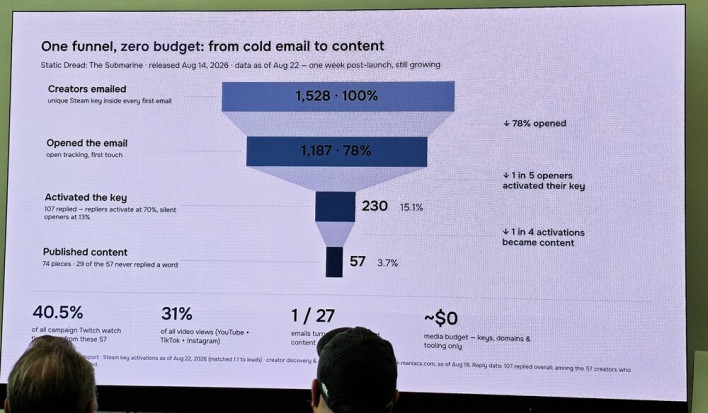
Kirill Akimkin of Polden Publishing presented practical email marketing strategies for small indie publishers with limited marketing budgets. Polden Publishing launched four games without spending marketing budget on creator channels, generating a total revenue of $2 million (approx. 2.755 billion won).
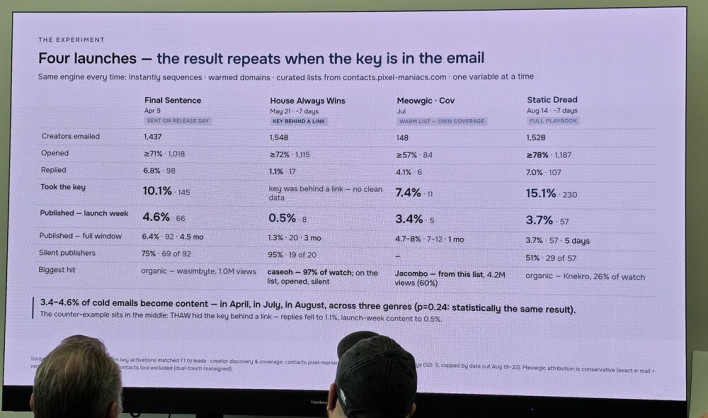
To boost cold email deliverability, he achieved a 90% email open rate by securing a custom domain, setting up SPF/DKIM/DMARC, performing email warmup, and managing verified recipient lists. He particularly emphasized that when reaching out to creators, Steam keys must be displayed directly in the body of the very first email. Hiding keys behind links forces creators through unnecessary steps, causing conversion rates to plunge to single digits; in fact, a campaign that provided keys via link clicks resulted in zero keys redeemed.
Akimkin also explained that sending over 10,000 emails per month requires an automated system to minimize human error. To achieve this, Polden varied email copy across 6 to 8 versions and sent follow-up emails with different content every three days. He advised that prior to sending, teams must filter a verified list of target creators based on clear criteria (SQL) such as subscriber count, watch time, and recent upload dates to avoid random blasts.
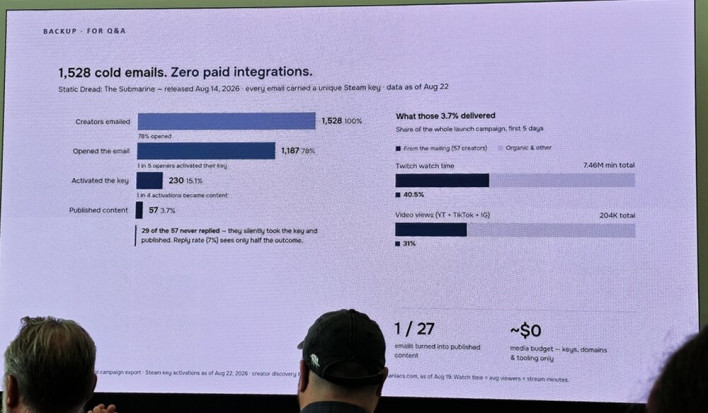
He also pointed out the traps behind the data. For the campaign of their August 2026 title Static Dread, they sent 1,528 cold emails, leading to 57 creators (3.7%) publishing content. However, 29 of those creators streamed the game after quietly redeeming the key without sending any reply. This means marketers miss half of the actual results if they evaluate campaign performance based solely on reply rates. Additionally, he noted that re-engaging a list of creators who had previously covered their games yielded a conversion rate seven times higher than cold outreach alone.

Sort by:
Comments :0