This year's Gamescom saw participation from around 1,600 companies across 67 countries. With an exhibition space of 233,000 m², it nearly filled Koelnmesse to capacity, making it the largest event in the show's history. Naturally, it is private companies that fill these numbers. Each studio competes in its own way to showcase its games to players and buyers from around the globe. But above this private-sector battleground lies another layer: the B2B national pavilion.
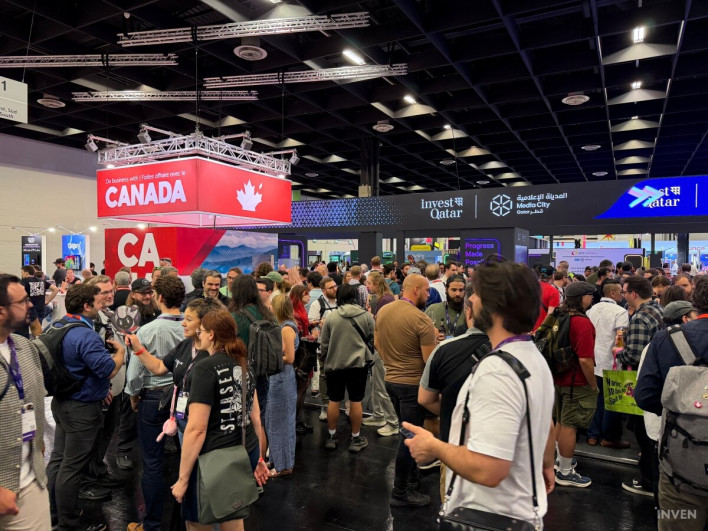
The message from countries setting up national pavilions is identical: "Invest in our games." Though the expressions and presentations vary, the underlying message converges into one. Up to this point, it reads like a standard state-support project. Step back, however, and a different picture emerges.
Gaming is leisure. A nation that has not solved the basic livelihoods of its citizens can hardly place the promotion of the gaming industry on its national agenda. Seeking entertainment and industrializing play come after that baseline is secured. When a country stands on an international stage and says "Invest in our games," it is also declaring that it has already passed that foundational stage. A national pavilion serves not only as an industry showcase, but also as a venue displaying a nation's stage of development and surplus wealth. That is why national pavilions are diplomacy.
Diplomacy is exchange, but it is also competition. While national pavilions standing side by side look like cooperation, in reality, they are structured to compete for the limited time of the same buyers. A crowded booth for one country means the neighboring country's booth was just as quiet.
In fact, national pavilions often adopt the formal structure of diplomacy. France is a prime example. The French Pavilion, operated by Business France, hosted a reception breakfast attended by French Consul General Etienne Sur. It is a setup where actual diplomats step into B2B exhibition booths to welcome guests.
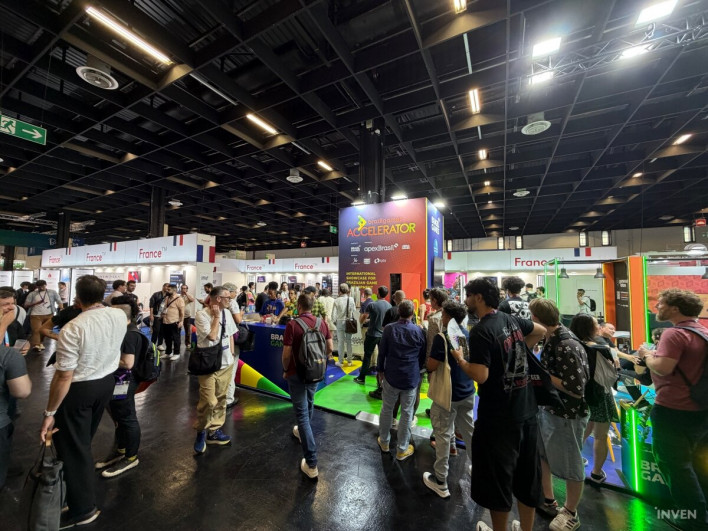
It is also worth noting that the French Pavilion does not showcase games alone. Engines, middleware, sound, localization, and education—the entire ecosystem of services and infrastructure surrounding games—are bundled together under the single banner of "Pavillon France." It is an approach that sells the country that makes games, rather than just selling individual games. On top of this, a financial structure covers up to half of the participation costs through regional export support programs.
The most impressive national pavilion on site this year was Brazil's. The Brazilian Game Developers Association (Abragames), together with export and investment promotion agency ApexBrasil, brought a delegation of 78 studios and companies. In addition, Embratur (the Brazilian Tourist Board), Sebrae (the Brazilian Micro and Small Business Support Service), and startup support agencies from the city and state of São Paulo were listed among the sponsors.
This speaks volumes about how Brazil views video games. It means they see games as a national brand asset. Behind this lies policy overhaul. Brazil established regulatory frameworks governing development, distribution, and commercial use while incorporating investment attraction and tax incentives. The national pavilion is a showcase for those policies.
On site, Brazil's booth was packed with people. This matters because the success of a national pavilion ultimately stems from headcount. If the success of a trailer reveal at Opening Night Live (ONL) is measured by the cheers of the audience, the success of a national pavilion is measured by how many people stand in front of its booth. A B2B exhibition area is no different; the target audience simply consists of publishers, investors, platform leads, and international media rather than the general public.
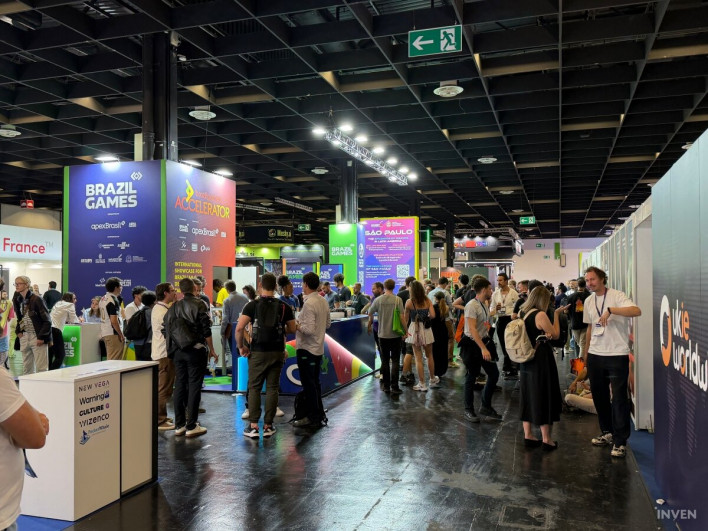
Pavilions that attract crowds share a common trait: they pull people in by any means necessary. They hold receptions, serve light alcoholic drinks, and pass around refreshments. They create hooks that stop buyers walking past consultation tables in their tracks. As crowds gather, exposure for the participating companies increases. That exposure is the true metric of support.
One might argue that crowd size in front of booths is not the goal, given that B2B joint pavilions measure performance by consultation counts and deal values. However, that perspective reduces a national pavilion to a booth rental proxy service. The additional value a national pavilion can generate lies in the moments when someone not on the pre-arranged meeting list spontaneously stops in their tracks—and that is precisely what Brazil and France designed for.
In that sense, Korea's pavilion this year felt like a lowercase "i" caught between uppercase "E"s. This is not to say it was wrong, but rather unfortunate. First of all, it was quiet. The booths were orderly, and meetings were taking place. However, there were no visible devices to catch the feet of passersby. It was the difference between simply providing a space and actively creating opportunities.
Of course, differences in crowd attraction can also be attributed to booth conditions. Budget determines booth footprint, and size directly dictates foot-traffic exposure. Where a pavilion is assigned within a hall and whether it faces a main aisle dramatically alters the number of passersby from the start. There are undeniably variables beyond the control of pavilion operators.
Yet tracing those variables back leads right to the same core issue. What determines booth footprint is budget, and what determines budget size is where this initiative ranks in national priorities. Securing prime locations comes down to negotiation, and negotiation leverage is built over years of participation history and delegation scale. Neither Brazil bringing 78 entities nor France bundling adjacent game industries under a single name was an achievement built in a single year.
Conditions did not create the results; interest created the conditions. Game against game, there is no reason Korean Pavilion titles should fall behind Brazil's. Brazil's gaming market ranks around top 10 globally at roughly $2.6 billion annually, while the Korean gaming industry's annual export volume alone surpasses that figure. Yet the heavier weight class in terms of industry size found itself standing in the background at the national pavilion level.
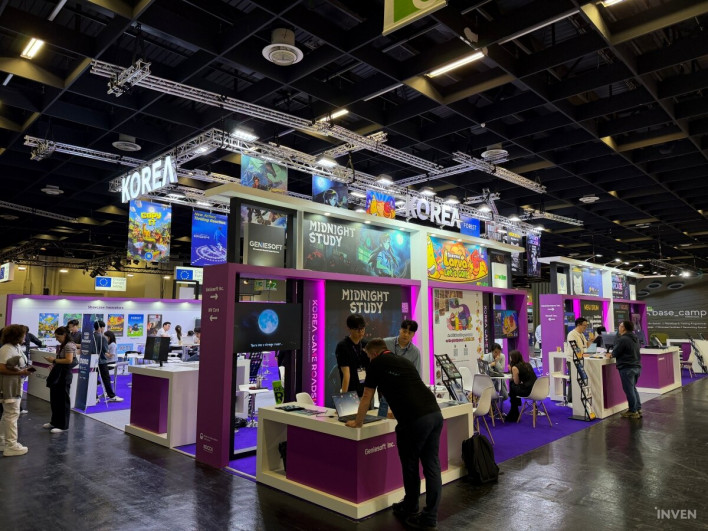
It comes down to a difference in how a national pavilion is defined. A country that views it as an arena of competition and a country that views it as a support channel perform entirely different tasks inside the same hall.
In an interview last year, Krafton Chairman Chang Byung-gyu cited Brazil as a market of new interest as the company focuses on global expansion. While Korean game companies view South America as their next market, that market's government brought 78 companies to Cologne. It is clear which side is converting the other's interest into an asset for its own industry.
What is needed is not a demand for budget increases, but a redefinition of the mission. Shifting the concept of national pavilions from an overseas exhibition support project for SMBs to a national branding and diplomatic initiative fundamentally changes the blueprint.
This year, the National Assembly visited Gamescom for the first time. The delegation was led by Representative Cho Seoung-lae of the Democratic Party of Korea, alongside Representatives Kim Seong-hoe, Jeong Yeon-wook of the People Power Party, and Lee Hae-min of the Rebuilding Korea Party. What they needed to observe in Cologne was not how well Korean games are crafted. What they needed to observe was who we were competing against and what was truly at stake.

Sort by:
Comments :0