
Krafton's 'NO LAW', showcased at Gamescom 2026, catches attention for how it is being made even before its content. The development team consists of just 24 people. While billing itself as a AAA open-world FPS RPG, its goal is to prove that a game of that caliber can be built without spending hundreds of millions of dollars.
'NO LAW' is an immersive open-world FPS RPG developed by Uppsala, Sweden-based Neon Giant. Set in the cyber-noir port city of Port Desire, the story follows retired veteran Gray Harker on a quest for revenge to reclaim what was taken from him. Targeted for a 2027 release on PC, PS5, and Xbox Series X|S, the game was first revealed at The Game Awards last December and will debut its gameplay at Gamescom 2026.
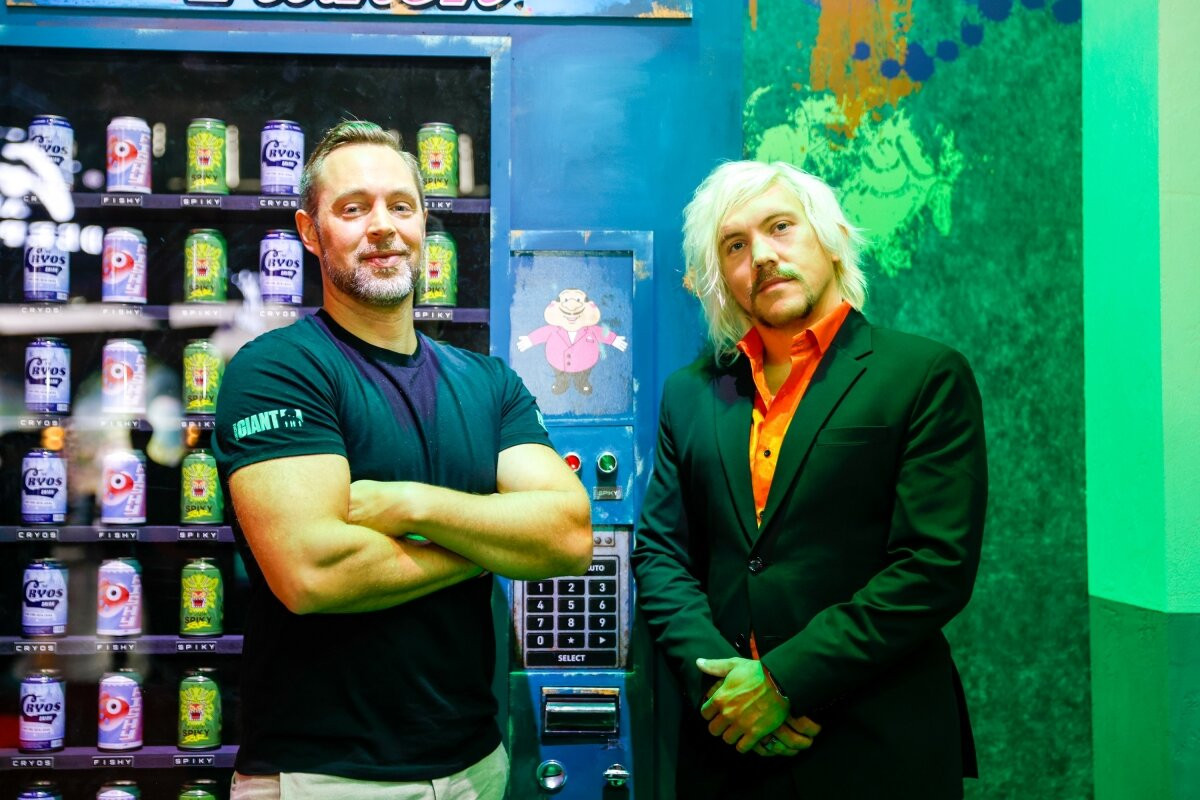
Presenting the game were Neon Giant co-founders and creative directors Tor Frick and Arcade Berg.
The rationale behind founding the studio was itself a critique of the gaming industry. Berg explained that while both of them came from the AAA space and loved making those games, after spending enough time in that environment, they felt there had to be a better way. "We saw a lot of waste happening in the industry. Budgets for AAA games exploded from $10 million to hundreds of millions of dollars, and that didn't feel right," he stated. "So we decided to put our money where our mouth was and start a smaller studio."
Neon Giant was founded in 2018. Initially, it was just the two of them building small projects on Unreal Engine, and their debut title, 'The Ascent', was developed with an average team of seven people, growing to 12 by launch. Although the current team has doubled to 24 people, Berg remarked that "the ambition of this game is ten times greater." According to presentation materials, the team consists of 25 senior developers with an average of 15 to 20 years of AAA development experience. Their portfolio of past works includes the Wolfenstein series, 'Doom', 'Just Cause', 'Fallout 4', 'The Division', 'Gears of War: Judgment', and the MotorStorm series.
Berg explained that the team composition itself was intentionally designed. "Everyone on the team has previously held lead or director positions, but once you reach those roles, you get pulled away from actually making the game," he said. "We are creators who want to stay hands-on, so we created a workspace where that's possible."
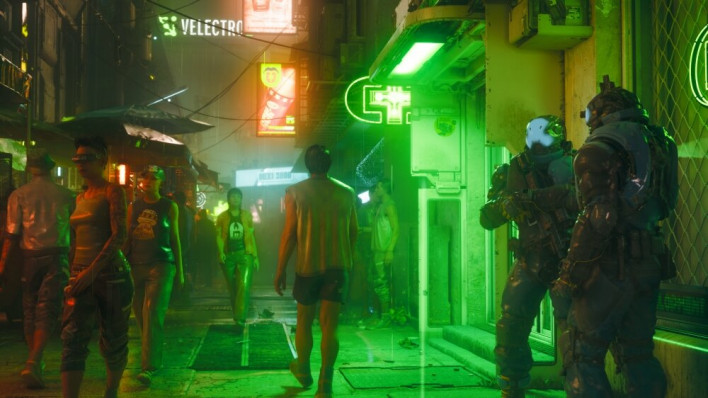
What they aim to achieve under the principle of "density over scale" is verticality and density. "We want players to climb onto rooftops, traverse balconies, navigate through alleyways, and head down into the underground. We want them to discover interesting backyards and find something in every nook and cranny of the rooftops," he said. The goal is not to create the largest city in the world, but the densest one.
They also revealed how they bypassed traditional development bottlenecks. Frick first pointed out that because the team is small and everyone is highly experienced, there is no need for prolonged arguments over decision-making. By largely skipping middle management layers and meetings, the entire team works directly inside the engine every day. "Even QA doesn't stay outside the engine," he noted.
The discussion about internal tools was even more specific. Berg mentioned that while software released to the market must be designed so anyone can use it, they have no such constraint. "We're fortunate enough not to work with idiots, so we can build complex internal tools. The most time-consuming part of tool development is 'fool-proofing'," he stated. "In my 20 years of game development, I've never seen a studio turn things around this quickly. A tool requested today arrives the next day—or actually, the next hour." However, he added that these tools are not something that could be handed off to other studios or larger teams.
Frick also acknowledged the limitations of this approach. "We can do anything, but we can't do everything," he said, explaining that they must always be careful about which battles to pick, making it difficult to state exactly what the final game will look like. He noted that they are finding their way forward together as a team as they build.
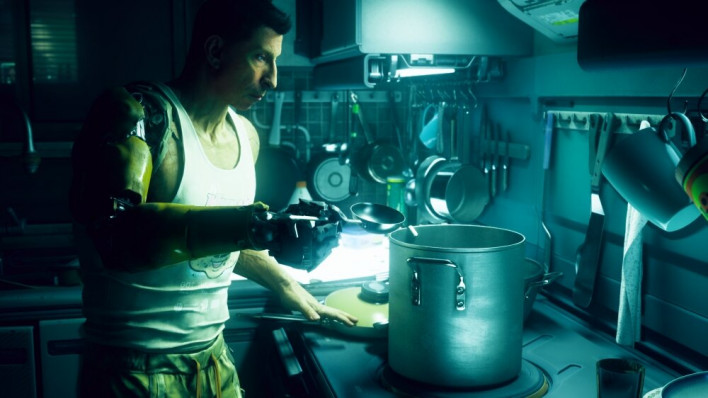
The vision they presented for the game rests on three pillars: systems-driven design that lets players solve challenges in their own way while elevating key narrative moments to AAA standards, non-linear narratives emerging from systems that react to player choices, and player agency that opens up multiple paths. They summarized this with the phrases, "If there are 100 players, 100 different experiences will be created," and "There is no such thing as failure."
Frick emphasized that the "choice" mentioned here does not refer to dialogue options. "It doesn't mean a dialogue tree where you choose A or B; it refers to decisions made during gameplay," he explained. "We want the game to react to whether you charge in with guns blazing or sneak in to hack." The narrative is also non-linear, leaving how and in what order to solve missions up to the player, while NPCs react differently depending on whether the player is violent or stealthy.
Where this principle manifests numerically is in the experience point design. "Going in with guns blazing is completely valid, and shooting everyone won't penalize you, but we also don't award XP for headshots," Frick explained. "We don't want stealth players to have a worse experience than shooter players." The same applies if players bypass mission objectives and find workarounds. Regarding that as a result of exploring the city and its systems, he stated, "Players cannot play the game wrong."
Port Desire, a Tri-Border City... "The City is the Main Character"
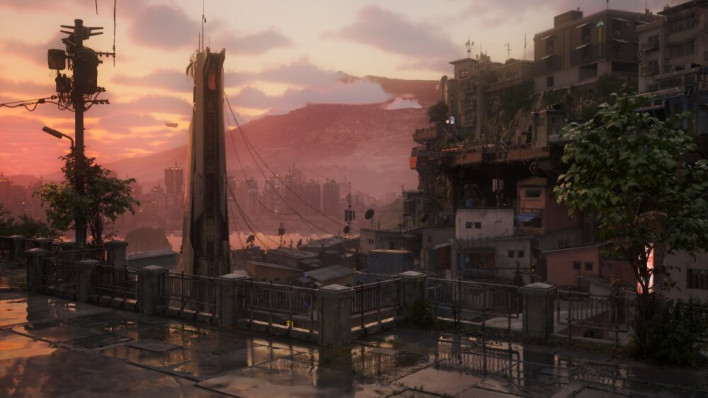
The setting, Port Desire, is a cyberpunk city located at the border of three nations. It is a high-density urban sandbox with narrow alleys and tightly packed vertical structures, defined as a city that is "stable on the outside, but rotten on the inside." It is an industrial cyber-grunge city perched on coastal cliffs as well as a trade hub filled with lush greenery.
Frick noted that "the city is the protagonist of this game." He explained that they spent a great deal of time making it feel like a living, breathing place rather than just a flat backdrop for the player. "We don't want a city that serves as a flat backdrop for missions. We want players to explore from top to bottom, moving across rooftops and down into sewers," he said.
The city also runs on systems. It features dynamic day-and-night cycles and weather systems, with AI and city life reacting to them. Frick provided specific examples: when it rains, fewer people are on the streets, except in party districts where people don't care about the weather. Bars and shops open depending on the day of the week. While the city looks decent enough during the day, at night, more alleys become places you wouldn't want to enter unless you're ready for a fight. Gangsters lie in ambush in back alleys.
Law enforcement is handled by "Peacekeepers." A "corrupt" Peacekeeper force maintains its own version of order. Frick explained that while it is a lawless city, it is not apocalyptic: "There are Peacekeeper forces deployed by neighboring nations, but they exist to maintain the status quo, not to enforce conventional laws." In other words, while they will pursue you if you start a fight, it remains a permissive city filled with vice and crime.
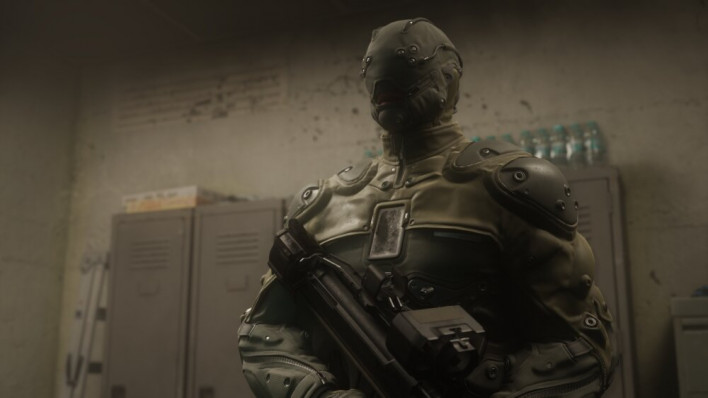
A point repeatedly emphasized is that actions leave consequences behind. The gameplay loop consists of four stages: scouring dense districts to gather clues and intel to find a target; infiltrating by climbing walls, crawling through vents, or walking right through the front door; eliminating the target using stealth, action, and deduction; and having the city and story change depending on who was eliminated and how. Presentation materials also included screens showing incidents published as newspaper articles.
Berg offered an even more extreme example. "If you shoot a shopkeeper in a store, they die permanently, and the shop has to close," he said. "Some crazy player could kill every shopkeeper and shut down every shop in the city." While not recommended or expected gameplay, he explained that it is crucial for the game world to react to and remember player actions. He added that while a bartender might keep a shotgun behind the counter, it shouldn't end there—there must be lasting consequences.
Purchasing items operates on the same principle. Players physically pick up goods, put them in a shopping cart, and pay at the counter. Berg stated, "We try to root every gameplay system in the world, the fiction, and the characters," while Frick added, "It's to keep the player in a state of maximum immersion."
Skipping mission sequences is also permitted. Berg cited the fact that the world exists independently of story progression as the reason. "Even if the sequence is to follow clues through ten steps to discover a location and kill someone, that person was already there from the start," he explained. "If you already know, you can go straight there, because they don't spawn just for the story." They expect sequence breaking and view it as valid play.
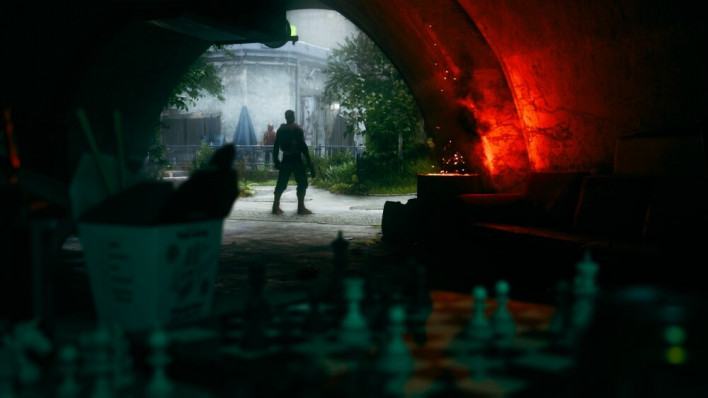
Emergent gameplay is already surfacing. The example Berg provided was a smart-matter grenade—a grenade that suspends targets frozen in mid-air, which can also affect the thrower. A tester threw a grenade on a rooftop and, timed with the explosion while suspended in mid-air, caught themselves and dropped down, descending from a rooftop that was normally inaccessible. "We expect to see many creative solutions and ridiculous speedrun videos we never anticipated," Frick said. "To us, those aren't bugs; they're features."
The mechanism balancing two opposing playstyles is inventory management. "Inventory capacity is limited, so you can't carry everything," Berg explained. "If you pack a pistol and a shotgun, you've chosen loud weapons. Alternatively, you might choose a taser and a stealth pistol, or attach a suppressor to a submachine gun." The logic is that for choices to be interesting, they must be meaningful, and if you can fit everything into your bag, choices disappear. The same applies to skill points: available viable options change depending on whether you invest in stealth, hacking, or gear trees.
An area that received special effort was the tactile feel of stealth. "An action star running around surrounded by loud guns and explosions while kicking faces always looks cool," Berg pointed out. "On the other hand, sneaking around undetected might be fun gameplay, but it isn't a power fantasy and doesn't feel as cool as being an action star." He explained that they put substantial effort into making the abilities and tools used by stealth players visually striking and spectacular.
In combat design, the rule established by the pair is that getting detected should not feel like failure. "The moment a stealthy player gets spotted and pulls out loud guns shouldn't feel like a failure," Frick said, citing James Bond movies as an example. Starting with stealth and transitioning into an escape through gunfights and explosions upon detection must remain a valid solution.
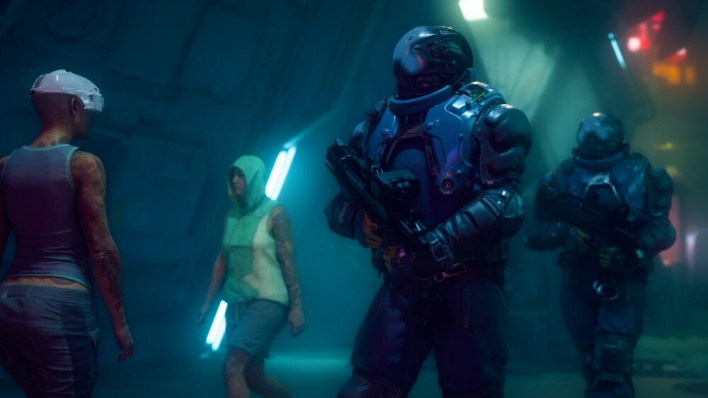
They also shared their stance on handling violence. "Gore and violence can be ridiculous, but they should be a spectacle," Berg said. "We wanted a heavy sense of impact, not anxiety, torture, or suffering. We wanted explosions and cheers." Frick summarized it in one sentence: "It's 'Judge Dredd', not 'The Last of Us'."
They expressed confidence in the gunplay itself, as a significant portion of the team previously worked on major shooter franchises. "When we started development, the shooting and action experience was the thing we worried about least," Berg said. "That doesn't mean it's easy—we put in a lot of work—but for that part, we could lean on 20 years of expertise."
At Gamescom, the two directors conducted a hands-off demo where they played and narrated in person. Built around a single core route with full freedom in approach, the session lasted approximately 50 minutes in total.
The demo takes place in the very early stage of the game. Starting in the protagonist's apartment building, it introduced the dialogue system through an encounter with the landlord Roscoe, then moved to Main Street during the day to showcase the shopping system at a store. The tone shifted as they descended into the lower city where gangsters multiply. The breakdown of time per segment listed in the materials was approximately 2 minutes in the initial building, 5 minutes on Main Street, 20 minutes in the informant courtyard, 10 minutes in the apartment, and 13 minutes in the escape sequence.
The core feature is branching paths. The materials listed alternative routes for each segment: daytime vs. nighttime on Main Street; infiltrating by vehicle vs. climbing fences in the informant courtyard; using suppressed weapons vs. causing chaos to enter the apartment; and taking an alternative exit vs. talking your way out during the escape.
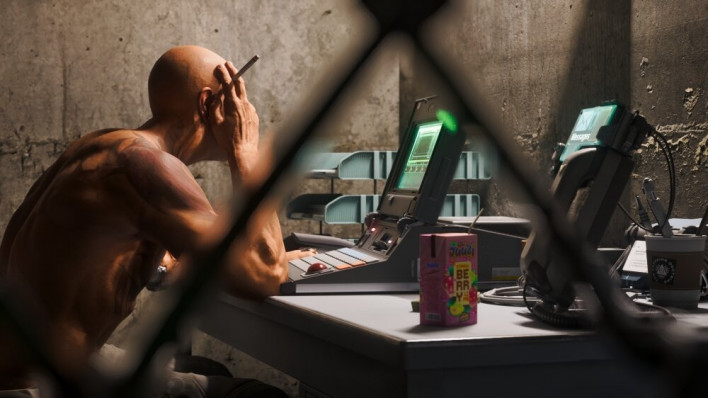
Berg detailed the apartment entry segment. The character inside, Ren, has no intention of letting the player in, but the dialogue varies depending on the approach. "If you made a lot of noise coming in, Ren mentions, 'What happened outside? I heard gunshots or something, and now a stranger shows up,'" Berg said, revealing multiple ways to get past, including choices leading to a fight, bribes, or specific passwords. He added, "Shoving a shotgun in someone's face is usually a working solution, but it's not the solution every player wants to use."
The two revealed plans to replay from a midpoint after completing the demo once. For instance, if the first playthrough was handled via stealth, the second would toss a grenade into the courtyard to see what happens. "We're trying to show a very small piece of the game alongside how broadly and deeply it can be played," Berg explained. "The intention is for people to project that across the entire game."
This is also why he attaches significance to Gamescom this year. Since last year's reveal, they have talked about the lore and tone for over half a year, but had yet to demonstrate actual gameplay. "It's time to show that everything we've shown so far is real and that you can have a great time inside that world," he said. "We proved the world is interesting; now we have to prove the game is engaging." Frick added that most footage released so far was actual gameplay shot using the in-game photo mode, noting that "there was a misunderstanding that it was just a tech demo."
"Cyberpunk is a Genre"
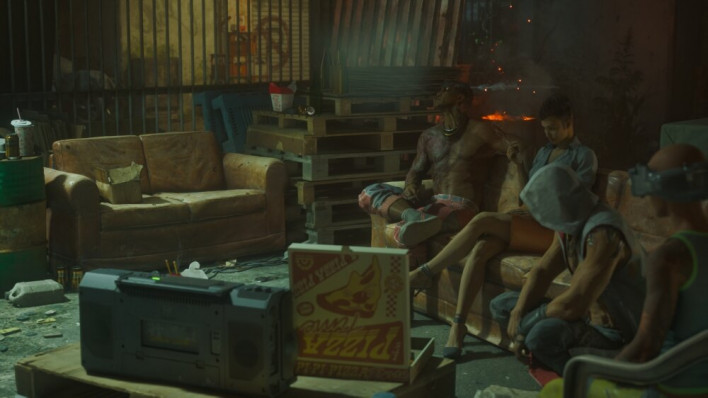
With a cyber-noir city as its setting, comparisons to 'Cyberpunk 2077' are unavoidable. Addressing this question, Berg replied, "When you say the word 'cyberpunk', that game naturally comes up. It's a great game, and I won't say a single bad word about it," but added, "However, I will keep saying that cyberpunk is a genre." Frick chimed in, "Even before that game came out, we were making cyberpunk."
The differences the two highlighted lie in the texture of the world and the type of game. "Our world is completely different. It's lush with vegetation, has a warm climate, feels gritty and grounded, and is a much more personal experience," Berg stated. Frick explained, "It's not a vast metropolis where you drive for kilometers, but something smaller and denser. If Cyberpunk is a massive RPG, 'NO LAW' is a game focused on Gray Harker and his journey, and it isn't a level-based RPG in the same sense".
The story itself was kept simple. Building around a revenge framework, Berg said, "We wanted to make a straightforward story that even people who don't care much for narrative can immediately understand and get immersed in. For those who want to dig deep, we left it open so they can talk to every character and learn as much as they want. We don't want to force the story."
Even the protagonist's personality is adjusted to match the playstyle. "If we wrote Gray Harker as a calm pacifist who hates violence, that wouldn't fit a player who shoots and kicks everyone," Berg stated, revealing that they wrote multiple versions of Harker tuned to different playstyles. If you complete a mission quietly and return, contacts might react with, "Nothing came over the radio, are you done already?" Whereas if you finished loudly, they might respond, "Of course, I could hear it all the way from here."
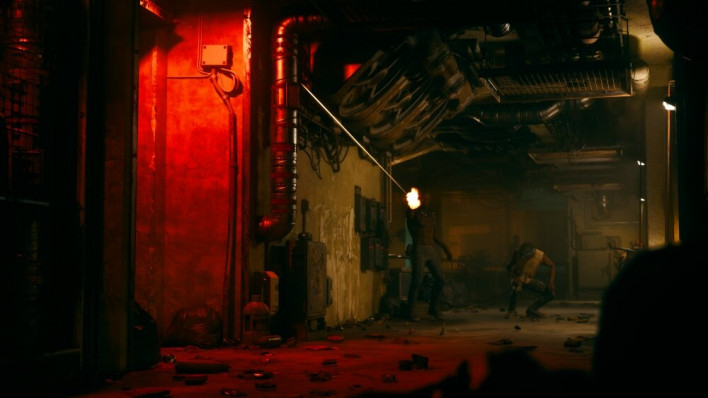
Neon Giant is a creative studio under Krafton. Berg noted that immediately following last year's reveal, the game exceeded wishlist projections and climbed near the top of Steam wishlists, stating, "We know people want a game like this".
In other words, expectations are already secured, and what remains to be proven is the game itself. Whether a high-density open world built by 24 people will serve as a counterargument to an era of skyrocketing budgets, or become another case where ambition outstripped scale, will be decided by the demo shown at Gamescom and subsequent actual gameplay segments.
Frick also confirmed that the current build is work in progress, and that is what will be shown at Gamescom. "In this genre of game, it's vital for players to feel that their choices and playstyles are respected, and the only way to verify that is for people to play it themselves," he said, adding that details discussed during the demo could change based on feedback.
The reaction the two hope for is clear. "I hope that when players talk to a friend about how they handled a segment of the game, they end up saying, 'It went completely differently for me,'" Frick said. "We want as many versions of play to emerge as there are players."

Sort by:
Comments :0