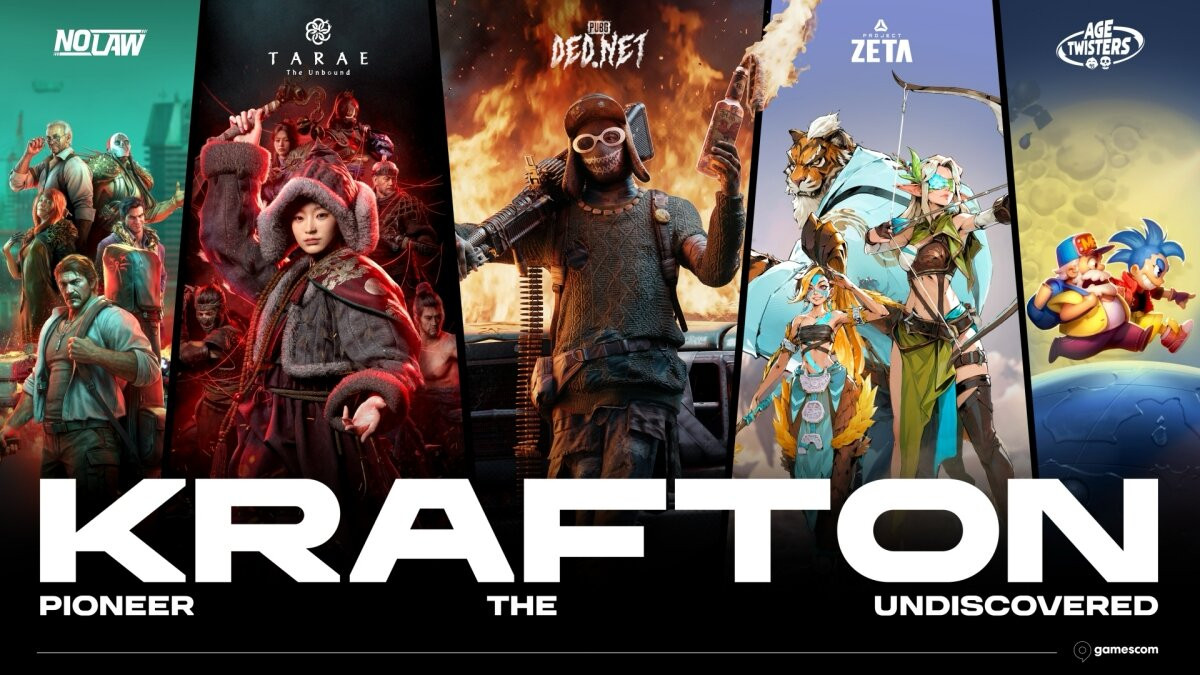
On August 26 (local time), KRAFTON held a Media Day at Gamescom 2026 in Cologne, Germany, to reveal five new titles. No two titles among the five brought to the stage shared a genre. The lineup featured immersive open-world FPS RPG 'NO LAW', team battle arena 'Project ZETA' under its own genre label, two-player co-op adventure 'Age Twisters', East Asian dark fantasy action RPG 'TARAE: The Unbound', and battle royale with a roguelite spin 'PUBG: DED.NET'.
Presentations were led directly by the CEOs and directors of the studios developing each game. KRAFTON framed the event around the overarching message, "Pioneer the Undiscovered."
NO LAW — "A place where no nation could tread"
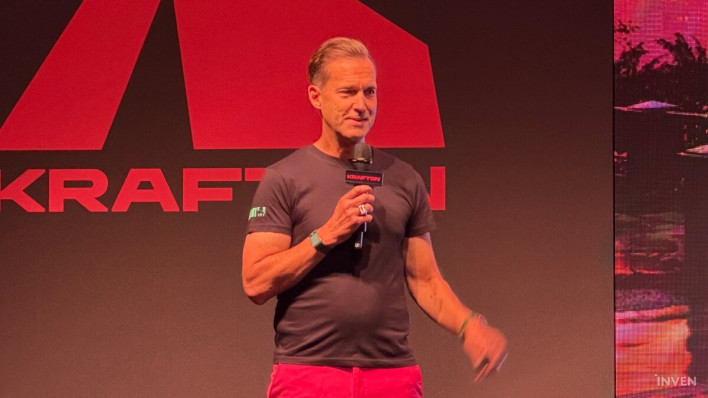
'NO LAW' is an immersive open-world FPS RPG developed by Uppsala, Sweden-based Neon Giant. Claës af Burén, CEO of Neon Giant, highlighted that market demand for such an experience has already been established. "We believe 'NO LAW' proves the demand for this type of gaming experience," he said. "We set extremely high expectations for ourselves, and by creating a memorable, immersive world, we are building on the gaming legacies of both Neon Giant and KRAFTON."
The setting, 'Port Desire,' lies in the border region of three nations. In a showcase video, the development team explained, "There is a space where no country could step foot, and out of that space emerged Port Desire, a city entirely free from regulation." Though a lawless city, it is not completely without order. 'Peacekeeping forces' deployed by outside nations guard the city—existing because preserving the status quo serves the interests of major powers—and clash with gangsters and mayors who run the city as they see fit. Referring to the protagonist as 'Gardner', the developers said, "Why this city makes Gardner so furious is for the player to uncover".
The core design pillar is player agency. "It was essential that players could experiment and do whatever they wanted," the developers said. "Everything is about player agency and choice". Missions do not need to be completed in sequence, and players can move back and forth between them. The city and its objectives were designed so stealth-focused players and combat-heavy players can enter locations in entirely different ways.
The action is equally open-ended. Players can kick enemies off balconies, blow them up, or trigger a pre-arranged plan from afar and watch it unfold. "We don't restrict players by saying 'you can't shoot here,'" said af Burén. "You can always shoot, and you can always create chaos."
The world is filled with detail through environmental storytelling. "If you're the type of player who stops to inspect a missing dog poster on a counter, you'll discover small stories scattered all across the world," said af Burén, adding that the city was built vertically so rooftops can serve as traversal paths. As for choosing the cyberpunk genre, he described it as "the perfect playground that can be silly and exaggerated at times, while staying grounded in reality."
Project ZETA — Dropping MOBA Heroes onto an F1 Hairpin Turn
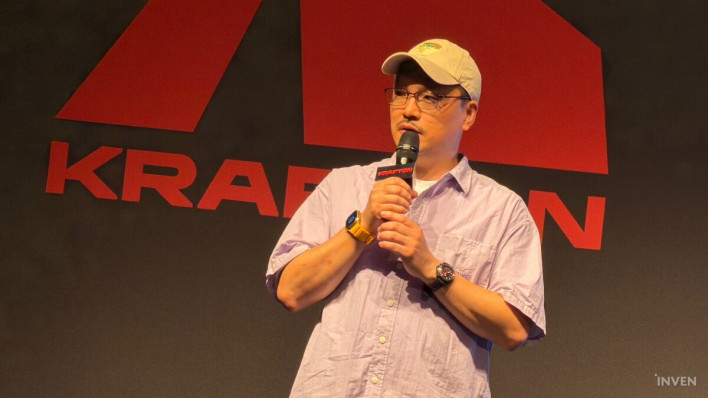
'Project ZETA' is a third-person multiplayer game developed by Nirvanana, in which four teams of three compete on the 'Aran Plateau' for about 20 minutes. Teams score 1 point by securing the core resource, the 'Prism,' and depositing it into the central 'Stabilizer'; the first team to reach 5 points wins.
Nirvanana CEO Nam-seok Kim likened the Prism to a basketball and the Stabilizer to a hoop. He outlined three main gameplay goals: a tactical hero arena with constant objective pressure and scoring battles; a structure that eliminates laning phases to jump into objective-focused skirmishes by minute 2 or 3; and an environment where the fun of ability-based hero PvP is not diluted on controllers or consoles.
He then explained what the game is not. It is not a MOBA because there are no laning phases, bases, or nexuses; it is not a battle royale because it does not limit lives to test survival; and it is not a hero shooter because there is no crosshair at the center of the screen, and basic attacks are designed to always hit.
"Victory comes down to reading the battlefield, positioning, teamwork, and smart movement rather than aiming," Kim said. "It's closer to a 3D fighting game than a hero shooter. It's mind games—predicting movement, dodging, and choosing when to engage". He cited experience from past projects as the rationale. "When limited respawns and real-time scaling mix, players naturally play safe, reducing major team fights," he explained. "There was a paradox where even as player counts increased, big moments and explosive team fights actually decreased. We started ZETA with the mindset to fix that flawed equation."
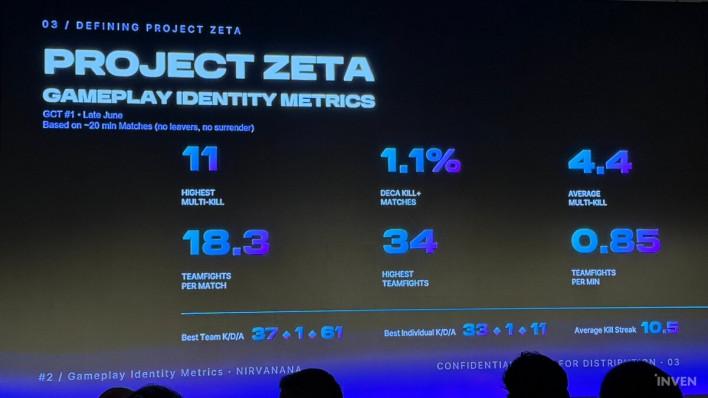
Specific stats were also disclosed. During the first global community test in late June, based on ~20-minute matches with no surrenders or leavers, the highest multi-kill was 11 kills, and matches with 10 or more multi-kills accounted for 1.1% of the total. The average number of multi-kills per match was 4.4, meaning every match averaged somewhere between a quadra kill and a penta kill. Team fights averaged 18.3 per match, peaking at 34. Kim described the game as "dropping MOBA heroes onto an F1 hairpin turn without waiting for a 15-minute setup," framing it as "4 teams, no brakes, non-stop high-stakes collisions".
Following Gamescom, Nirvanana will hold its second global community test on Steam from Friday to Sunday next week. The update will address issues identified in the first test and add two new heroes: 'Nova Crash', a righteous mecha warrior pursuing the evil organization 'Black Hexagon', and 'Azrael', a dogmatic, cold-blooded assassin. "Even if it's not us, someone will open a new future for MOBAs," Kim said. "Together with our player community, we will do everything we can to make ZETA that game".
Age Twisters — Translating the Generational Gap into a Game
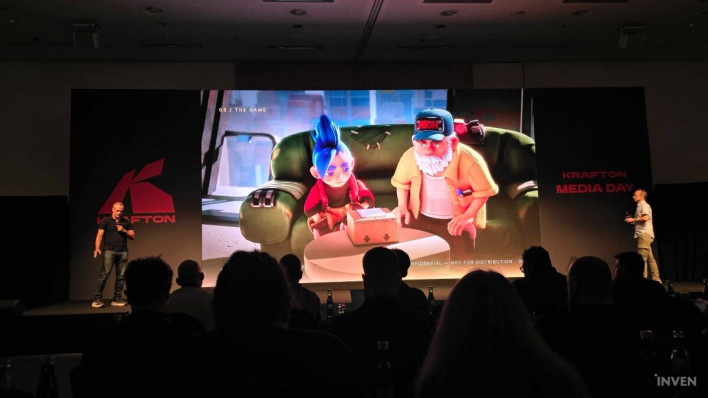
'Age Twisters' is a two-player co-op adventure developed by Barcelona, Spain-based Piccolo Studio. Jordi Ministral introduced the studio as being "based in Barcelona, making games for 10 years, and consisting of 35 people," while sharing three core principles: starting from an emotional topic, creating unique gameplay connected to that theme, and delivering high artistic value.
The theme of this title is the generational gap. Director Ministral first brought up stereotypes surrounding generations. He noted how every generation repeats the view that older people complain and are blamed for the world being a mess, while younger people don't want to work, are lazy, and only complain. "The elderly were also young, had dreams, and wanted to change the world. That's just how life turned out," he said. "Young people will also grow up; they just don't know better right now, but they will learn over time. It's a journey we all go through." He explained that they wanted to make a game that bridges that gap.
The protagonists are a grandfather and his granddaughter. Their relationship is defined by the backstory that the mother passed away when the granddaughter was a baby, leading the grandfather to raise her. The story begins on the day the granddaughter comes of age. A box arrives from her mother, who was believed to be dead, containing a letter telling her to retrace her steps to uncover secrets of the past, along with a clue to find 'Factory 206'. At the bottom of the box are two bracelets. Director Ministral explained that during this journey, the grandfather reconnects with the feelings of a time when everything was driven by emotion, while the granddaughter learns what it feels like to be responsible for someone else.
The bracelets are the 'Age Twisters' themselves. Director Corominas revealed that players can switch between childhood, adolescence, young adulthood, and old age at any time. As a game centered on age, damage is not standard damage, but 'age damage.' When enough age damage accumulates, the character turns into a baby or a skeleton; if only one player transforms, the other can revert them. If both reach an unplayable age, it is game over, and they restart right on the spot. Abilities differ by age stage. Childhood pulls objects and swaps positions with any character in the world. Adolescence uses musical instruments to slow down moving targets, while young adulthood smashes walls and activates machinery. Old age magnetizes metal objects to grab and throw them. As players progress, they can combine abilities across different ages.
Tools and vehicles are also added to the mix. Using weapons that age or de-age targets, players can grow palm trees or regress dinosaurs back into eggs; escape prisons using an umbrella that reflects lasers; or disguise themselves as cacti to remain undetected by enemies when standing still. Sections where one player drives while the other shoots, segments operating giant robots, and a boss fight against an animatronic T-Rex are also prepared.
While the story follows a single linear path without branching choices, the dialogue changes. Dialogue varies entirely depending on the age combination of the two characters at any given moment, with every possible combination fully written and voice-recorded. "Looking at a dinosaur as a child is different from looking at it as an elderly person. A conversation between two teens is also different from one between a teen and an elderly person," said Director Ministral. It is a 2-player co-op title supporting both local and online play, where only one player needs to own the game for both to play together. It is scheduled for release on major platforms next year.
TARAE: The Unbound — A Mass of Entangled Karma, Hence 'Tarae'
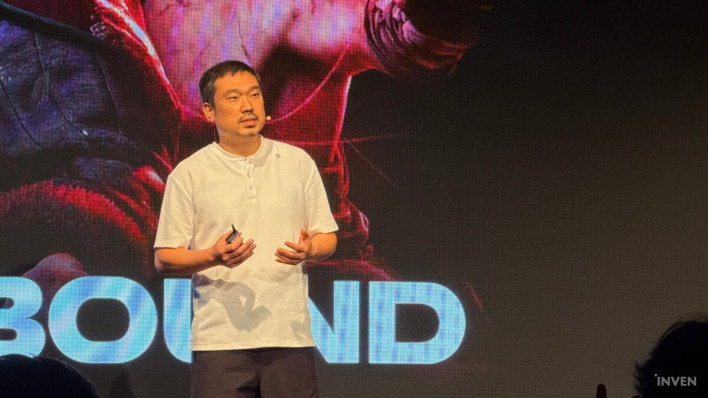
'TARAE: The Unbound' is an Eastern dark fantasy action RPG developed by Boundary. Boundary CEO In-young Gu introduced the title saying, "We are presenting for the first time our challenge and thought process behind reinterpreting Eastern imagination through dark fantasy." He explained that the team sought to depict a new dark fantasy grounded in traditional Eastern aesthetics and mythical imagination, a vision that extended beyond the world-building to serve as the starting point for core gameplay elements.
The narrative stems from the Buddhist concept of the Six Realms of Samsara (Rokdo Yunhoe). The lore dictates that beings wandering the six realms undergo endless reincarnation within the cycle, according to the karma they have accumulated. The game's title originates from this concept. "We named the project 'Tarae' [meaning skein or bundle] to express the image of endlessly entangled, bound sins forming a massive mass," Gu said. The Samdo River, flowing at the boundary between the living world and the afterlife—a concept parallel to the River Styx in Greco-Roman mythology—features a tree on its bank where the clothes of the deceased are hung to weigh their karma before directing them down one of three paths. The game kicks off as a being conceived in the Samdo River twists and fractures the tightly woven trajectory of the 'tarae.'
The setting spans 15th- to 17th-century East Asian culture. Gu stated that departing from conventional action RPGs that rely on Western medieval settings, the team reinterpreted the historical contexts of Korea, China, Japan, and Mongolia as dark fantasy. The primary focus was on the classes. "The area we pondered over most fiercely to complete an Eastern world view was the classes," he explained, noting that rather than common classes with merely Eastern visuals, they reinterpreted unique historical roles from Eastern history. A prime example is 'Mansin,' a reinterpretation of traditional Korean spiritual shamans (mudang), which features unique combat mechanics of divine possession (Jeopsin), devotion (Heonsin), and spirit advent (Gangsin). Other revealed classes include 'Chakhogapsa' (tiger hunters utilizing gunpowder and traps), 'Feng Shui Master' (utilizing the energy of the Five Elements), and 'Kunoichi' (executing ninjutsu).
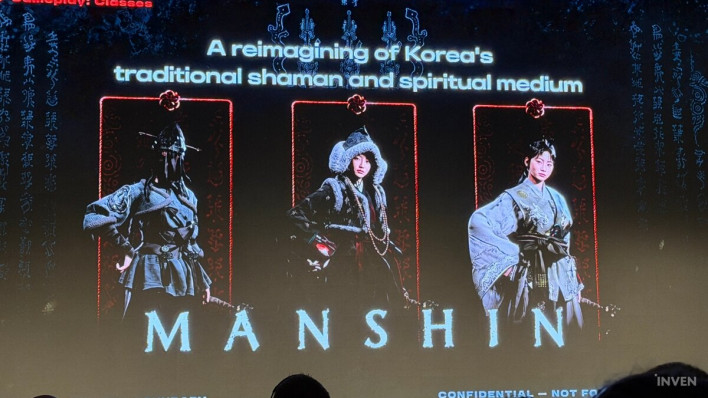
Combat adopts a system optimized for top-down action. If mob-clearing—sweeping through swarms of enemies while taking in the wide battlefield on a single screen—forms one pillar, boss fights demand precise controls and meticulous strategy. Players must strategically manage 'Stamina' used for sprinting and dodging; successfully executing a perfect dodge against enemy attacks recovers a portion of spent resources, allowing for flexible combat flow. Every boss features unique attack patterns.
Class differentiation was also highlighted as a core focus. Features include signature skills tailored to class identity—such as a Samurai's sword stances, a Feng Shui Master's elemental harmony, or a Battle Demon's combo skills—alongside auxiliary techniques that augment or modify them. The single special ultimate skill that unleashes a class's core identity can be customized to preference via masteries, complemented by unique traits and the Yin-Yang system combination.
The final point emphasized by Gu was the narrative. He defined the game's top priority as a "heavy narrative with traditional premium boxed game sentiment," adding, "To prevent the story from being squandered in favor of grinding and farming, we focused on a narrative-driven campaign so players can enjoy the journey through the cycle of karma itself."
Upon completing the campaign, players transition into end-game content where build-crafting comes to the fore, with details on end-game content to be revealed separately at a later date. "We don't believe every player is rushing solely toward the end game," Gu added. "We are refining the action and quality of the narrative so that players who simply want to follow the rich storyline and reach the campaign ending can feel completely satisfied." The game aims for a simultaneous PC and console release.
PUBG: DED.NET — "You're Not Playing a Match, You're Doing a Run"
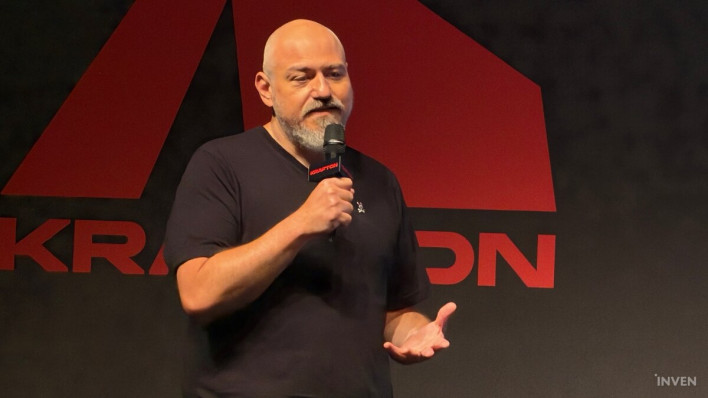
'PUBG: DED.NET' is a new title developed by PUBG Studios. Dave Curd, Vice President and Creative Director at PUBG Studios, introduced himself as a battle royale fan who has worked at PUBG Studios for nearly a decade, saying, "The formula KRAFTON and PUBG pioneered—land, loot, survive—is 10 years old. We wanted to evolve that formula, and that was the starting point for DED.NET".
The motivation behind its creation stemmed from questioning existing genre norms. Director Curd pointed out that modern live-service shooters are obsessed with level playing fields, remarking, "They're perfectly balanced, as long as you're looking up the 'right' way to play on YouTube." "I felt that chasing the perfect live-service shooter at some point started getting in the way of delivering a fun game," he said, explaining that instead of a perfectly fair experience, they chose "raw, uncontrolled chaos with higher highs and lower lows." The goal, he explained, is a game where extremely competitive play is possible, but one that players can also enjoy while kicking back on the couch with a beer.
The vehicle for this is the roguelite structure. Regardless of win or loss, players grow their character across multiple matches, acquire abilities, manage injuries, and pursue builds. "In DED.NET, every time you lose, you get one step closer to the perfect build," Curd said. "You're not playing a match—you're doing a run". Each game is a chapter in that run, where players hunt for 'ROMs.' These are game cartridges slotted into the head to unlock new gameplay abilities. The trade-off is injuries. "Injuries can be funny, painful, and increasingly hard to manage. If too many stack up, your run ends," he summarized. "You play a match, find ROMs, build power, manage damage, and extract before injuries catch up to you".
The setting is 'Cascadia,' a reinterpretation of the 1990s Pacific Northwest. Curd cited the fact that he was a teenager in the 1990s as the reason for choosing the era. It was a time with one foot in analogue and one foot in digital—a remix era defined by gangster rap, grunge, alternative music, and the films of the Hughes brothers and Quentin Tarantino. "Things that didn't seem to belong together fit together, and that was the magic," he said. "We want to use those cultural touchpoints to satirize the modern world."
The game's title, DED.NET, originates from 'Dog Eat Dog.' Describing the world as dark, funny, and messy, he added, "If you look around, that's the world we live in, and survival of the fittest is the oldest theme PUBG has stood for."
What fills Cascadia is music. Curd noted that the game features real music that defined the era, naming The Notorious B.I.G., Wu-Tang Clan, Pixies, and Nine Inch Nails. It pours out from dive bars, strip clubs, car radios, and sometimes from rivals carrying boomboxes. The landscape is built on contrast. Deep forests, rolling hills, and steep alpine terrain blend with abandoned small towns, desolate farms, and hazardous outposts.
"Every session in DED.NET tells a different story, and death is not the end, but the next chapter," Curd said. "I can't promise a happy ending, but I promise the journey getting there will be a hell of a lot of fun."

Sort by:
Comments :0