Today, the term 'optimization' is used by both game companies and fans in a remarkably broad sense. This isn't an attempt to define the word's precise meaning. Rather, it is to highlight that the expansion of the term's usage reflects the growing importance of optimization in the industry today.
With the expansion of the PC game market where uniform hardware specifications cannot be guaranteed, the rise in overall prices for PCs and consoles due to semiconductor supply issues, and the resulting consumer-facing price hikes to cover development costs, optimization has evolved into a concept of 'value for money'—ensuring a game runs smoothly while keeping costs low.
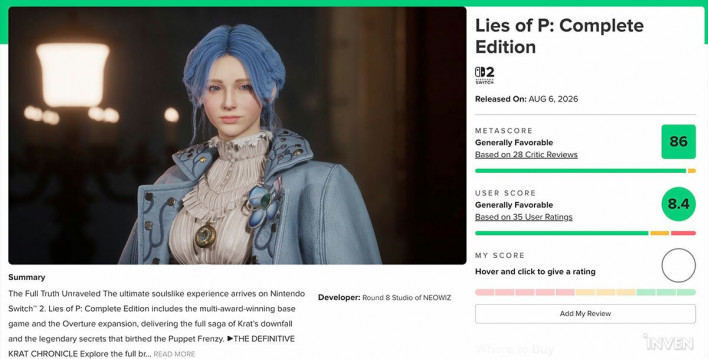
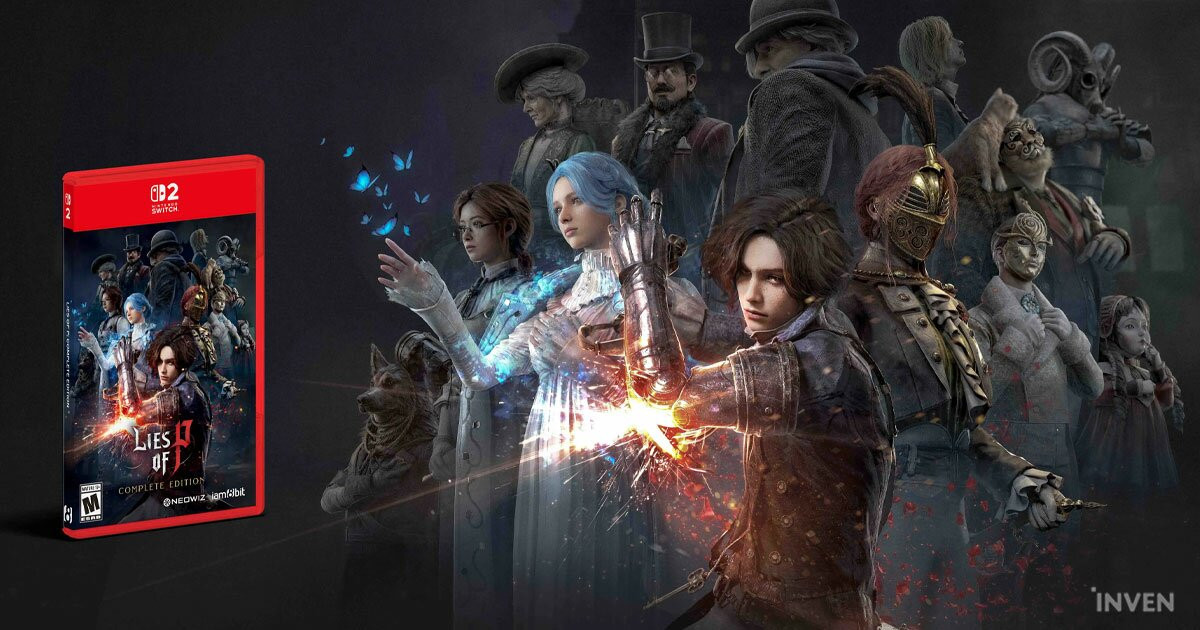
In that sense, the optimization of the 'Lies of P Complete Edition' (Lies of P) ported to the Nintendo Switch is top-tier. This isn't just about compromises for the sake of high frame rates; the game's genre, gameplay, visuals, and the technical utilization of the Nintendo Switch are clearly impressive.
30/40/60 — Three Presets, Three Compromises: Unlike PCs, consoles lack granular graphics settings, save for brightness. Therefore, the key is finding a balance within pre-set graphics configurations that maintains natural movement and visual satisfaction. Lies of P manages to capture both.

Based on the Nintendo Switch launch version with the day-one patch, Lies of P supports three graphics quality options: 'Performance,' 'Balanced,' and 'Quality.' In docked mode, these target 60 FPS, 40 FPS, and 30 FPS, respectively. In practice, these target frame rates are clearly and consistently achieved.
The Quality mode runs at 30 FPS and delivers stunning graphics. With a 1440p output resolution and a mostly locked 30 FPS, it offers high visual satisfaction. In particular, lighting, water reflections, and the effect of clothes getting wet are among the best seen on the Nintendo Switch. As of now, there is hardly any noticeable pop-in, and frame pacing issues are minimal. Since many AAA games ported to the Nintendo Switch target 30 FPS, this means players whose primary platform is the Nintendo Switch will not find the frame rate distracting.
In Performance mode, the game supports a solid 60 FPS. Naturally, there is a loss in visual quality, but it allows for the smoothest gameplay experience. As the name suggests, it delivers a stable 60 FPS without significant frame drops.
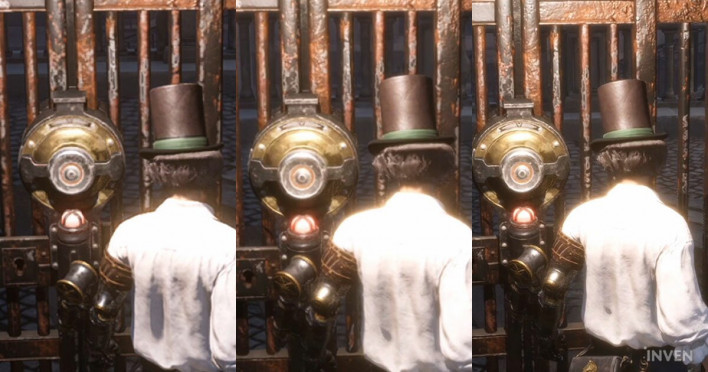
Like other well-ported Nintendo Switch games, Lies of P has undergone fundamental memory reductions in all graphics options, including objects and lighting effects. This is no different even in the highest setting, Quality mode. However, unless this 'trimming' process interferes with essential artistic direction, it is better to focus on removing non-essentials to improve gameplay stability. This additional work is the key to delivering a gameplay experience on the Nintendo Switch—which has significantly lower specs than the PS5 or XSX—that remains comparable to other platforms.
This also ties into the genre characteristics of Lies of P.
Soulslike — Why Obsess Over Frame Rates: Lies of P follows the 'Soulslike' formula, as described by the developers, from its overall atmosphere to its gameplay mechanics. In Soulslike games, there is a player obsession with frame rates that differs from typical action games. This is intertwined with the philosophy of the genre.
The core of the Soulslike genre lies in learning through death and avoiding death through that learning. Despite unreasonable map structures and enemy placements, the responsibility for death ultimately rests on the player's mistakes. If it feels unfair, you must memorize, block well, and dodge well. Therefore, you must not be given a reason to blame your death on anything else. This is why, even if a Soulslike game cannot hit the highest frame rates, it must at least maintain stable ones. A minor optimization issue could otherwise escalate into a feeling of unfairness in a Soulslike.
The fact that hit detection is tied to individual frames also fuels this obsession. Dodging, such as rolling, and parrying—which requires perfectly timing an enemy's attack—are all structured around specific frame windows in the character animation. Frame errors, such as stuttering or lack of smoothness, cause the detection itself to be delayed or missed.
This technical obsession is also highly evident in fighting games, which, like Soulslikes, are decided by individual frames. That is why Street Fighter 6 prioritized a locked 60 FPS over graphics quality for its Switch port. Furthermore, Mortal Kombat 1 had to make the choice to sacrifice very low resolution and visual fidelity to hit a 60 FPS target when it launched on the lower-powered Nintendo Switch.
This is why it is significant that Lies of P maintained a locked 30 FPS and 60 FPS despite the platform's limitations.
40 — The Balance Between Visuals and Play: Lies of P adds a 'Balanced' option to these two fixed-frame presets. The preset targeting 40 FPS maintains the frame rate with little variation, effectively acting as a locked 40 FPS.
On devices supporting 120Hz, 40 FPS is an option that is much smoother than 30 FPS while offering better graphics latitude than 60 FPS. Basically, for 60Hz displays—the former monitor standard—60 FPS games display each frame once per second, and 30 FPS games display each frame twice, resulting in a clean image. However, since 40 FPS does not divide evenly into 60Hz, it alternates between displaying frames once and twice. This unevenness leads to 'judder,' where the screen appears to stutter.
However, now that 120Hz displays are mainstream, 40 FPS is a number that divides perfectly into 120 by 3. It is a condition where you can experience the full frame time without judder. The frame time for 30 FPS is 33.3ms, 40 FPS is 25ms, and 60 FPS is 16.7ms. Increasing from 30 to 40 FPS adds 10 frames per second and reduces frame time by 8.3ms; increasing from 40 to 60 FPS adds 20 frames but results in the same 8.3ms reduction.
Lower frame times reduce the interval at which player inputs are checked, naturally reducing input lag. Naturally, 40 FPS offers half the benefits of 60 FPS with only the effort of increasing the frame rate by 10 FPS over 30 FPS. On the Nintendo Switch, where device performance and limitations are fixed, and in the Soulslike genre, where input responsiveness is critical, this effect is even more pronounced.
Optimization — Lies of P Proves Itself Without Excuses: Many game companies have expressed a desire to grow in the domestic PC/console market and challenge the global market. However, when meeting with domestic game industry officials, they always lamented the lack of talent to pull it off. While there are many skilled developers with long careers, there is an inevitable shortage of people with console experience who can lead such projects.
Lies of P stands out because it is the result of such a situation. The optimization direction honed on PC and home consoles was carried over to the Nintendo Switch, which clearly has lower specs. Regardless of the game, neither a lack of experienced talent nor hardware limitations are excuses in the face of the final product. Lies of P honestly achieved its targets across all three presets where those excuses would not hold up.
The fact that optimization is used in a broad sense today is because, with both device prices and development costs rising, optimization itself has become a matter of value for money. Even with the price hike in September, the Nintendo Switch remains a relatively affordable device compared to PCs and other consoles. What and how much can be run on that single affordable device is what optimization must prove today.
However, in Soulslikes, that proof requires one more thing. In Soulslikes, frame rate is not just a matter of whether the screen is smooth. The responsibility for death hangs on those individual frames. What the Switch version of Lies of P ultimately protected was the locus of that responsibility. Even for players holding a cheap, low-spec device, death had to remain their own mistake, not the fault of the hardware.