'Iron Nest' has been released.
Back when all I knew was that it was a game about controlling a massive turret on four mechanical legs, I let my imagination run wild. I assumed it was an action game where you ride around on a legged turret and blast enemies to pieces.
Thinking it might be fun, I reached out to the developer to request a review code, only to be told, "There are only two of us, and we're still polishing the build, so we don't have separate review codes." That was when I learned it was an indie game made by just two people. I waited for the release with a humble heart, then bought it with my own money and started playing.
Hmm.
Wait, why is my military service here?
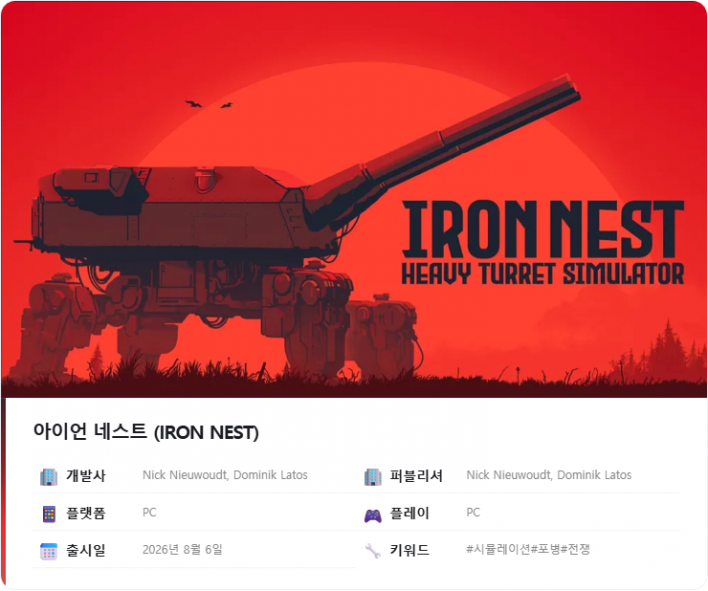
Let me tell you about 'Artillery'

Rewind 18 years to June 2008. A young man with a buzz cut headed to the Uijeongbu Replacement Battalion. After a month of rolling around in the dirt, I boarded a bus to my unit and fell fast asleep. I was jolted awake by a shout, and as I looked out the window, I saw something massive. A long barrel and wide-spread legs. A giant hunk of steel where various mechanical devices were fused together. Military Occupational Specialty (MOS) 1312. That was the day I became a 155mm towed artilleryman.
Let's be clear: this game is a 'simulator.' It is not an action game where you ride a legged tank and smash enemies with direct fire. It is not like World of Tanks, where you blast shells with a simple mouse click. It demands something more sophisticated. What is that, you ask? Everything an artilleryman does—or, to be precise, about 40% of it.
As any former artilleryman knows, the branch is divided into five specialties. There's 'Survey' (finding the exact location of the battery), 'Observation' (spotting targets), 'FDC' (Fire Direction Center—we used to call it the 'Burning Dancing Club,' where we crunched numbers to calculate firing data), 'Communications' (connecting all units), and finally, 'Gun Crew'—the heroic specialty where you handle the gun directly and get wiped out if counter-battery fire comes in. Naturally, I was in the Gun Crew.
To put it simply, the roles are divided like the semicircular canals, eyes, brain, nervous system, and fists. And for every single shot, all these members must play their part. It means you can't just shout "Fire support!" like in a drama and expect a shell to fly out with a click.
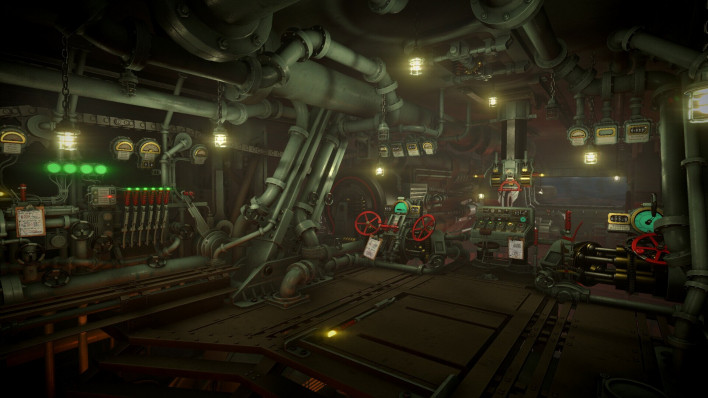
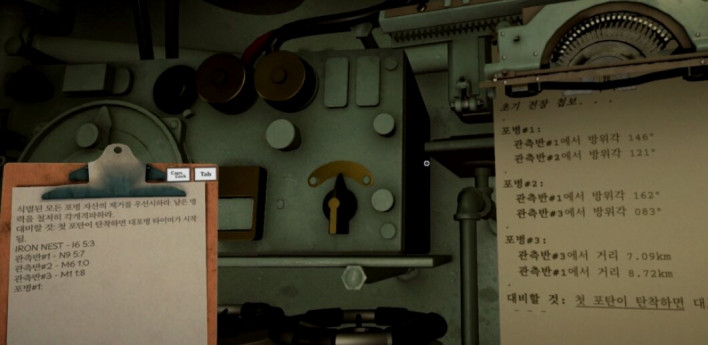

In 'Iron Nest,' you take on the roles of the 'Gun Crew' and 'FDC.' Information about the battery's location and data from the observers are continuously delivered via a fax machine inside the turret. Based on this, the player must perform precise calculations to pinpoint the enemy and derive firing data (this is the FDC's mission), load the shell and propellant, set the elevation (vertical angle) and azimuth (deflection/direction), and then pull the lanyard to fire (this is the Gun Crew's mission).
You only have to do two of the five specialties. Hence, 40%.
The question is whether this process is fun. Speaking as someone who did it for about two years, it’s actually not that fun. Many people think artillerymen just handle big guns, but our primary weapons were actually pickaxes, shovels, and sledgehammers. I don't know what life was like for the 'royalty' of the artillery—the self-propelled gunners—but for us towed artillerymen, the daily routine was no different from manual labor. How could that be fun.
However, 'Iron Nest' is quite different. The most physically demanding part of being an artilleryman is 'emplacing' the gun (preparing it for firing), but here, the gun is already emplaced. No pickaxes, shovels, or sledgehammers needed. Even loading is automatic. The ammo crew doesn't have to sweat buckets carrying shells, and the assistant gunner doesn't have to report propellant charges like Ultraman.
What does that mean?
This game is the ultimate 'Artillery Simulator: Hopeful Edition,' which takes only the fun parts of what an artilleryman does and strips away all the grueling labor. If my military life had been like Iron Nest, I would have reenlisted as an officer or gone the NCO route. Of course, in reality, I didn't even look toward the base after I was discharged.
Growing as an artilleryman just by playing a game
I've talked enough about artillery, so let's look at it from a gaming perspective. Each mission in Iron Nest begins with receiving a fire mission from a higher command. These range from simple requests to destroy enemy units or ammo depots, to requests for illumination flares because it's too dark to see, or smoke screens to cover an allied advance.
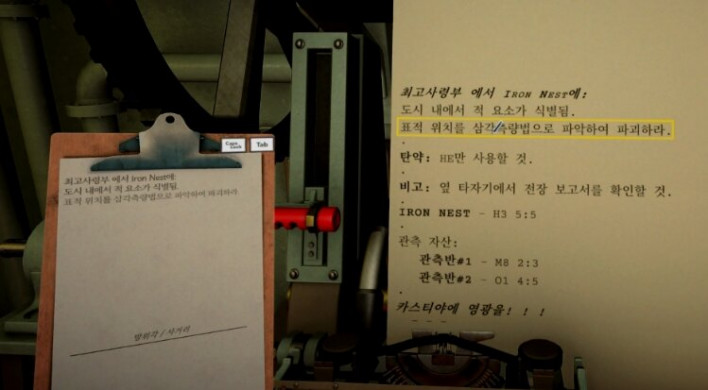
And these requests aren't just simple 'click to fire' tasks. For example, it looks like this.
Observer #1: M8 2:8
Observer #2: O1 4:5
Observer #3: D3 7:2
Target #1
- 17.79km from Observer #1
- Azimuth 275 degrees from Observer #2
Target #2
- Azimuth 176 degrees from Observer #1
- Azimuth 283 degrees from Observer #3

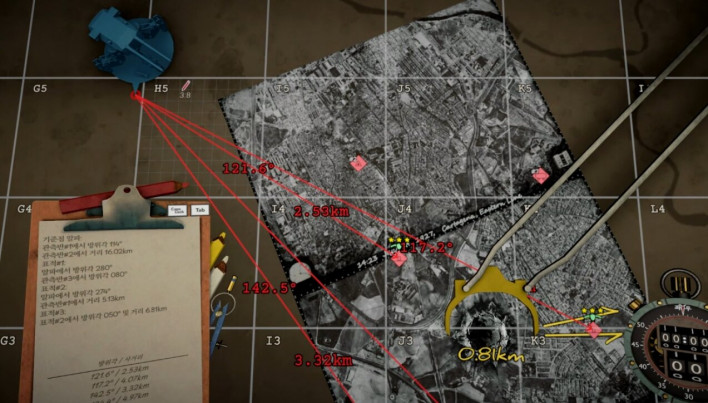
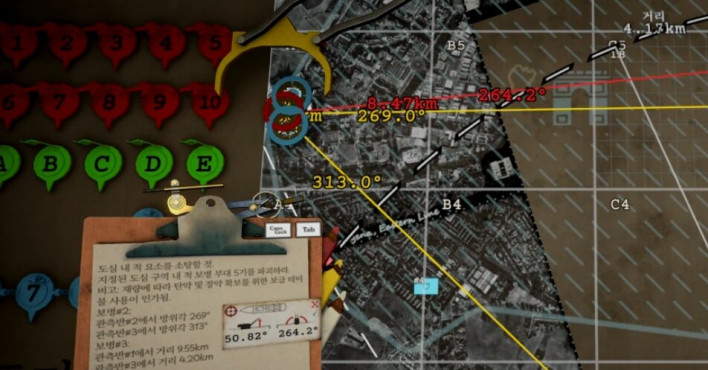
When information arrives like this, you have to place markers on the plotting board in the middle of the turret and use colored pencils to draw and calculate the firing data. You place the battery and observer markers, use a compass and pencils to draw, derive the exact data, and input it into the machine to get the elevation.
From there, it's the Gun Crew's mission. Select the right shell, load the necessary propellant based on range, input the elevation and azimuth, and the massive turret rumbles as it rotates. Once everything is set, pull the lanyard to fire. Afterward, the shell's trajectory appears on the plotting board, and an aerial reconnaissance map is added upon impact so you can see if you hit the target.
Writing it out like this, you might wonder what's fun about it, but when you actually play, it's not just a simple simulator. Why? Because the 'battlefield situation' is constantly changing.
Iron Nest has its own narrative, and the situation evolves based on the player's performance. You might fire high-explosive shells at an enemy infantry unit that popped up unexpectedly, only to trigger a counter-battery alarm and a time-attack scenario. Later on, targets move or hide, making observation impossible—the kind of situations that would make any real artilleryman curse.

The interesting thing is that when these 'unexpected situations' occur, a gamer who has been consistently performing their missions will find they have unknowingly acquired the skills to solve them. Even with standard fire missions, you eventually develop an eye for propellant, range, elevation, and ballistic movement.
From this point on, you don't really need the firing data calculator; the data just pops into your head through intuition and simple mental math. You can use techniques like lowering the elevation while over-charging the propellant to maximize muzzle velocity for moving targets, or swapping shell types to minimize collateral damage to nearby allies. You see yourself becoming not just a skilled gamer, but a skilled artilleryman.
For this alone, the game's design is truly excellent.
It might be even more fun with multiplayer
However, the game does have its shortcomings. The first thing you notice is the 'visual monotony.' Half the game time is spent running around inside the turret fiddling with various mechanical devices, and the other half is spent looking at the plotting board to calculate data. While I understand this is an inevitable limitation for a two-person development team, it's hard to avoid the eyes getting bored as the game goes on. If they had at least rendered the flying shells or the impact visuals with rough graphics, it might have been more satisfying to watch.

The lack of any 'multiplayer' support is also a bit disappointing. It's not that hard to do everything alone, but this turret is a dual-barrel system. Since the turret is just sitting idle while you calculate data, it's a shame you can't have a more intense and immersive artillery experience with just one other person.
Still, objectively and subjectively, 'Iron Nest' is a well-made game. Its direction is clear, and while it doesn't add anything beyond that, it includes all the necessary components without omission. Actually, while I mentioned visual boredom, that's a bit of a stretch. Iron Nest is an artillery simulation, and it has everything a simulation needs. Even in real life, artillerymen rarely fight while seeing the enemy directly. We were taught direct-fire techniques for enemies that got too close as a last resort, but I doubt anyone who has actually used that in combat is still alive.
A part that confuses me slightly is that I might be overrating this game because I'm a former artilleryman.
Iron Nest definitely triggered my nostalgia. The moments of practicing deflection while getting hit on the helmet with a rammer rod, the days of lifting hydraulic jacks until my back felt like it would break, the vibration that shook the world after firing, and the acrid smell of burnt propellant—playing the game brings back memories of my lost two years. It feels like a beautiful memory, slightly embellished, but the reality was dirty and grueling.
I thought I had forgotten everything after so much time, but the moment I saw the shells and the breechblock, all the memories came flooding back. Like a high schooler who returned after being reincarnated in another world. But I'm not sure if that's a good feeling. The game is fun, but...
- Realistic firing procedures that trigger artillery nostalgia
- Game design that makes you aware of your growing skills
- A narrative with its own flow
- Somewhat dull visual elements
- Repetitive gameplay
- Confusing achievement requirements
Review Platform: PC(PC)