Eleven content industry associations, including the Korea Association of Game Industry (K-GAMES), have jointly set a goal to expand content industry revenue to 220 trillion won by 2030. Expanding content production tax credits—currently applied only to video content and webtoons—to all content sectors including video games was selected as the top priority.
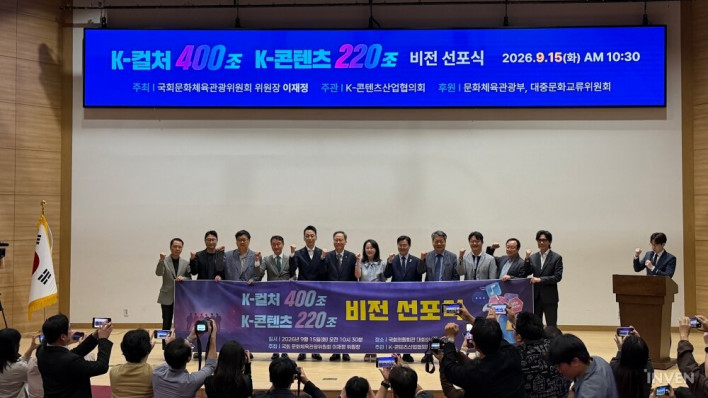
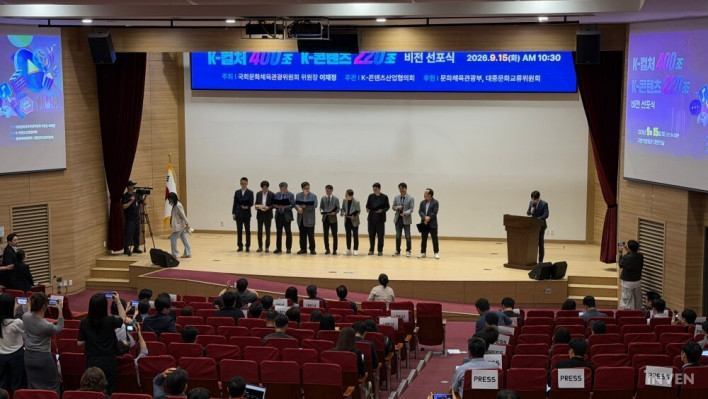
On September 15, the K-Content Industry Council held the "400 Trillion Won K-Culture, 220 Trillion Won K-Content Vision Declaration Ceremony" at the National Assembly, hosted by Lee Jae-jung, Chair of the Culture, Sports and Tourism Committee.
At its inaugural general meeting earlier that morning, the council established its bylaws and elected Kim Tae-heon, President of the Korean Publishers Association, Cho Young-gi, Chairman of K-GAMES, and Woo Seung-hyun, President of the Korea Popular Music Industry Association, as its inaugural co-representatives. An informal consultative body established in May 2025 has thus officially launched as a formal organization.
From the gaming sector, K-GAMES and the Korea Mobile Game Association (KMGA) are participating, with the K-GAMES secretariat serving as the council's administrative office. This marks the first time that associations spanning all content genres—including games, film, TV series, music, webtoons, publishing, and animation—have gathered in one place to present unified goals for the entire industry.
According to the "K-Content 220 Trillion Won 2030 Vision Report" unveiled by the council, the targets for 2030 are 220 trillion won in revenue, $27 billion in exports, 750,000 employees, and 146,000 companies. Reaching these targets requires compound annual growth rates of 6.4% in revenue from 161.5 trillion won in 2025, and 12.6% in exports from $14.91 billion. The revenue goal accounts for 55% of the government's national agenda target of "400 Trillion Won K-Culture."
The council also delivered an assessment that reaching these targets under the current policy direction will be difficult. According to a mid-to-long-term forecasting model presented at the National Assembly in June by Song Jin, Head of the Policy Research Center at the Korea Creative Content Agency (KOCCA), maintaining the current level of policies and budget would limit 2030 revenue to 205.9 trillion won and exports to $18.7 billion. Even under the assumption of increasing the budget by 10% annually, revenue would reach 215.3 trillion won and exports $19.18 billion, falling short of the goals.
Kim Seung-wook, Senior Executive Director of Policy at the Korean Publishers Association, who presented the vision, said, "Failing to reach the target even with a 10% annual increase means that increasing financial input alone cannot achieve this goal. The solution lies not in expanding existing projects, but in shifting the policy frame."
The council proposed shifts across three pillars—taxation, finance, and legal framework—and specified them into six shared initiatives: ▲ full expansion of content production tax credits ▲ expansion of policy financing including fund-of-funds enhancement ▲ improvements to flexible work hours reflecting content industry characteristics ▲ support for AI transformation and establishing a copyright framework ▲ boosting demand by expanding cultural vouchers from 270 billion won to 1 trillion won ▲ establishing integrated governance, including the creation of a presidential K-Content Committee.
The initiative directly affecting the gaming industry most is production tax credits. The council pointed out that while more than 12 countries, including the UK, France, and Canada, implement tax credits of 25–40% for digital content creation including games, South Korea limits eligibility to video content and webtoons. According to council data, games account for 57.7% of content exports but remain excluded from tax credits.
Director Kim remarked, "While competing nations are strengthening support, music, publishing, and gaming remain left out."
Improving flexible work hours also aligns with pressing issues in the gaming industry. At an inaugural press conference in April last year, Chairman Cho Young-gi cited making the 52-hour workweek flexible for game developers and tax support for game exports as policies hoped for from the government. The tax and working hours issues that the game industry previously raised as sector-specific concerns have now been bundled into shared initiatives across all content genres and delivered to the National Assembly.
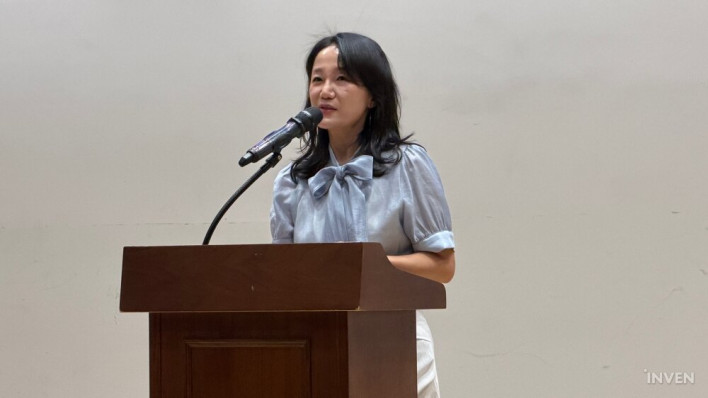
In her opening remarks, Chair Lee Jae-jung said, "Rather than finding common ground, each association spoke of struggling individually on their own issues. Trapped in isolated voices because everyone was busy trying to survive and accomplish their goals, we have finally arrived at a time to communicate and unite our vision." She added, "Holding this proclamation ceremony at the National Assembly right as the budget session and parliamentary audits begin carries significant meaning."
Regarding the role of the National Assembly, Chair Lee stated, "We will start by listening. However, we will not stop at merely taking notes. The Assembly will unleash its imagination to ensure these ideas substantially build our industry's capacity and become the foundation for K-Culture to take deep root and achieve sustainable growth."
She added, "It may not be possible to accomplish everything in a single step. Though we may be lacking, the National Assembly will follow half a step behind, so please lead the way."
In his congratulatory speech, Kim Young-soo, First Vice Minister of Culture, Sports and Tourism, expressed intent to pursue budget increases during the parliamentary review stage for next year's budget. Vice Minister Kim said, "During this budget season, the government also intends to seek necessary budget increases at the parliamentary stage. Although the government proposal increased by 22% to rise from the 7.8 trillion won range this year to the 9.6 trillion won range next year, it will likely still be insufficient to fully satisfy the content industry's urgent needs."
Regarding the launch of the council, he stated, "Throughout my career as a public servant at MCST, there has never been a gathering like this. Seeing the official launch today with the three co-representatives and general meeting gives a great sense of reassurance. While much has improved, there are still areas where we lack true field insight, and despite our continuous efforts to listen to industry practitioners, gaps remain." He added, "Behind the glamour of K-Content lie structural challenges, and we will strive to address and resolve those issues together."
The 2027 budget proposal announced by MCST on September 4 stands at 9.6345 trillion won, up 22.6% from this year's main budget of 7.8555 trillion won. However, while culture and arts grew by 44.6%, the content sector grew by only 9.5% to 1.7719 trillion won. Considering the council's forecasting model concluded that even a 10% annual budget increase would fail to reach the target, this context illuminates the rationale behind calling for structural redesigns in taxation, finance, and legislation alongside fiscal expansion.
Democratic Party Representative Lee Jeong-mun (ruling party secretary of the Culture, Sports and Tourism Committee) said in his speech, "Although the 11 organizations have different interests and perspectives, since they have gathered together to form this council, the National Assembly will do what it can through legislation and budget allocation. We will work to ensure this slogan does not remain merely a slogan, but becomes an achievable goal."
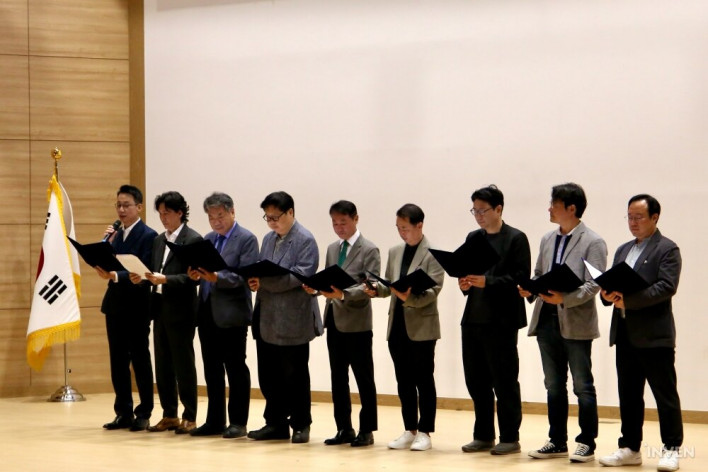
Following the vision presentation, the three co-representatives—Kim Tae-heon, Cho Young-gi, and Woo Seung-hyun—read the "400 Trillion Won K-Culture, 220 Trillion Won K-Content Vision Declaration" alongside attendees. The declaration stated that "contrary to its global stature, industry growth has remained in the 2% range for three consecutive years," and called for a redesign of systems and policies, emphasizing that "the issue is not how much to inject, but how to design it."
It also noted, "In the era of artificial intelligence, the content industry is both the rights holder of training data and the user of new production tools. Protecting creators' rights and utilizing technology are not conflicting demands, but two sides of the same industry."
The council decided to review performance from the previous year every first half based on KOCCA's government-approved statistics and publish a "K-Content 220 Trillion Won Implementation Audit Report" under the council's name. Rather than an incorporated association, the organization will operate as a network-based consultative body maintaining member associations' autonomy. Kim Nam-hee, Vice President of the Korea Animation Industry Association, was elected auditor.
Earlier that morning, a policy roundtable with the Culture, Sports and Tourism Committee Chair was also held, attended by Chair Lee Jae-jung and representatives of member associations. Four agenda items were discussed: National Assembly cooperation for the 2030 vision, the 2027 content budget, AI transformation and creator protection, and expanding content tax support. The council plans to submit content industry regulatory reform recommendations and hold a Korea-China Content Industry Exchange Meeting in the second half of this year.